
Microsoft struggles to fulfill its 2030 sustainability promise amid carbon-heavy AI expansions — the company’s chief sustainability officer claims the target is still feasible
Microsoft’s emissions for fiscal 2025 (FY25) rose by 25% from the previous year, even as the company’s 2030 deadline to become carbon-negative draws closer. According to the company’s 2026 Environmental Sustainability Report, released on Thursday, July 9, the backward step was driven primarily by the rapid expansion of its data center infrastructure and its decision to stop using short-term renewable energy certificates, which reduced its reported footprint without necessarily adding new clean electricity to power grids.
- Photonics and high-speed data movement is the next big AI bottleneck
- The data center cooling state of play
- Massive AI data center buildouts are squeezing energy supplies
- Ultra Ethernet: The data center interconnection of tomorrow
Microsoft reported approximately 20.3 million metric tons of carbon dioxide-equivalent emissions across its operations and supply chain, up from 16.2 million tons in fiscal 2024 and nearly 58% above its 2020 baseline. Electricity consumption increased by 24% during the year as the company built the computing capacity required for its cloud and AI businesses. Regardless, Microsoft says it remains committed to becoming carbon-negative, water-positive, and zero-waste by 2030. It also reported meeting its 2025 renewable-electricity target, replenishing more water than it withdrew globally, and exceeding several waste-recovery targets
The report’s foreword, written by Microsoft Vice Chair and President Brad Smith and Chief Sustainability Officer Melanie Nakagawa, focused heavily on the collision between the company’s headline sustainability goals and the realities of AI. Microsoft established the goals in 2020, a few years before the current scale of AI’s capabilities and the corresponding high environmental demands began to manifest.
While AI is inarguably a world-changing technological revolution, it is raising serious environmental concerns that begin right at the raw material sourcing and the complex semiconductor fabrication stages. The impact continues even after the processors have been compiled into supercomputers in massive data centers, with issues related to land use, energy consumption, noise pollution, and water consumption. Residents are increasingly opposing the building of these data centers in their communities due to these issues.
Microsoft is exposed at nearly every point of the AI chain. It procures servers and custom AI chips; owns and operates a massive, global network of over 300 data centers across 34 countries that powers the Azure cloud platform; and supplies the computing infrastructure behind products such as Copilot and its partnership with OpenAI. Scope 3 emissions from construction, purchased hardware, suppliers, and other value-chain activities remain the largest part of its footprint. Meanwhile, electricity-related Scope 2 emissions grew from nearly 2% of the total in 2024 to 13% in 2025.
Microsoft acknowledges that environmental solutions are not expanding as quickly as AI infrastructure. “This tension is real,” the foreword states. “It is forcing sharper questions: Where do we need to move faster, invest differently, or rethink our approach?” The company argues that the answer is not to retreat from AI, but to combine carbon-free electricity, carbon removal, sustainable fuels, lower-carbon construction materials, hardware reuse, and efficiency improvements into a single portfolio rather than treating each environmental target separately.
Its decision to stop buying non-additional, unbundled renewable energy certificates forms part of that change. These certificates can allow a company to claim renewable electricity already being generated elsewhere. Microsoft says it will instead prioritize longer-term agreements that help add additional carbon-free generating capacity to the grid, even though doing so will increase its reported emissions in the near term. Its renewable-energy agreements now cover up to 40 GW across 26 countries, with approximately 19 GW operational.
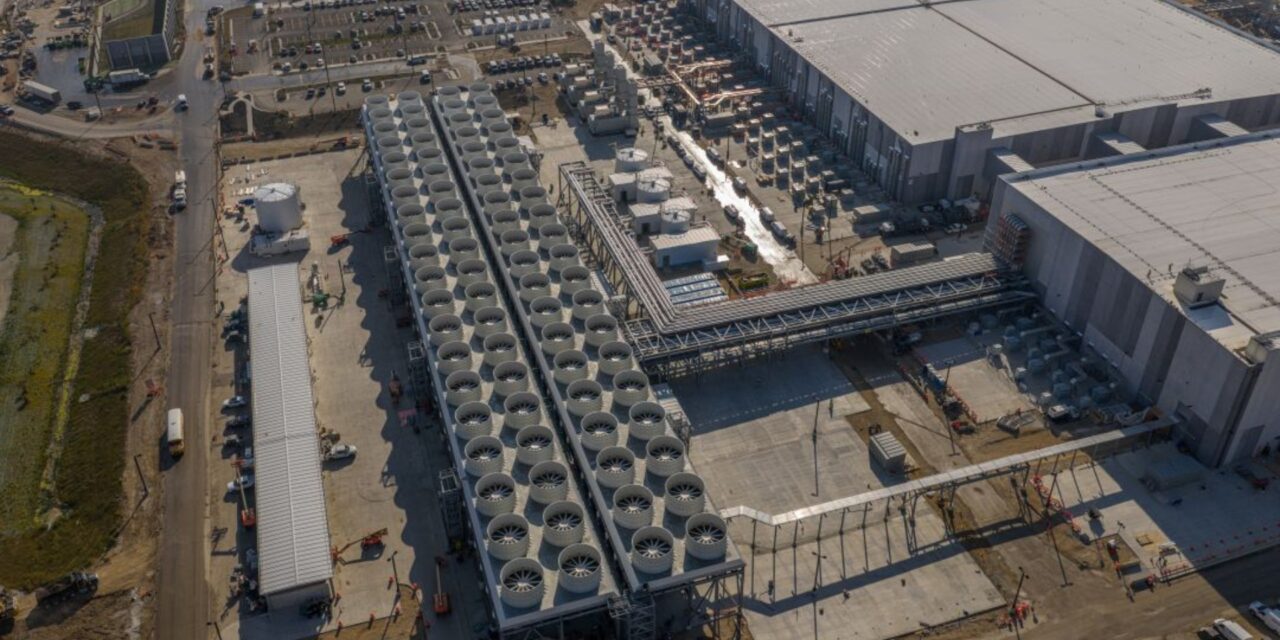
The company is also modifying the data centers themselves. It introduced a closed-loop liquid-cooling design that CEO Satya Nadella says enables AI data centers to use about as much water annually as a restaurant. Microsoft is experimenting with microfluidic channels etched into silicon, zonal cooling that reserves colder liquid for the hottest equipment, and lower-carbon concrete, steel, and mass timber for its construction. These efforts have not exactly quelled anti-data-center sentiment around its data centers. The company faced protests over a planned facility near Granger, Indiana, while residents living near its $7.3 billion Fairwater AI complex in Wisconsin have filed a lawsuit alleging persistent noise, dust, traffic, and light pollution.
Away from carbon, the report records clearer progress. Microsoft replenished 14.2 million cubic meters of water, exceeding its global withdrawals for the first time, and reduced average data center water-use effectiveness by 25% from its 2022 baseline. It achieved a 92% reuse and recycling rate for retired cloud hardware, diverted 90.5% of construction and demolition waste from disposal, and reduced single-use plastics in primary product packaging to 0.07%. It also legally protected 16,266 acres of land, approximately 36% more than the land estimated to be occupied by its operations.
The report is equally candid about where Microsoft is falling behind. The company’s most important commitment—becoming carbon-negative by 2030 — is moving further away rather than closer. Total greenhouse-gas emissions climbed 25% year over year and now sit roughly 58% above the company’s 2020 baseline, largely because AI infrastructure is expanding faster than its decarbonization efforts can offset. Scope 2 emissions also jumped sharply, rising from nearly 2% of Microsoft’s footprint in FY24 to 13% in FY25 as electricity demand from new data centers surged. While Scope 3 emissions remain the company’s largest source of carbon pollution, the report says the growing contribution from purchased electricity underscores how increasingly difficult it is to power AI infrastructure with clean energy alone.