
Acer’s new Swift Blade 14 might be the lightest 14-inch laptop yet
Are we in a thin-and-light laptop renaissance? Acer’s new sub-2-pound Acer Swift Blade 14 implies that we are.
A few months ago, I balanced Acer’s TravelMate P6 14 AI in my hand. It weighed just 1 kg (2.2 pounds), limbo-ing under the 1kg bar like a feather. Now, Acer has debuted the Swift Blade 14 at an incredible 0.8 kg (1.76 pounds), shaving off an additional 0.2 kg from the TravelMate’s bulk. I can only imagine what that feels like!
Put another way, if Acer somehow managed to repeat the process, that would put it at almost the exact weight of Apple’s smaller 13-inch iPad Pro… without its additional, optional keyboard.
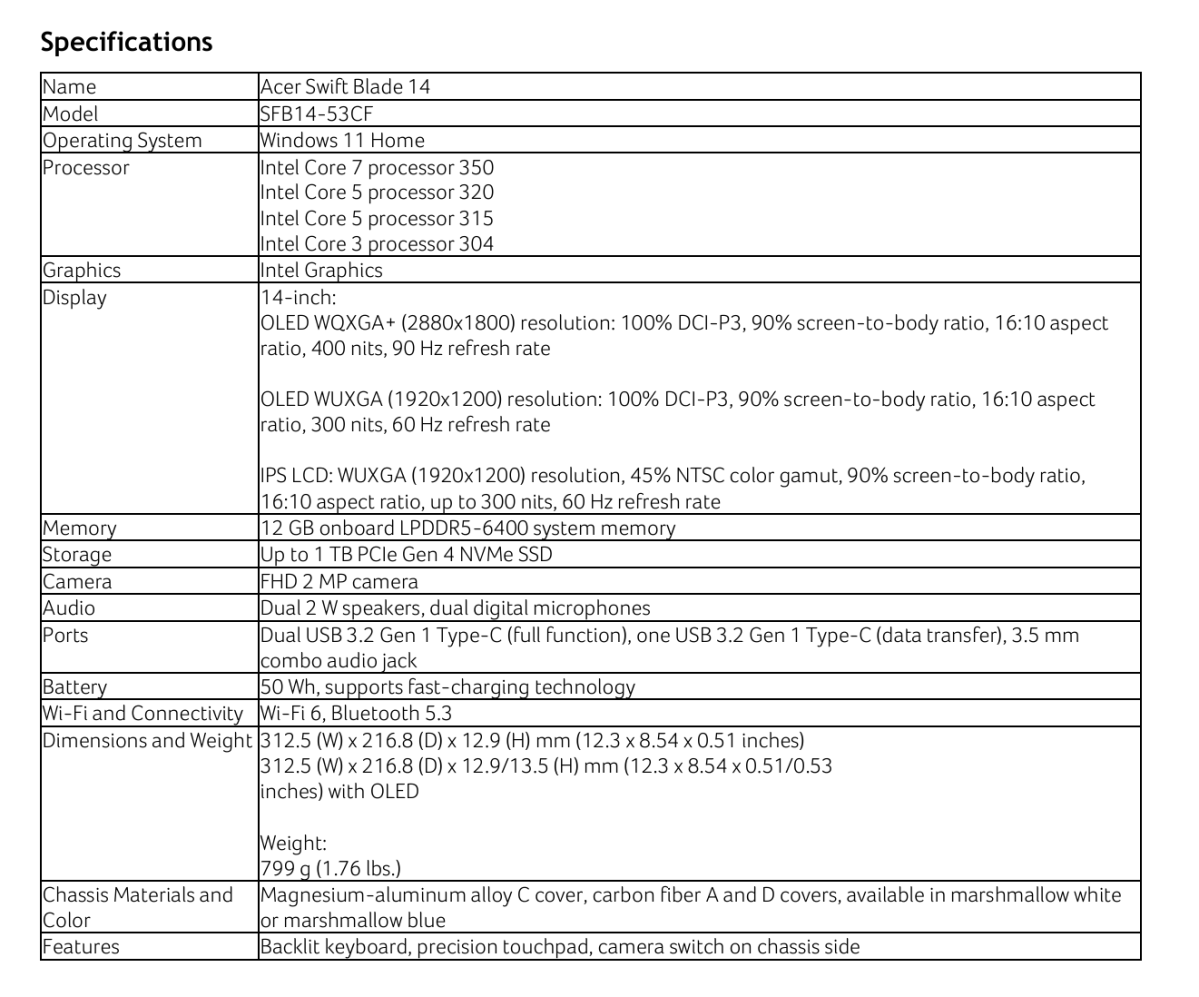
So, what changed? The processor, mainly. Intel designed its “Wildcat Lake” chip for cheaper, lighter devices and Acer’s Swift Blade 14 (SFB14-53CF) takes full advantage of that with an Intel Core 7 350 chip inside. (Acer is also launching a 16-inch version of the Swift Air 14, which it launched at Computex. It’s a 3.31-pound device, also based on the Core 7 350, and will ship in the first quarter of 2027.)

Acer
Productivity laptops have to balance two things: a large, bright, high-resolution-enough screen that’s comfortable to look at, and enough power efficiency to make that screen work without draining battery life. (The Swift Blade includes either 1920×1200 IPS, 1920×1200 OLED, or 2880×1800 OLED display options.) Adding a larger battery pushes that battery life number up, but at the cost of additional weight.
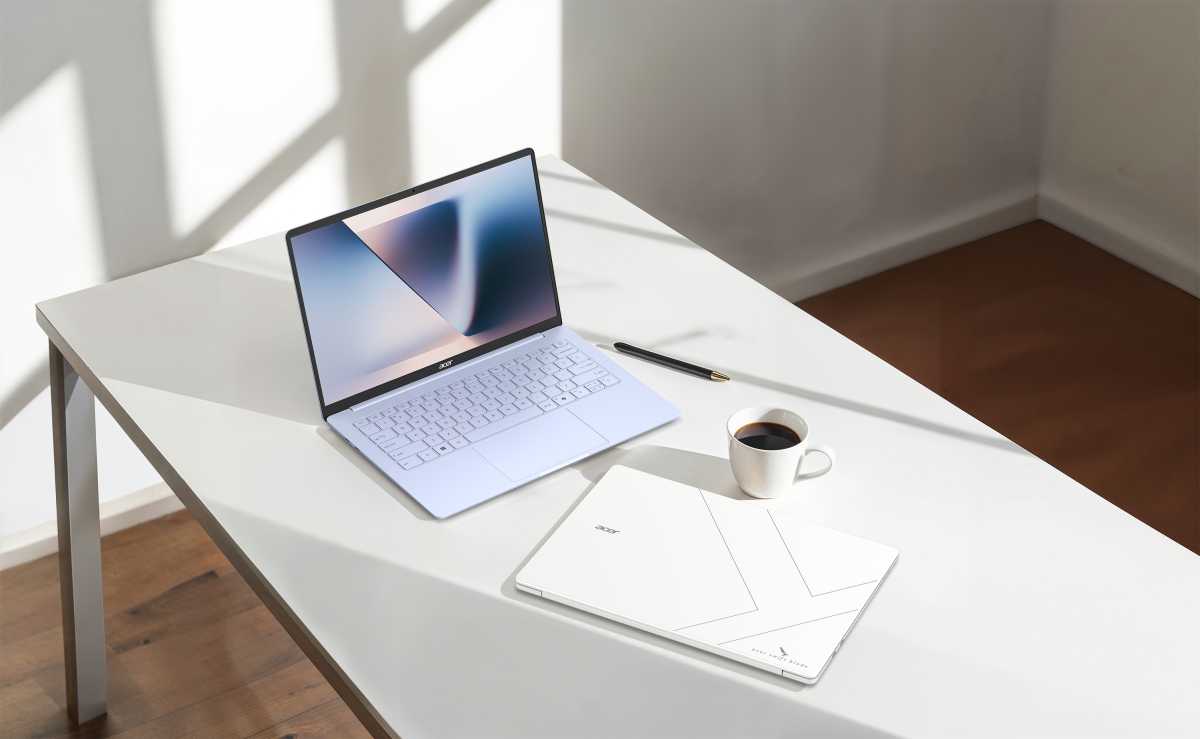
The chassis plays a role, too. Here, Acer used a combination of magnesium-aluminum alloy plus carbon fiber to lighten the load. And while the TravelMate ships in business black, the Swift Blade 14 will be available in two colorways: marshmallow blue and white. Incidentally, while the Swift Blade isn’t the lightest laptop—the 13.3-inch Fujitsu Lifebook UH-X weighs 1.40 pounds—it might be the lightest 14-inch laptop announced so far.
I don’t care as much about how thin a laptop is, though, and Acer seemingly agrees with me. The Swift Blade 14 measures 12.3 x 8.54 x 0.51 inches, which is thin but not too thin. If a laptop is too thin, it can suffer from bending and other structural issues.
Intel’s Wildcat Lake was designed inside a single module, reducing the need for a bulky, heavier cooling system. At the time, Intel suggested it might use memory designed for smartphones to reduce cost. There’s no indication that Intel or Acer went that route, but there’s a standard loadout of 12GB of LPDDR5-6400, which differs a bit from the standard 8GB or 16GB options. Storage options will climb “up to” 1TB of PCIe Gen4 SSD storage. Also, Wildcat Lake lacks advanced I/O, so there’s only a pair of standard 10Gbps USB-C ports alongside Wi-Fi 6 and Bluetooth 5.3.
Acer
The other consideration, however, is performance. It’s here that Acer and other laptop makers suffer. Based on my review of the Lenovo IdeaPad Slim 3i, the Core 7 350 just isn’t that powerful. (It’s also worth noting that even the Apple iPad Pro uses an Apple M5 chip.) However, the 50 watt-hour battery inside that laptop allowed it to loop a 4K video for over 12 hours before the battery expired. My conclusion? The Slim 3i was a decent laptop by itself, but paled by comparison. However, the Slim 3i weighed 3.51 pounds—that’s two Swift Blade 14s, combined!
The weight, then, opens up another opportunity for the Swift Blade 14 to attract potential buyers who are less interested in an ultra-endurance, powerful laptop and simply want a computing solution with as little bulk as possible.
So, what do the availability and ship date look like? Well, that’s still a mystery. Ongoing shortages of memory and storage have made these questions perpetually difficult to answer, and Acer isn’t saying when the Swift Blade 14 will ship to US customers and what the price will be. (Europeans will receive it in December.)
Here are the specifications for the Swift Blade, as presented by Acer: