Montech Century II Gold 850W ATX 3.1 power supply review: Excellent budget-friendly Gold-tier ATX 3.1 unit with Cybenetics Platinum efficiency
Montech is one of those brands that, despite a relatively recent international profile, traces its lineage back through the Taiwanese components industry to engineers with three-plus decades of experience. The company formally took shape in 2016 and entered Western retail channels around 2019, initially building its name on aggressively priced PC cases. From that beachhead, Montech expanded methodically into air and liquid coolers, fans, mechanical input devices, and, most relevant for this review, power supplies.
The original Century line positioned Montech at the value-conscious end of the PSU market. At the same time, the more recent Titan series advanced to premium territory by relying on Seasonic and CWT for its underlying platforms. The Century II line, refreshed for ATX 3.1 and PCIe 5.1 with native 12V-2×6 connectivity, sits between those bookends. It is meant to deliver modern-spec compliance and Gold-level efficiency at a price point that undercuts the established premium players by a meaningful margin. The 850W model is the entry point of the family, and today we examine whether it belongs among our list of best power supplies on the market.
Specifications and Design
|
RAIL |
+3.3V |
+5V |
+12V |
+5Vsb |
-12V |
|---|---|---|---|---|---|
|
MAX OUTPUT |
20A |
20A |
70.8A |
3A |
0.3A |
|
100W |
100W |
849.6W |
15W |
3.6W |
|
|
TOTAL |
850W |
||||
|
AC INPUT |
100 – 240 VAC, 50 – 60 Hz |
||||
|
MSRP |
$90 |
In the Box
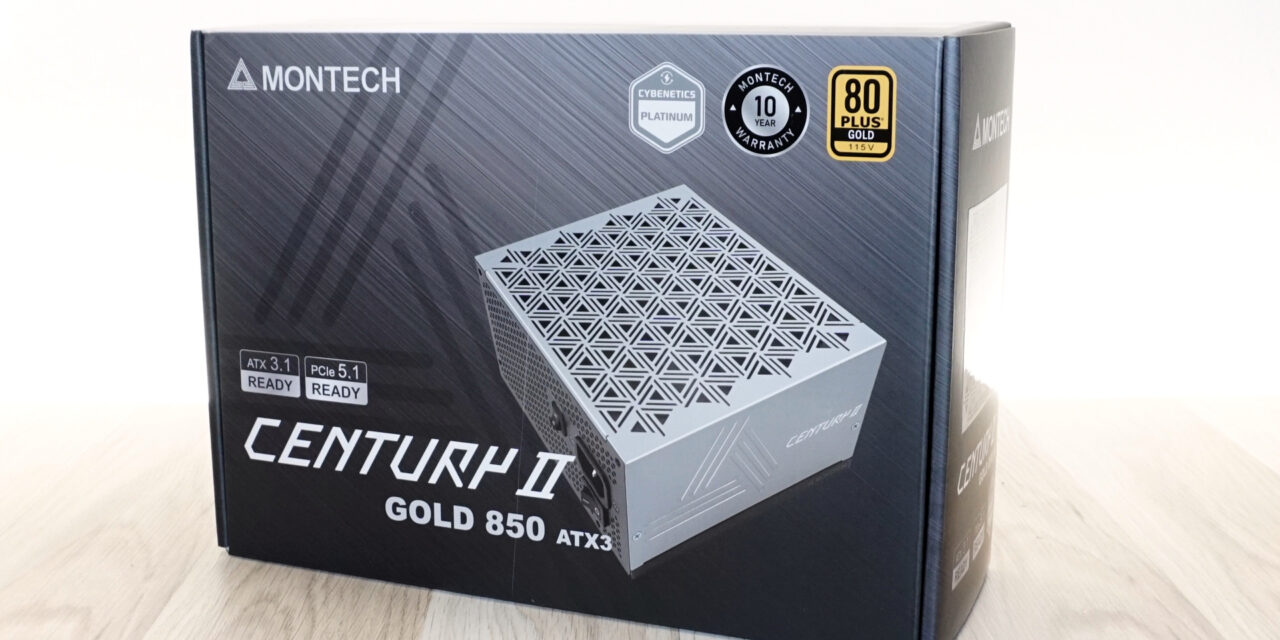
The Century II 850W ships in a tidy cardboard box dressed in a charcoal/silver color scheme that attempts to mirror the unit’s own finish. Montech leans hard on the dual certification story up front, with the 80Plus Gold and Cybenetics Platinum badges both printed prominently on the box face, alongside the ten-year warranty claim and references to the ATX 3.1 and PCIe 5.1 standards. Foam inserts protect the PSU itself.
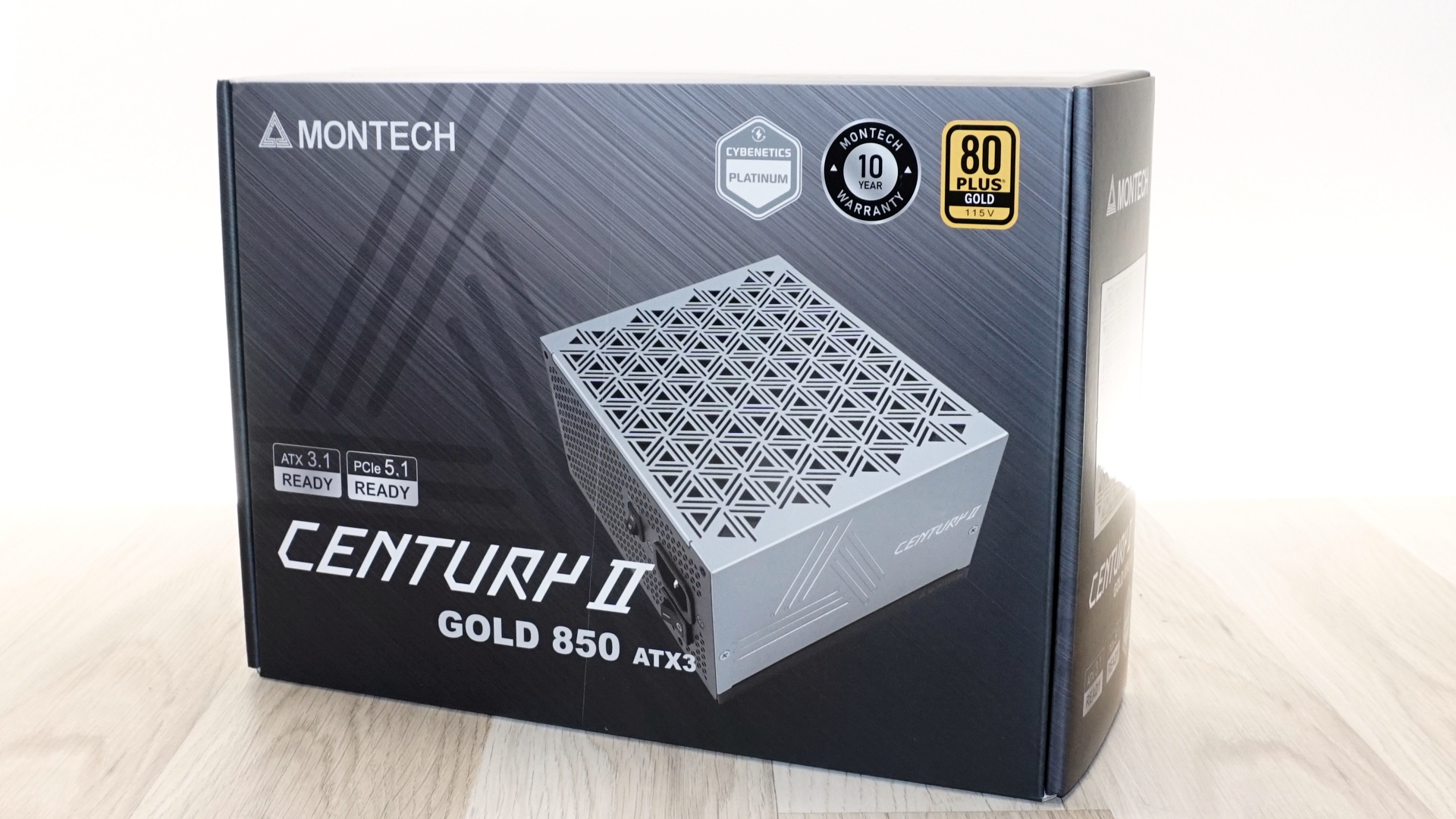
Bundled accessories are beyond modest, especially for the price range of the unit. We found the AC power cable, a sleeve of mounting screws, a few reusable Velcro-style cable straps, a few cable ties, and a small user manual. At this price point, that is an unexpectedly good unboxing experience.
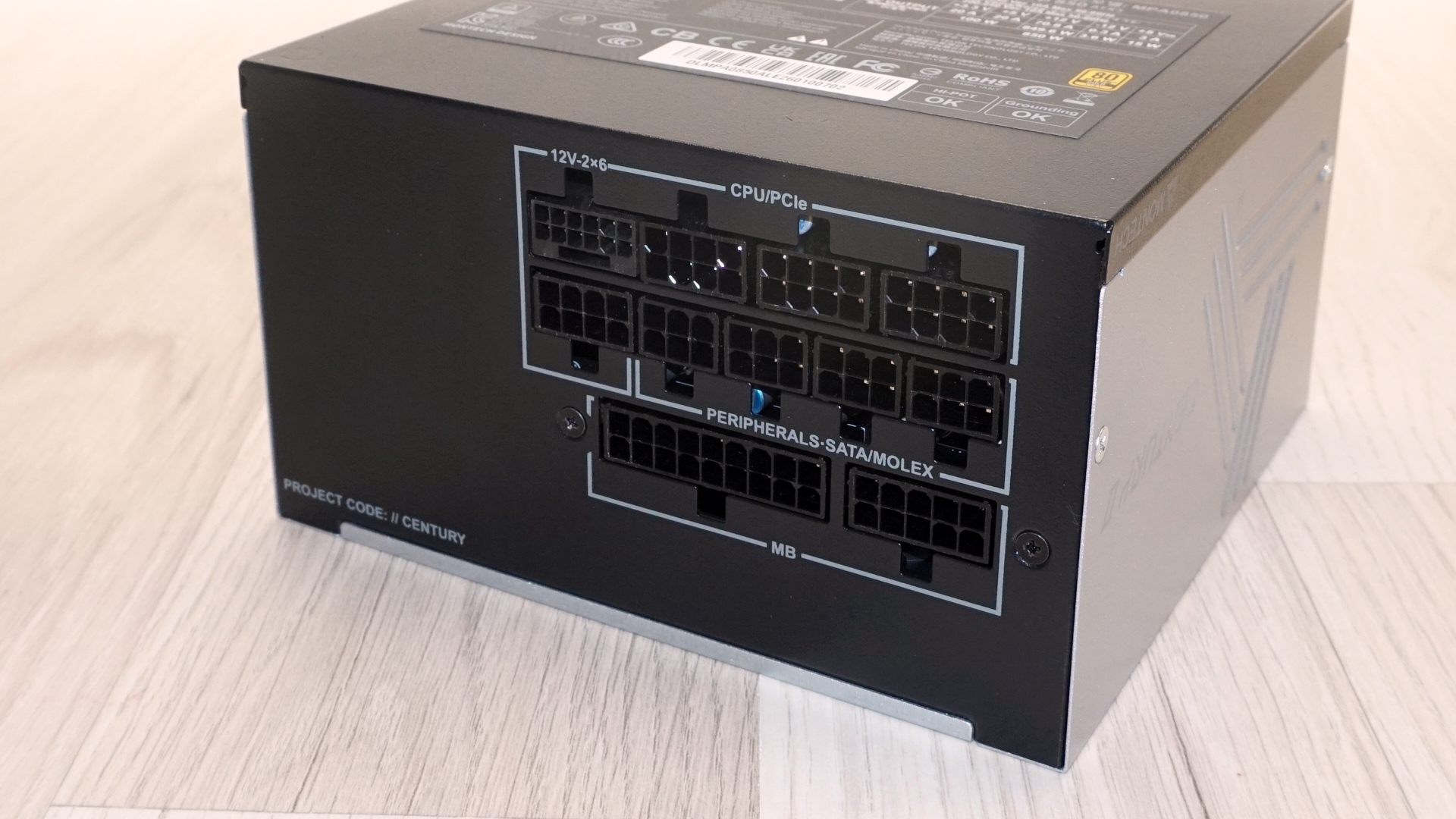
The cable bundle itself is all-black and entirely flat-ribbon in construction. The native 12V-2×6 cable is the highlight, rated at the full 600W of the connector standard. Buyers get two 6+2-pin PCIe cables carrying four connectors total, two EPS 8-pin runs for CPU power, two SATA chains with four connectors apiece, and a single Molex chain. The total connector count covers every realistic single-GPU configuration this PSU should be paired with, including current-generation cards with multiple PCIe inputs.
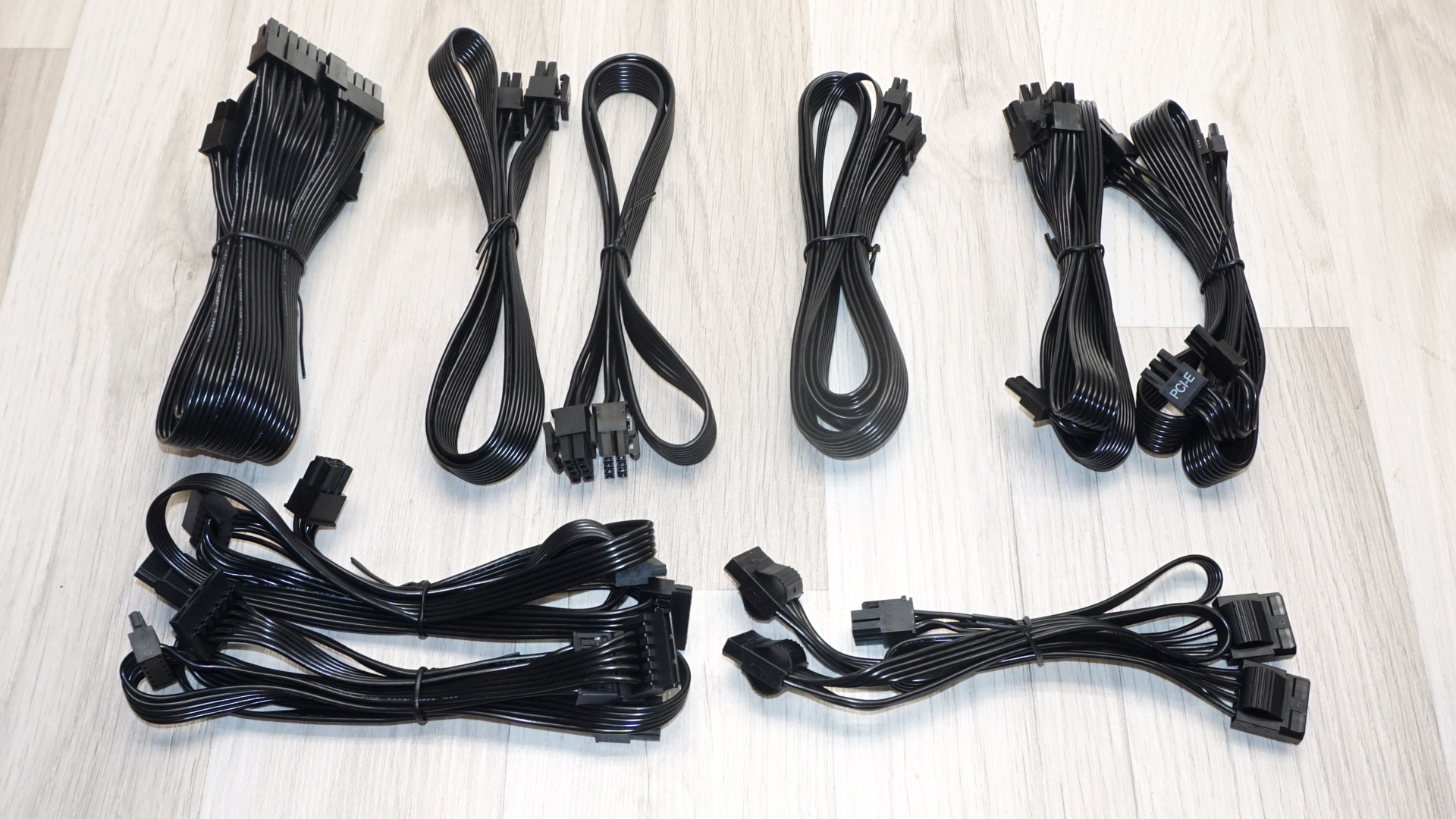
|
Connector type |
Hardwired |
Modular |
|
ATX 24 Pin |
– |
1 |
|
EPS 4+4 Pin |
– |
– |
|
EPS 8 Pin |
– |
2 |
|
PCI-E 5.1 (12V-2×6) |
– |
1 |
|
PCI-E 6+2 Pin |
– |
4 |
|
SATA |
– |
8 |
|
Molex |
– |
4 |
|
Floppy |
– |
– |
External Appearance
At 160mm in length, the Century II 850W is a touch longer than the ATX guideline 140mm reference, though well within what any modern mid-tower will accept without complaint. Compact-case builders should double-check clearances before committing.
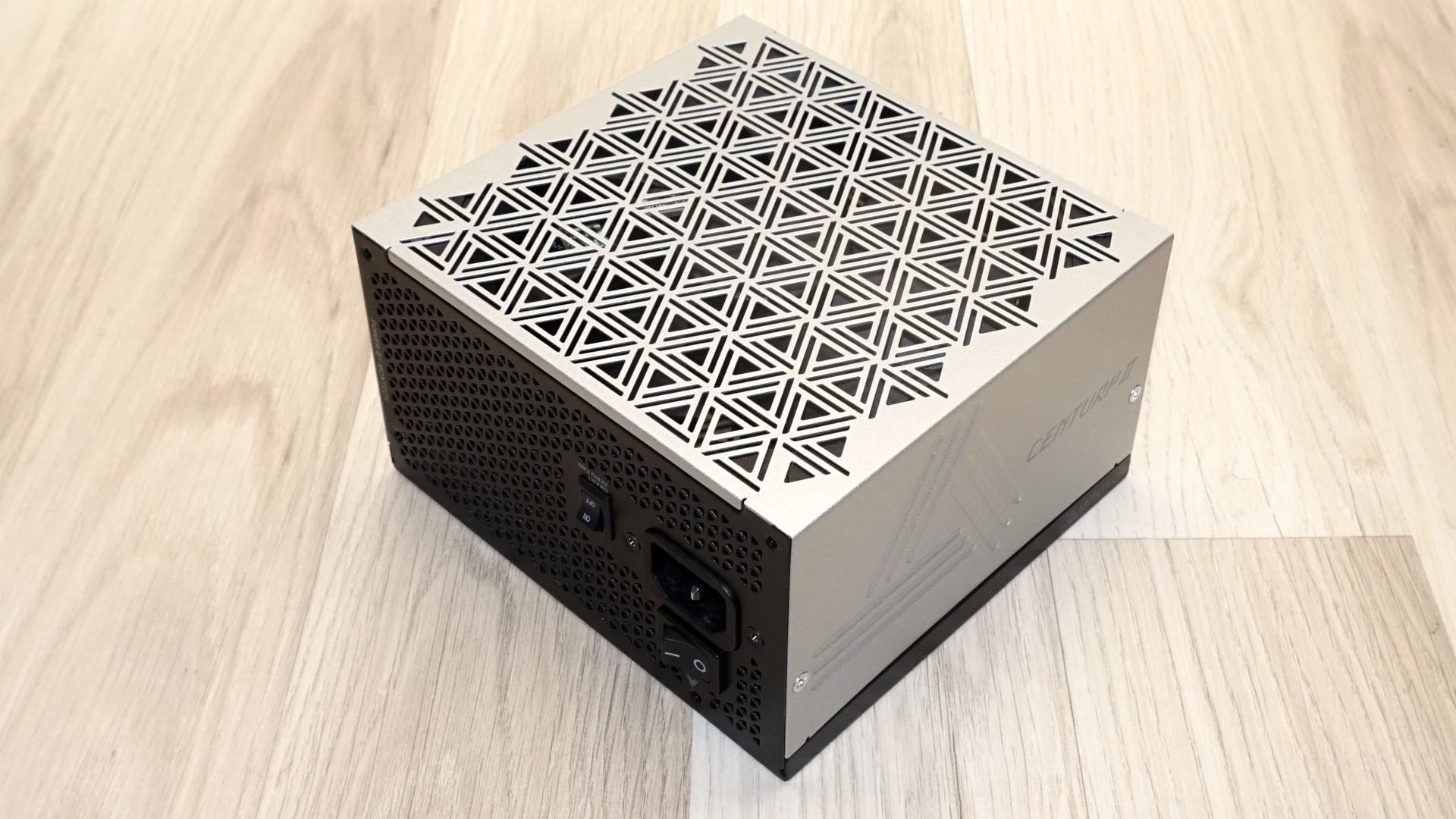
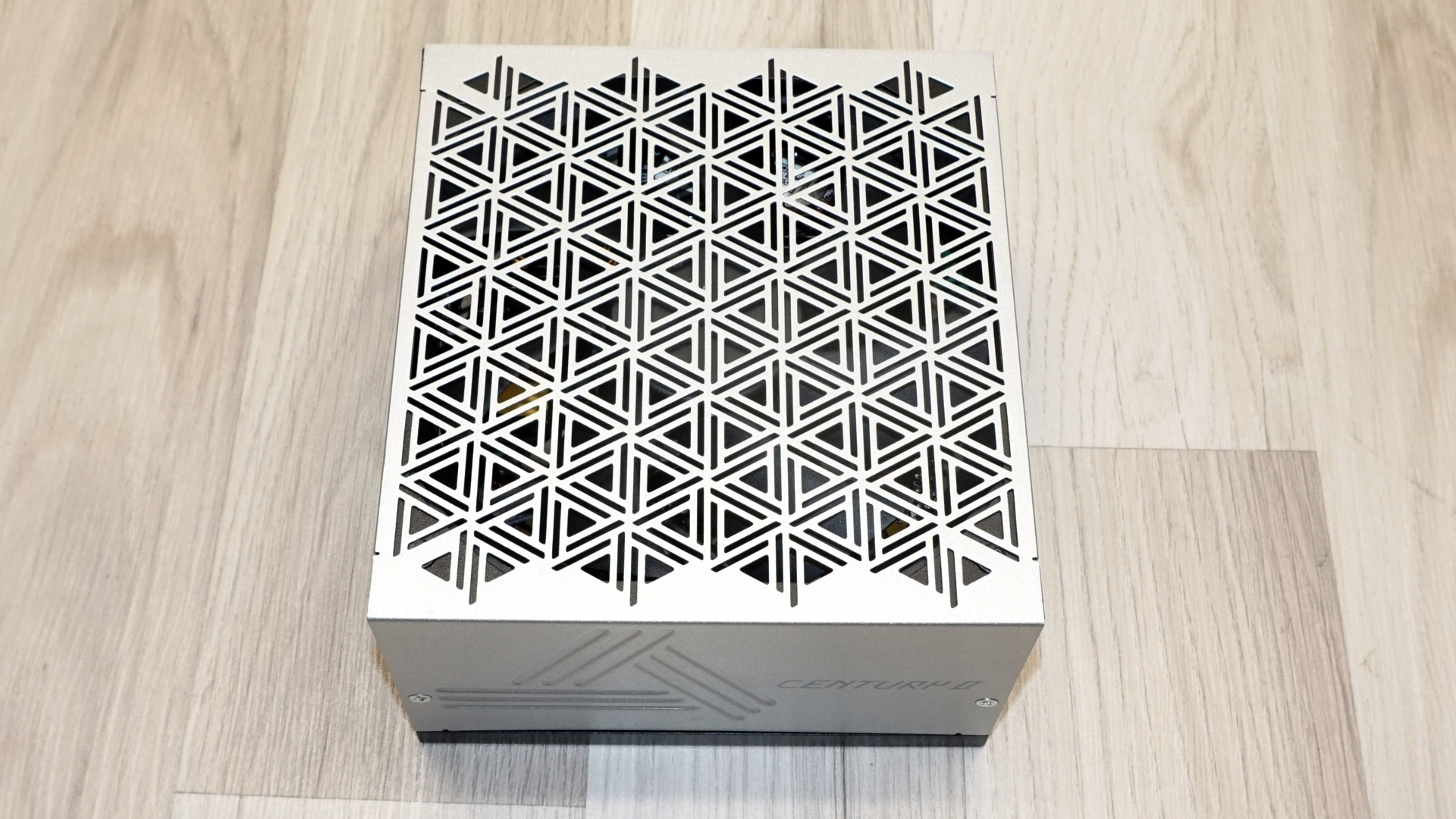
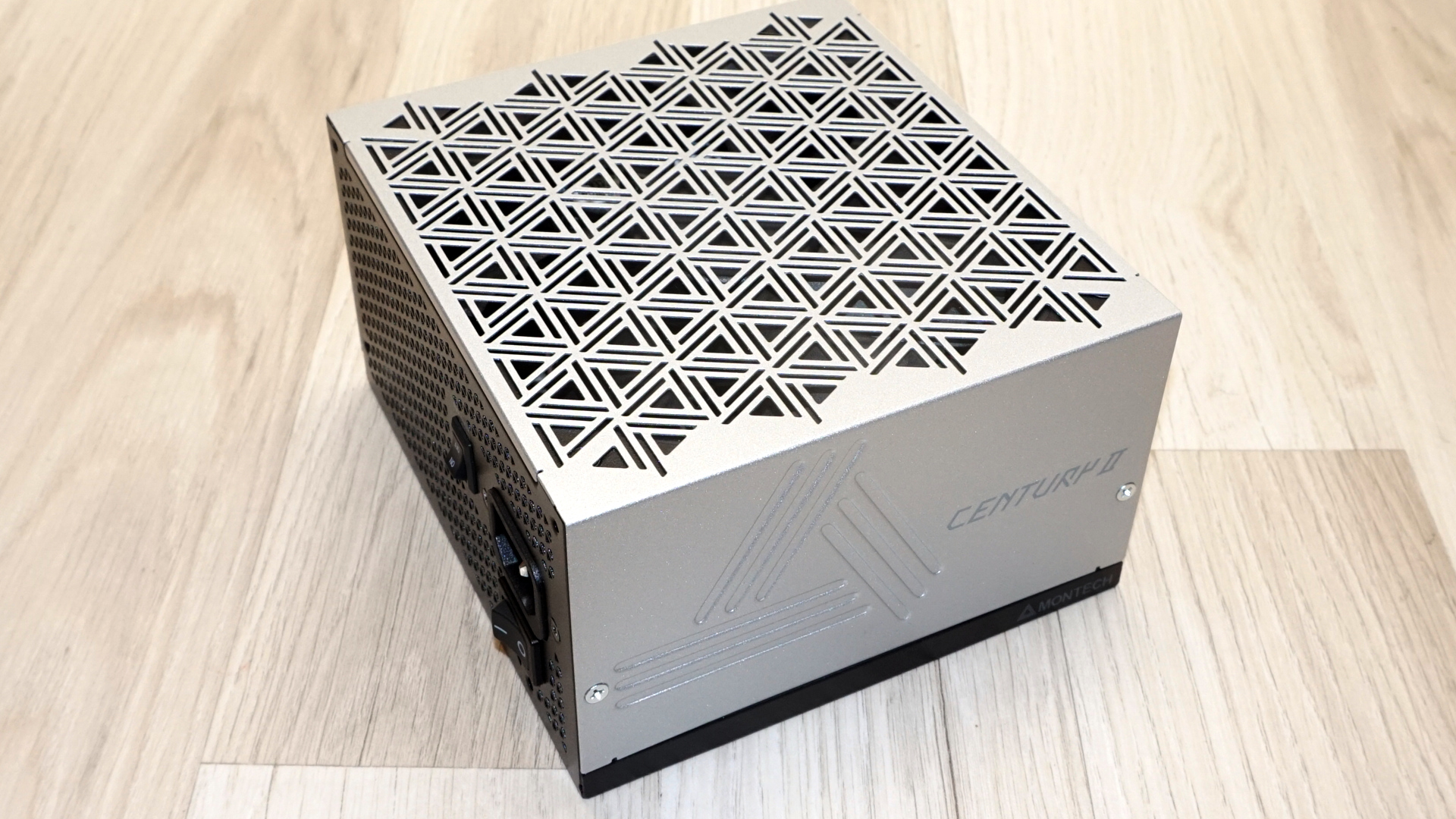
Visually, this is one of the most distinctive units in its class. Where the vast majority of competitors stick to plain black sheet metal, Montech has gone with a two-tone treatment: a matte silver top panel cut with a geometric triangular grille that looks like an architectural detail more than a fan vent, paired with a black chassis body. Both side panels carry a subtle, debossed angular pattern and the Century II wordmark, while a discrete “Montech” logo is along the bottom edge. The finish is clean, and the panel gaps are tight.
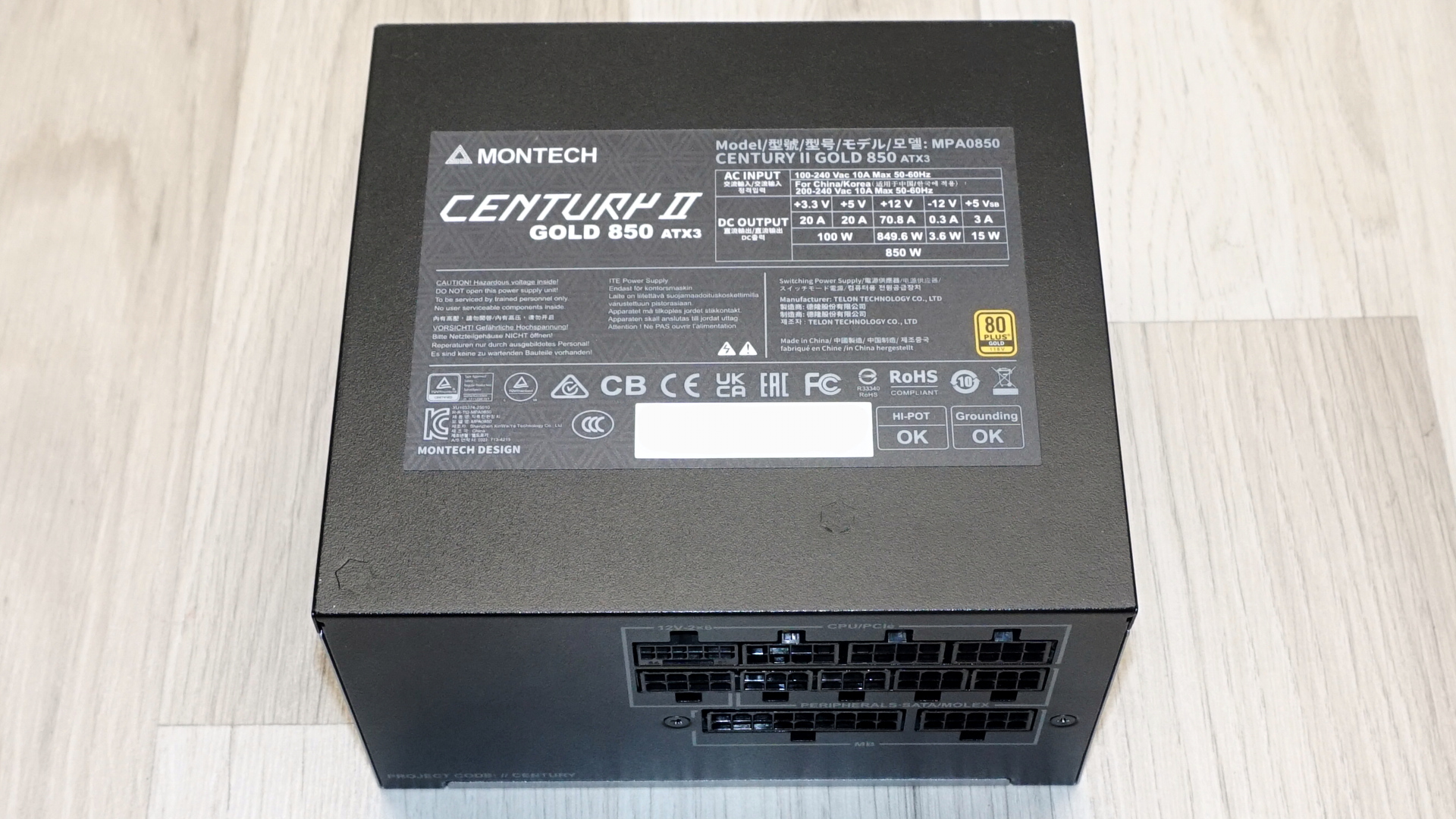
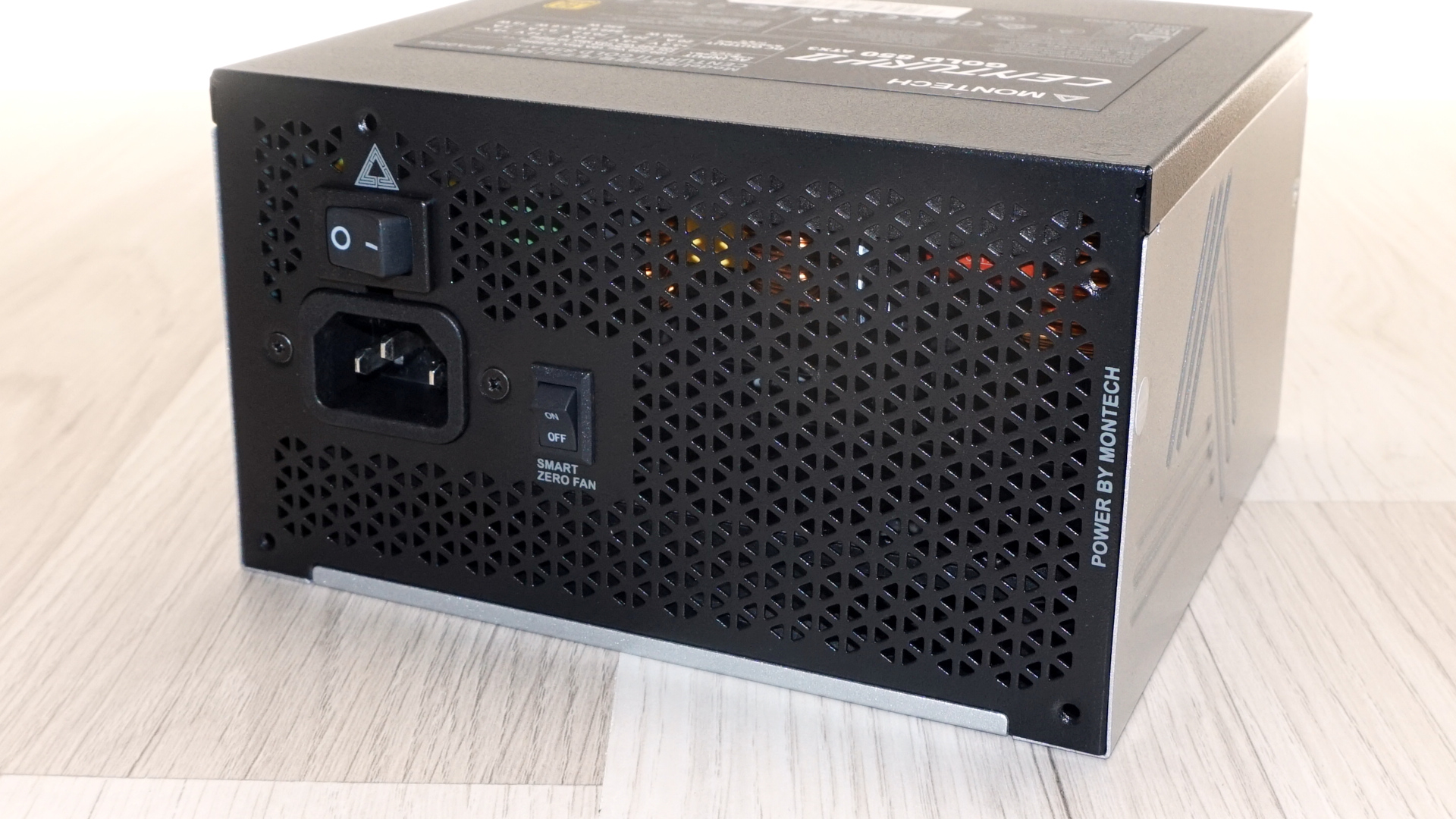
The rear face holds the AC receptacle and the primary on/off switch, plus a smaller secondary toggle that lets the user disable the hybrid mode and run the fan continuously if they prefer. That second switch is something Montech could easily have buried, and it is a small feature but one we are glad to see. At the front, we can only see the modular connectors with their silkscreened labels that clearly identify each socket. Connector keying makes mis-insertion practically impossible anyhow.
Internal Design
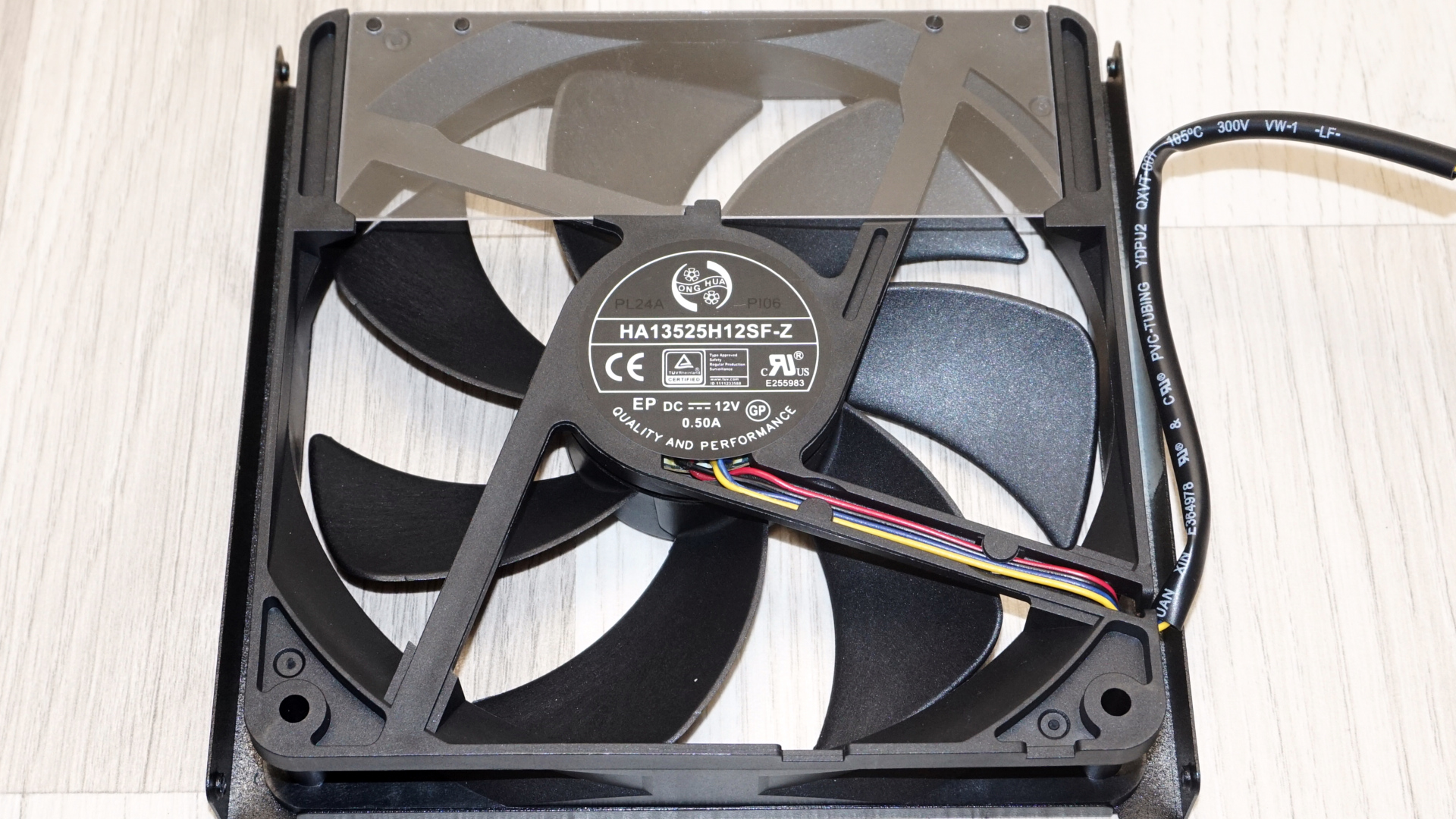
Cooling falls to a 135mm Hong Hua HA13525M12SF-Z fan, which uses a fluid-dynamic bearing engine. The model designation indicates a medium-speed variant rather than the higher-rated H-series spindle some premium Hong Hua models employ, but the maximum speed of 2000 RPM is very high. In practice, fluid-dynamic bearings are the right choice for a unit pitched for long service life, and the fan curve of this unit is calibrated conservatively enough.
The OEM is Shenzhen Xinweiye Technology Co., typically referred to as XWY. XWY is not as familiar a name as Seasonic, CWT, or Great Wall, but the company has been quietly supplying Montech’s Century II family and a handful of other brands’ mainstream ATX 3.x designs.
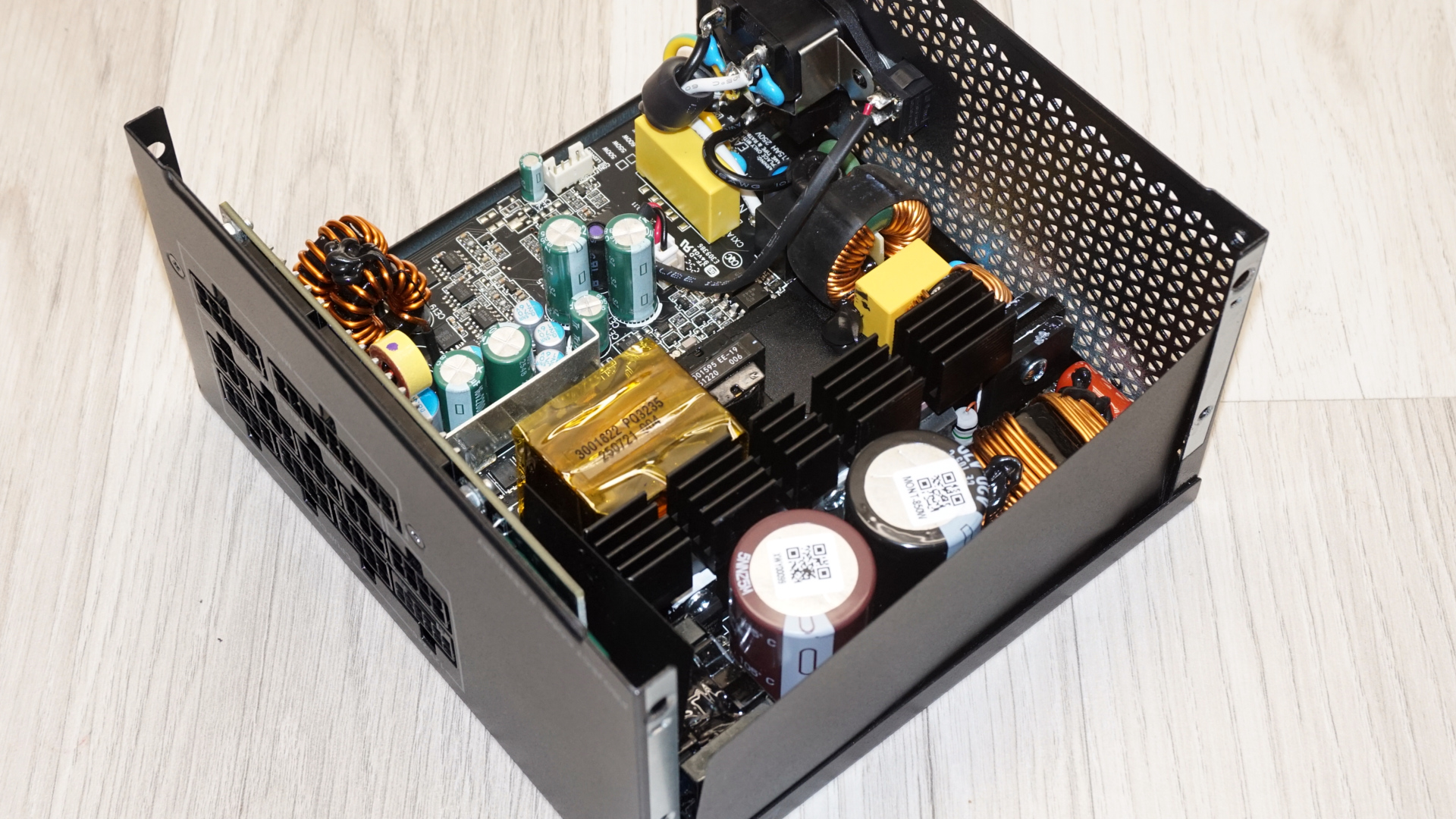
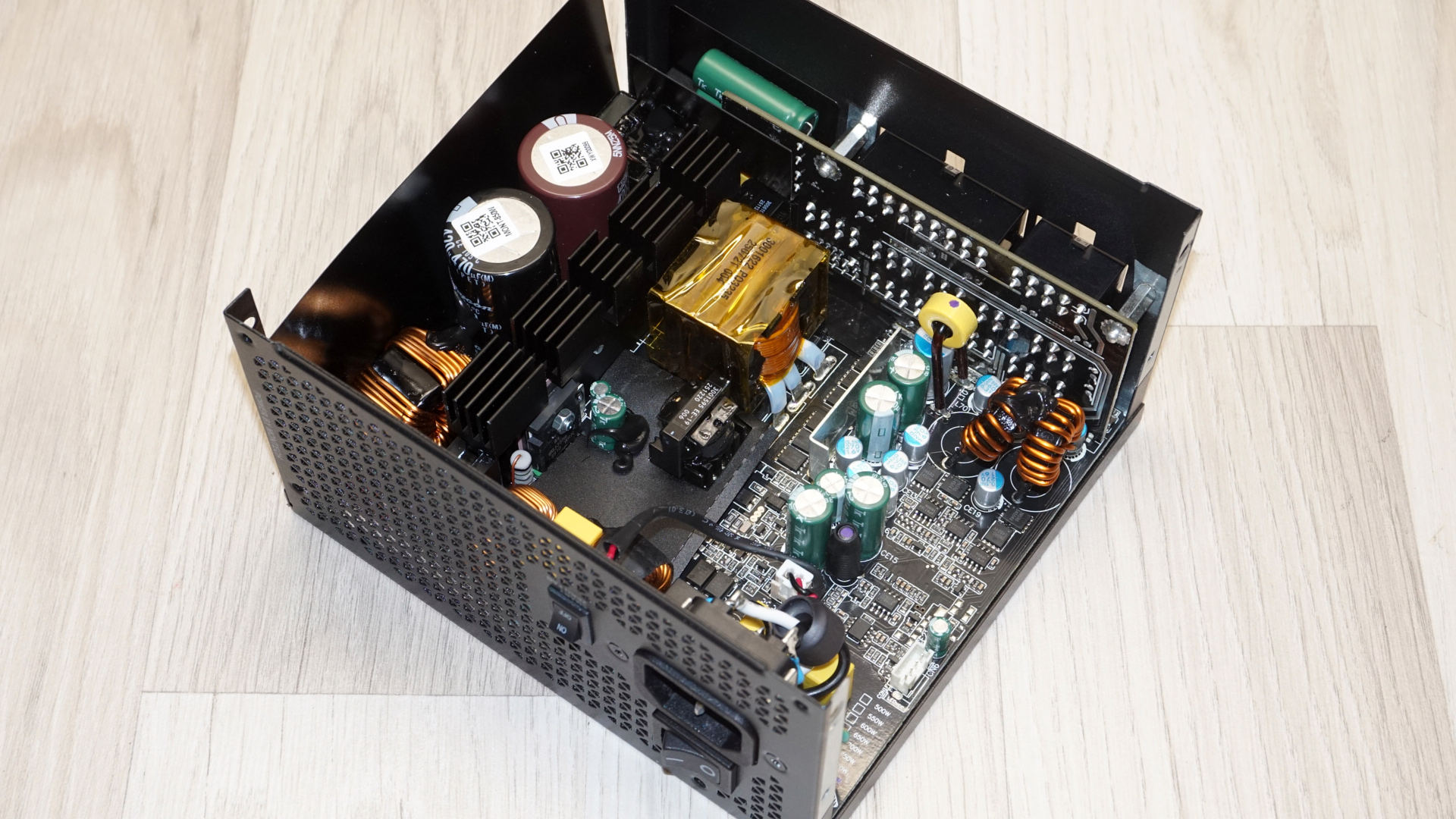
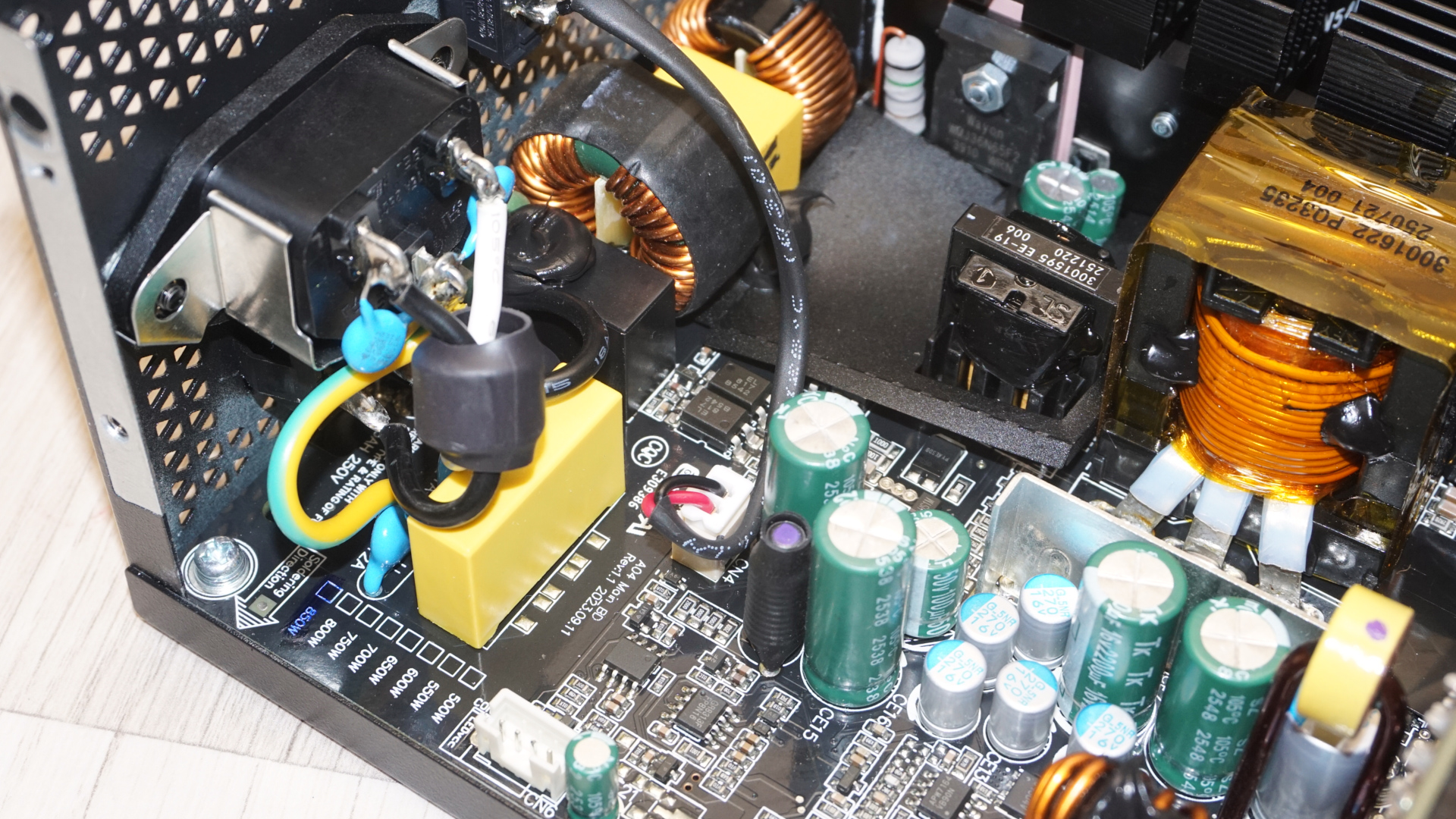
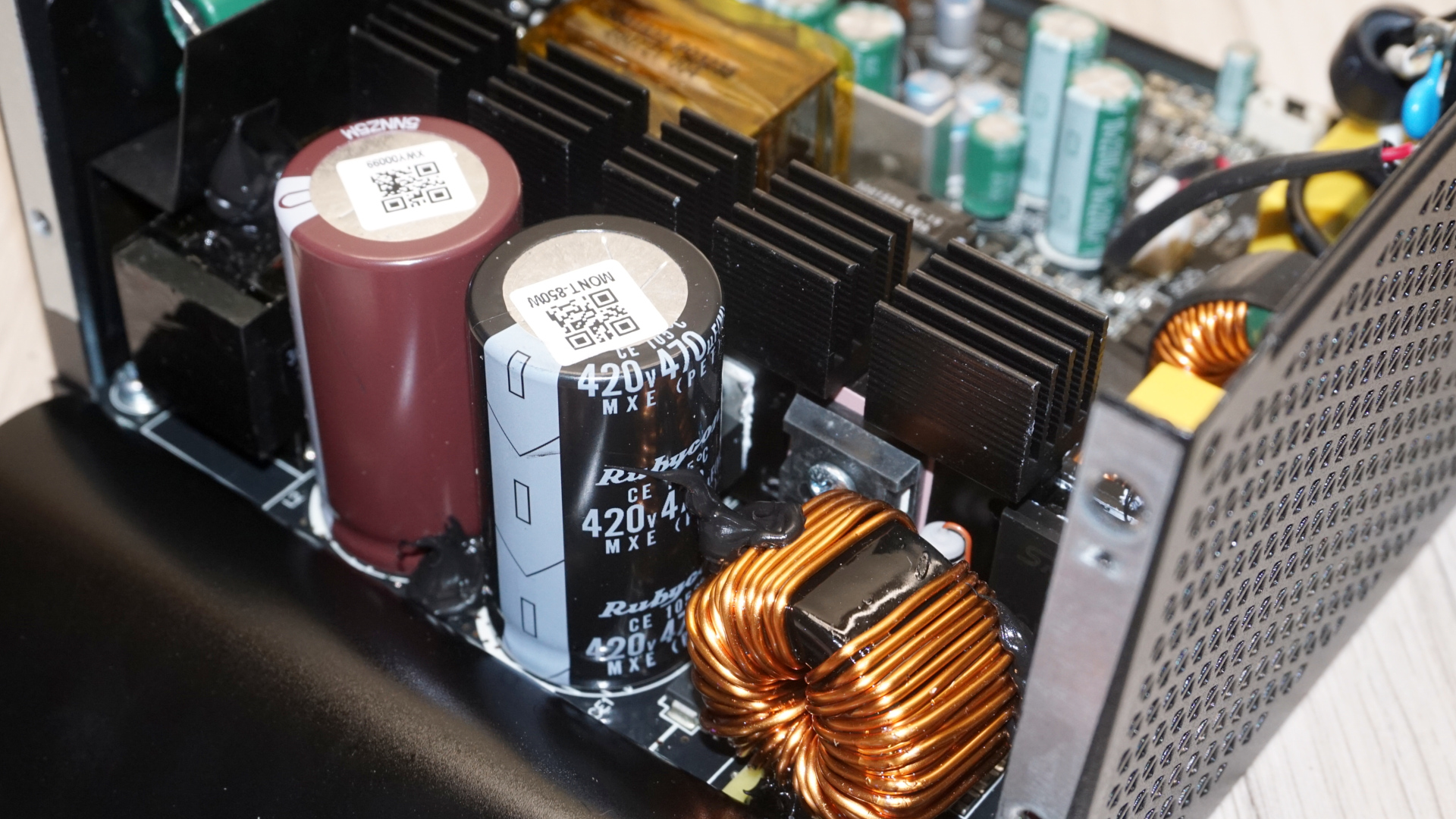
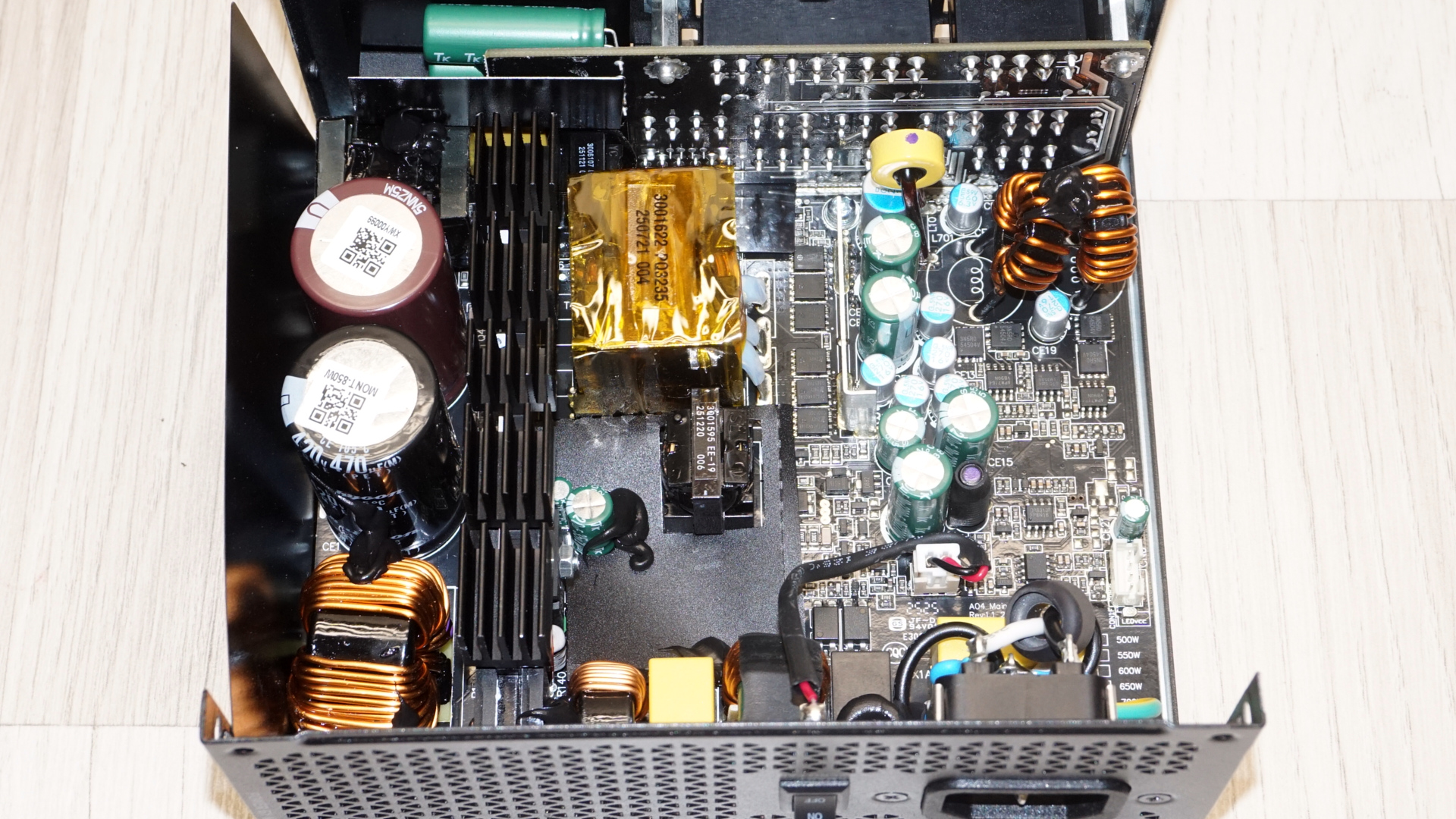
Filtering on the AC inlet PCB consists of four Y capacitors, two X capacitors, and two filtering inductors – a good, complete configuration for a unit at this wattage. The two bridge rectifiers sit on the large heatsink across the unit’s edge, sharing it with the APFC stage components. The APFC stage uses a typical inductor paired with two bulk capacitors mounted side by side, one from Rubycon and one from Nippon Chemi-Con, both branded for 105°C operation. These are two of the most reputable Japanese manufacturers, in line with Montech’s marketing claim of 100% Japanese capacitors, although the products themselves are extremely unlikely to have been made in Japan nowadays.
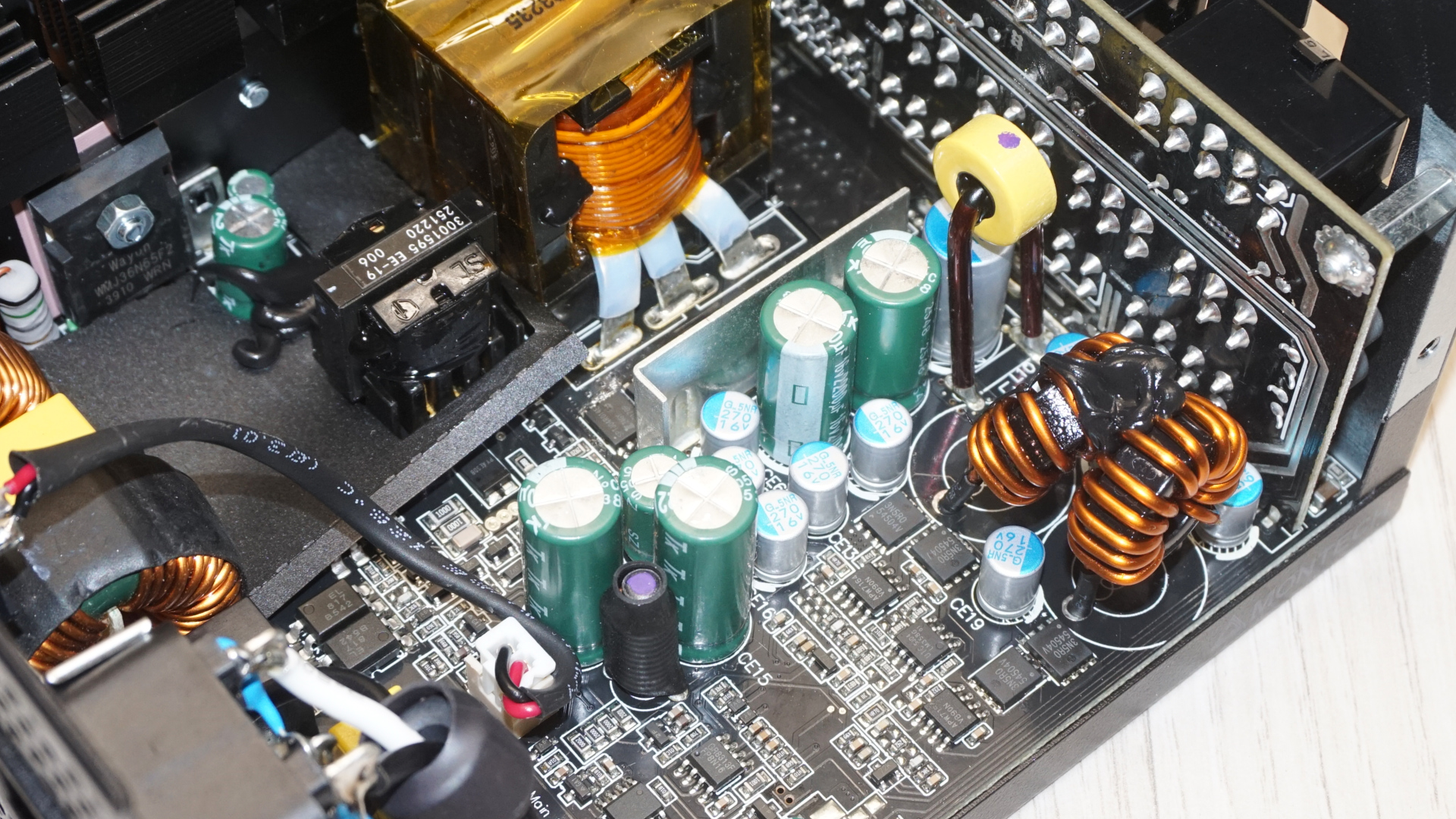
The primary inversion stage topology is a half-bridge LLC with two PIP Semiconductor SPTA65R130FDD MOSFETs, entirely appropriate for the price point and well-proven at this output rating. The main transformer sits centrally on the board with gold tape insulation, dividing primary from secondary. The rectification stage on the secondary side is handled by six SPTJ04R014E MOSFETs operating in synchronous-rectifier mode. 3.3V and 5V is generated through typical DC-to-DC conversion, but unlike the commonly found vertical daughterboard, all components are on the main PCB.
Secondary-side electrolytics are predominantly TK-branded, which corresponds to the Japanese manufacturer Toshin Kogyo. TK is genuinely Japanese, which validates Montech’s marketing copy, but enthusiasts should be aware that Toshin Kogyo is widely regarded as a second-tier domestic capacitor brand rather than a peer of Nippon Chemi-Con, Rubycon, or Nichicon. Then again, TK’s reputation is solidly higher than that of the manufacturers supplying the silicon of this unit. In practical terms, the unit should age perfectly well, but it is a tier below what the higher-end competition uses (and that is reflected in the price).
Cold Test Results (25°C Ambient)
Cold Test Results (25°C Ambient)
For the testing of PSUs, we are using high-precision electronic loads with a maximum power draw of 2700 Watts, a Rigol DS5042M 40 MHz oscilloscope, an Extech 380803 power analyzer, two high-precision UNI-T UT-325 digital thermometers, an Extech HD600 SPL meter, a self-designed hotbox, and various other bits and parts.
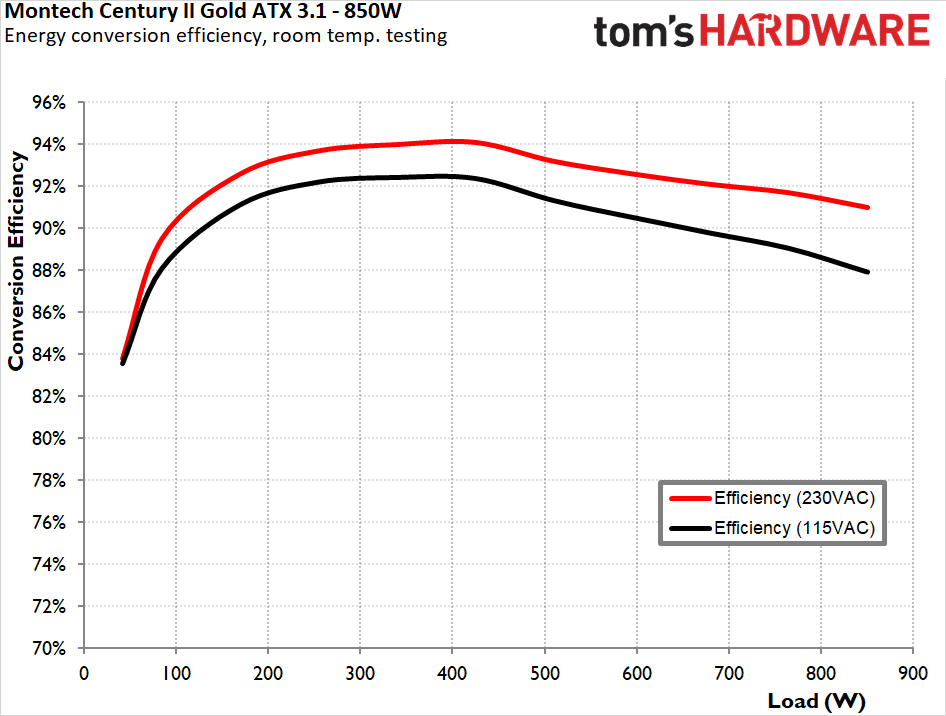
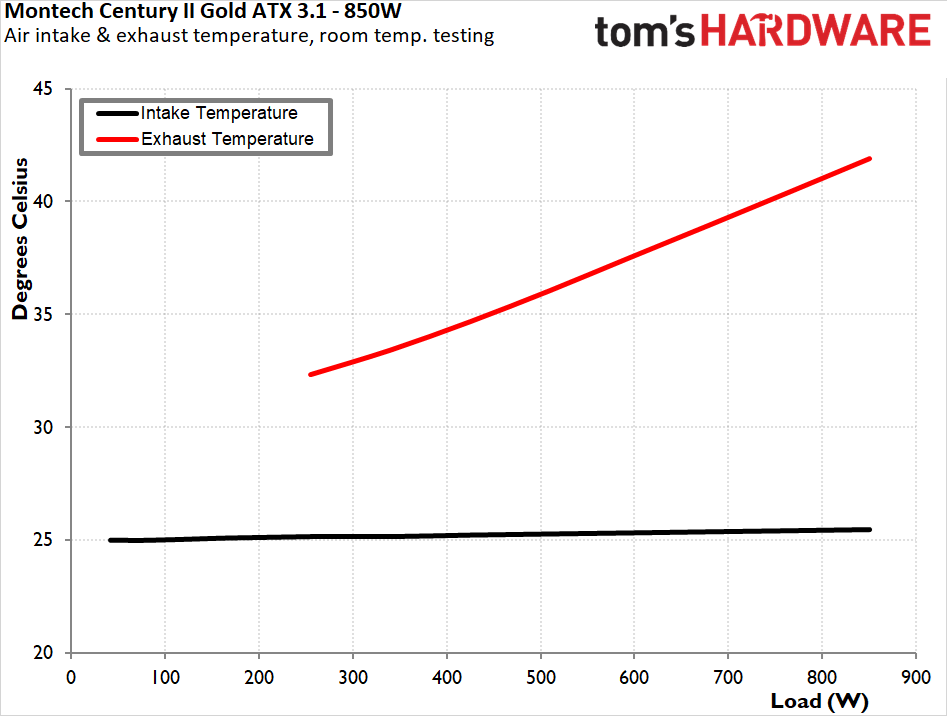
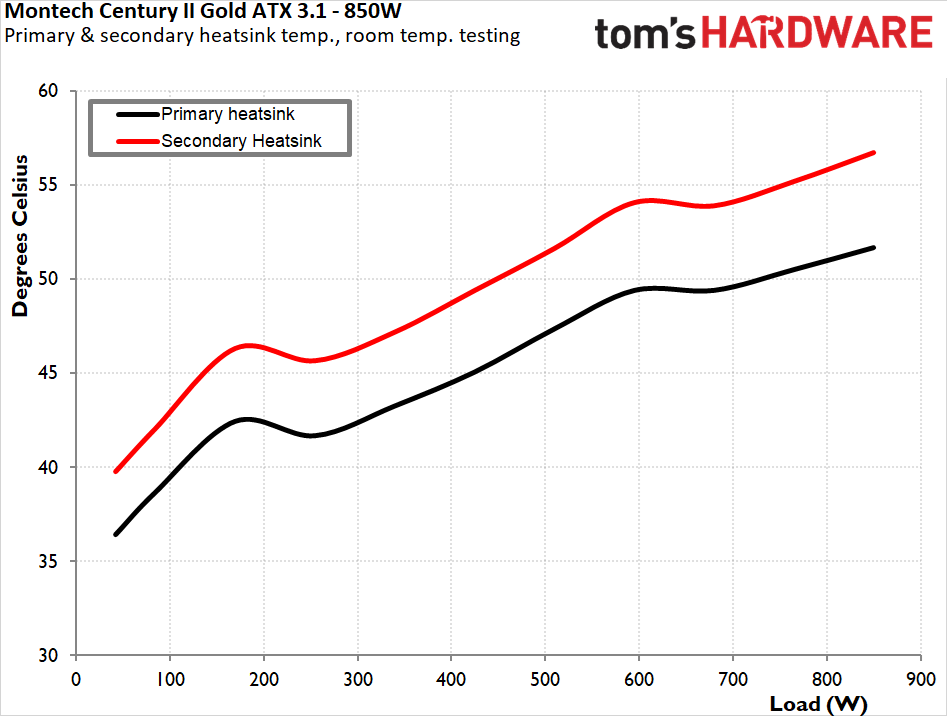
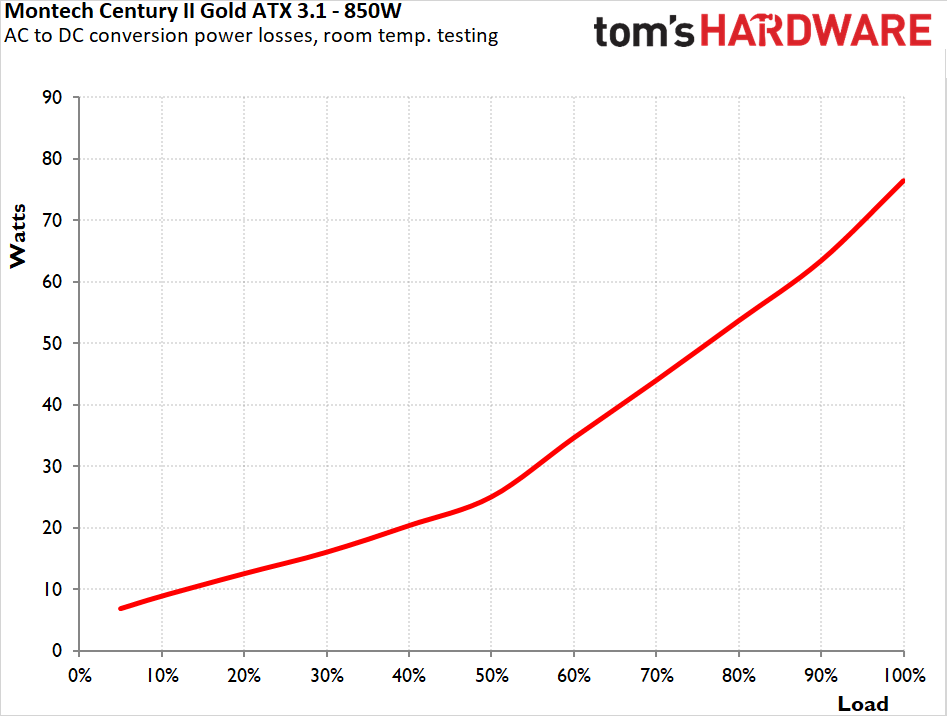
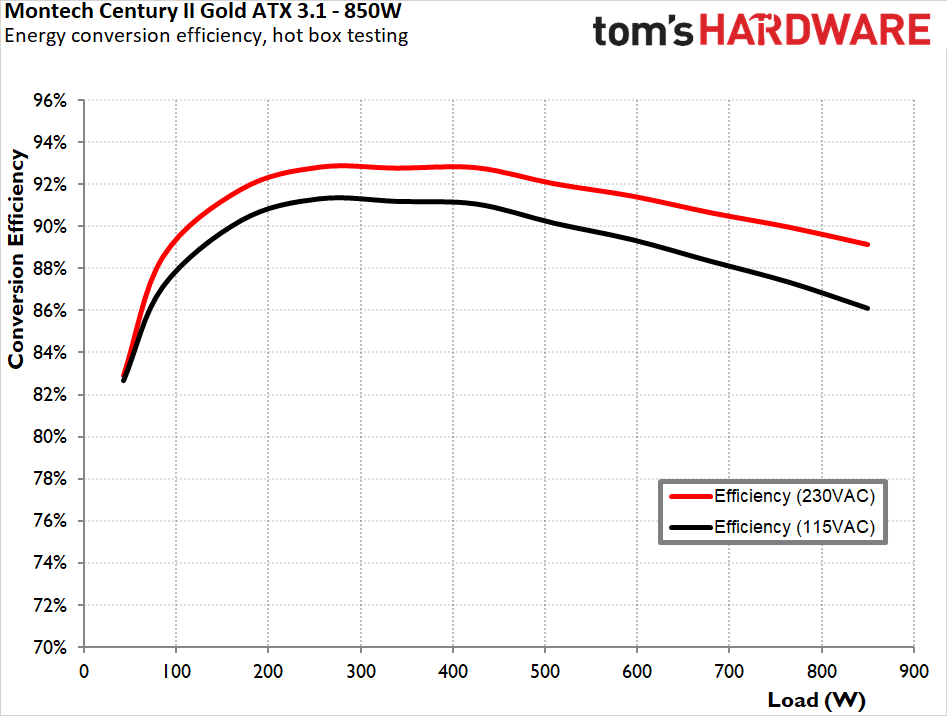
At 115 VAC, the Century II 850W averaged 90.5% efficiency across the 10-100% load range during cold testing. At 230 VAC, the figure rose to 92.5%. Both numbers comfortably exceed the Cybenetics Gold threshold, with Cybenetics independently certifying the unit as Platinum across both input voltages. The unit holds 80Plus Gold certification under the 115V input voltage because it does not meet the 100% load efficiency requirement for the 80Plus Platinum badge, which is why Montech labels it Gold rather than Platinum on that scheme. The Cybenetics methodology, which considers the average efficiency rather than the four-point 80Plus protocol, reflects the platform’s strengths more accurately. The efficiency curve peaks just below the 50% load mark and stays largely flat from there through the upper end of the range.
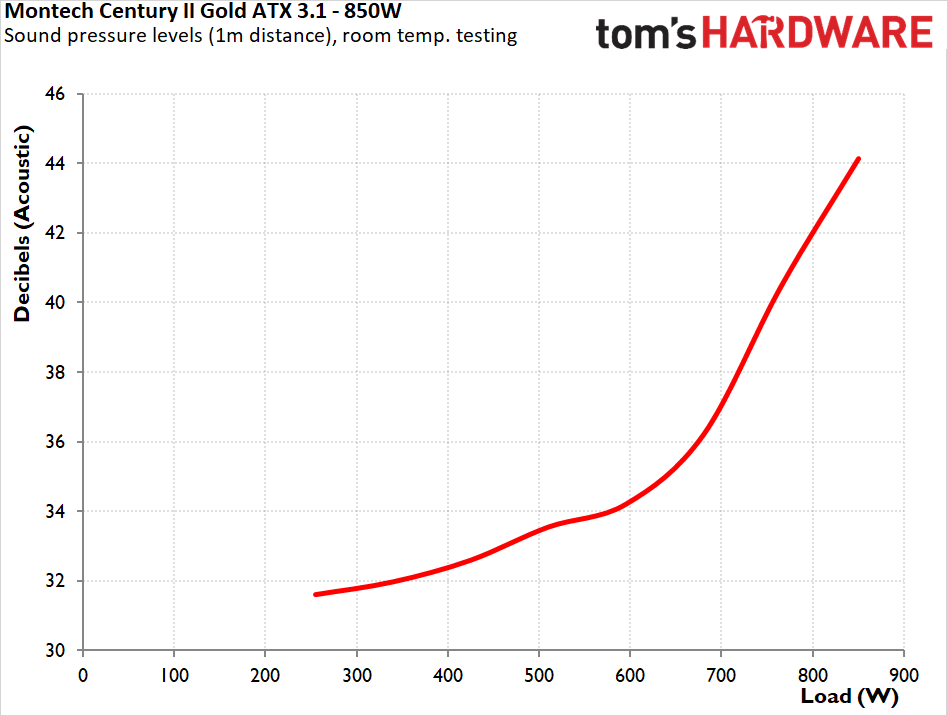
Fan behavior under cold conditions is adequately good. The smart fan mode keeps the rotor stationary at the lowest load points, and even after the fan begins spinning, the noise floor stays well under the threshold of audibility in a typical desktop environment. There is a ramp toward maximum output, but the fan does not approach anything resembling a high RPM during room-temperature testing. Internal temperatures climb predictably with load but remain well within the comfort zone of the components throughout.
Hot Test Results (~45°C Ambient)
Hot Test Results (~45°C Ambient)
Inside the hot box, the average efficiency at 115 VAC fell to 89.2%, while 230 VAC operation averaged 91.1%. The roughly 1.3-1.4 percentage-point degradation is not small but is in the expected range for a Gold-tier 850W design under sustained elevated ambient conditions. The unit shrugged off the thermal stress impressively, better than we thought it would after checking its parts.
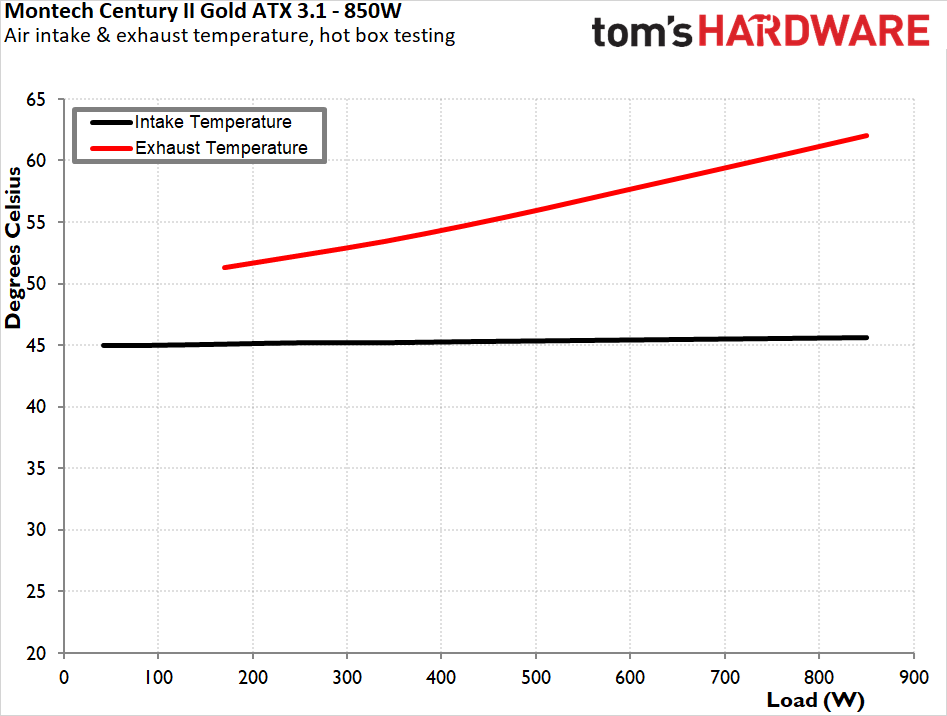
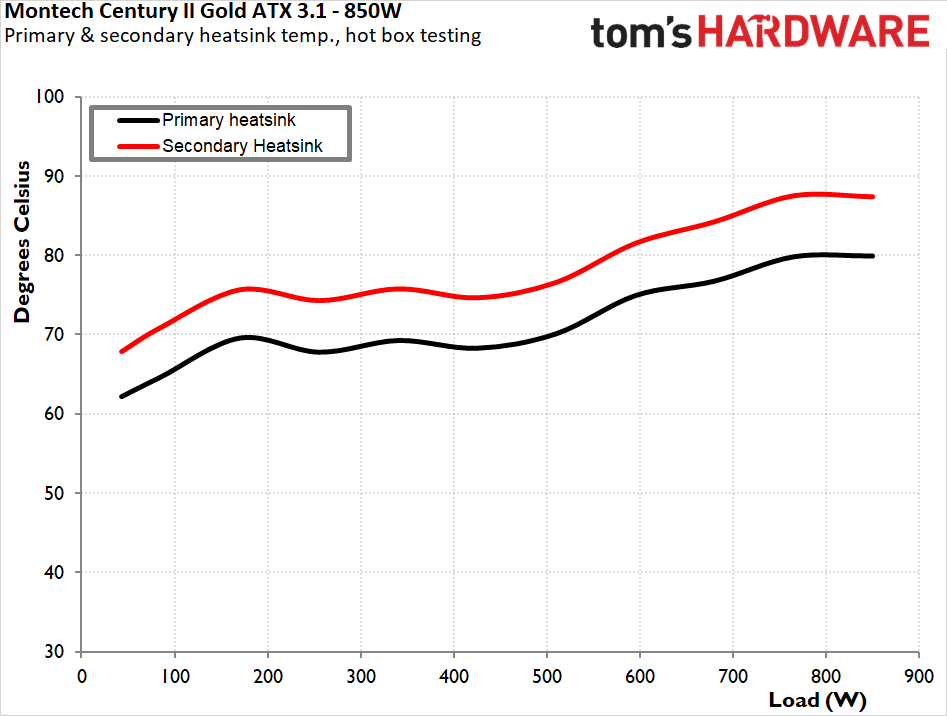
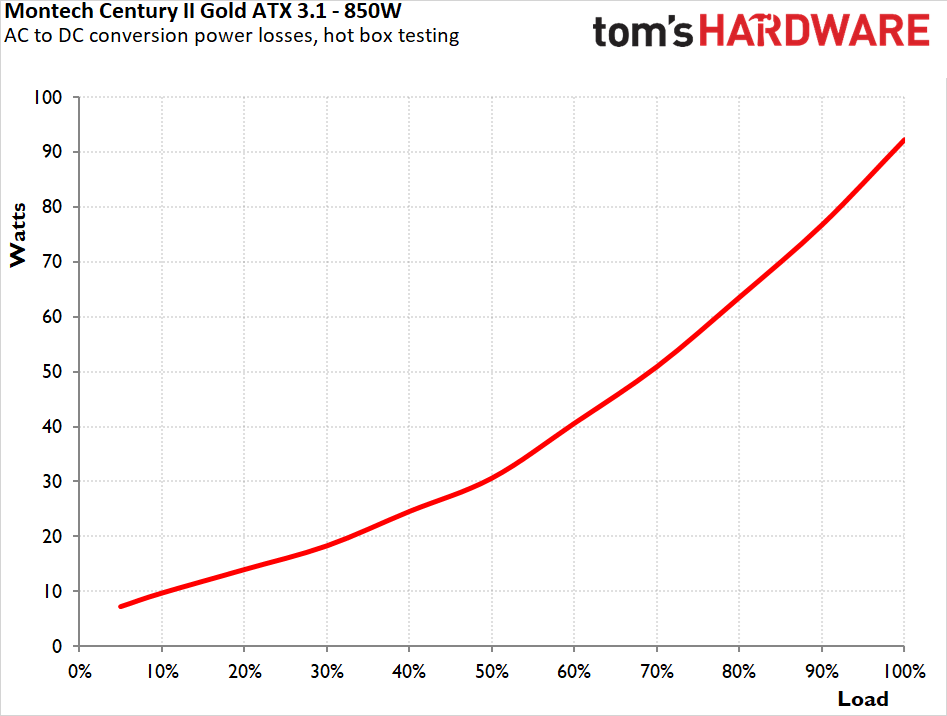
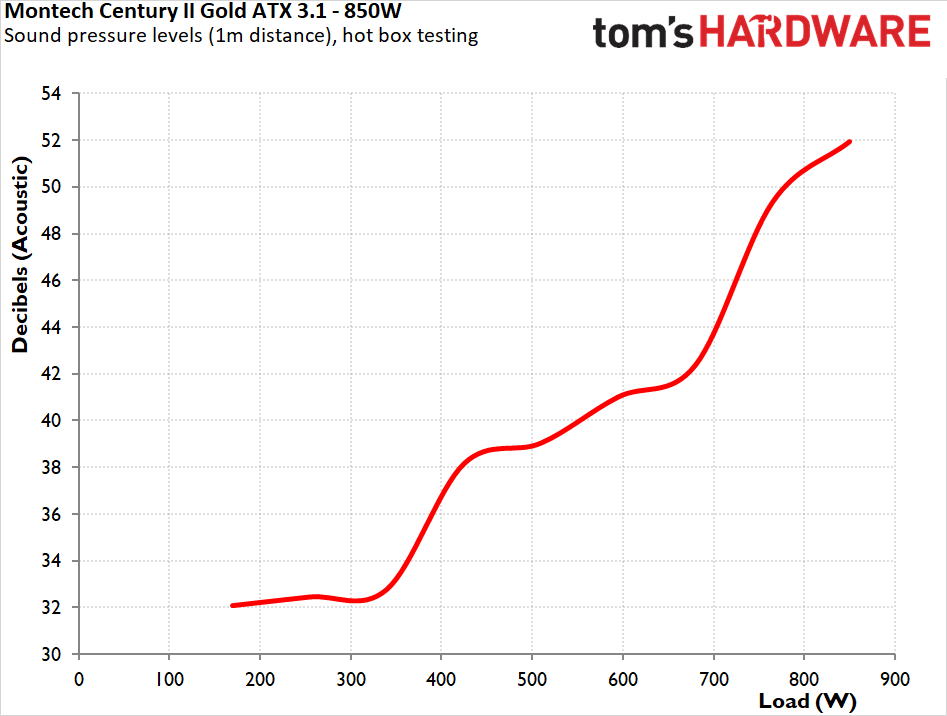
The fan ramp under hot conditions is, as expected, much steeper than under cold testing. The fanless operation threshold moves down, and the speed curve becomes more aggressive. The fan reached its maximum rated speed at maximum load. The heatsink temperatures we measured are fair, suggesting that the platform has a cooling margin but largely depends on its massive fan for cooling.
PSU Quality and Bottom Line
Power Supply Quality
Electrical performance is solid across the board. Voltage regulation sat at 0.4% on the 12V rail, 0.5% on the 5V rail, and 0.4% on the 3.3V rail across the 20-100% load range. Those numbers are well below the ATX specification recommendations and demonstrate that the unit is extremely well-tuned. They do not match the absolute best units we have tested, but they are firmly in exceptional territory for a Gold-class design.
Ripple suppression follows a similar pattern. At 100% load, the 12V rail peaked at 30 mV, the 5V at 24 mV, and the 3.3V at 22 mV. All of these figures sit well inside ATX limits (120 mV on 12V, 50 mV on the minor rails). They are not the cleanest numbers we have ever seen, but they are clean enough that system components will see a stable, quality power supply.
During our thorough assessment, we evaluate the essential protection features of every power supply unit we review, including Over Current Protection (OCP), Over Voltage Protection (OVP), Over Power Protection (OPP), and Short Circuit Protection (SCP).
All four protection mechanisms triggered correctly during our hot-box stress runs. OCP on the 3.3V and 5V rails sat at 154% and 150%, respectively, with the 12V triggering around 126% of its nominal rating. OPP triggered at approximately 124% of the 850W output during hot testing, which translates to roughly 1,050W of sustained delivery before the unit pulled the plug. That is a substantial cushion. The minor rails in particular carry far more headroom than the nameplate implies, and even the 12V rail tolerates well over its rated current before tripping.
|
Load (Watts) |
171.92 W |
429.38 W |
643.02 W |
855.86 W |
||||
|
Load (Percent) |
20.23% |
50.52% |
75.65% |
100.69% |
||||
|
Amperes |
Volts |
Amperes |
Volts |
Amperes |
Volts |
Amperes |
Volts |
|
|
3.3 V |
1.82 |
3.40 |
4.56 |
3.40 |
6.84 |
3.39 |
9.11 |
3.39 |
|
5 V |
1.82 |
5.09 |
4.56 |
5.09 |
6.84 |
5.07 |
9.11 |
5.06 |
|
12 V |
12.91 |
12.12 |
32.26 |
12.11 |
48.40 |
12.09 |
64.53 |
12.07 |
|
Line |
Regulation |
Voltage Ripple (mV) |
|||||
|
(20% to 100% load) |
20% Load |
50% Load |
75% Load |
100% Load |
CL1 |
CL2 |
|
|
3.3V |
0.4% |
14 |
16 |
20 |
22 |
16 |
22 |
|
5V |
0.5% |
16 |
16 |
22 |
24 |
16 |
22 |
|
12V |
0.4% |
12 |
20 |
26 |
30 |
28 |
20 |
Bottom Line
At its $90 pricing at the time of this review, the Century II 850W is one of the most aggressively priced ATX 3.1 units with a native 12V-2×6 connector and Cybenetics Platinum-equivalent efficiency on the market. Competition at that price point exists but is genuinely thin once you start filtering for fully modular, all-Japanese capacitor designs with a decade of warranty coverage. Especially at the $80 sale price that it reaches periodically, it becomes a borderline default recommendation for mid-range 5070-tier and 9070-tier builds.
The performance picture is a study in restraint. Voltage regulation and ripple suppression are not class-leading, but they surely are exceptional. Efficiency comfortably exceeds the Gold thresholds across almost all of the load range, easily granting the platform a Platinum certification badge when the average efficiency is the primary factor. Fan management is quiet, and the Smart Zero mode behaves the way the marketing claims.
Where the unit shows its budget positioning most clearly is in the platform and silicon. XWY is a less established OEM than Seasonic or CWT, much of the silicon comes from relatively unknown Chinese manufacturers, and TK secondary capacitors – while genuinely Japanese – are not Nippon Chemi-Con. None of these are problems per se but simply the cost-engineering decisions that make the $90 price possible. The 10-year warranty is the strongest signal that Montech itself expects the platform to age gracefully, and that warranty length is a meaningful feature, not marketing decoration.
Taken on its own terms, the Century II 850W ATX 3.1 unit is exactly the unit Montech intended to build: a no-nonsense, modern-spec, Gold-tier 850W power supply that does not try to compete with the premium tier on engineering pedigree, but does compete, and very effectively so, on overall value. It is the sort of PSU we expect to see in a lot of mainstream builds over the next few years, and there are worse fates than that for any product.
MORE: Best Power Supplies
MORE: How We Test Power Supplies
MORE: All Power Supply Content