
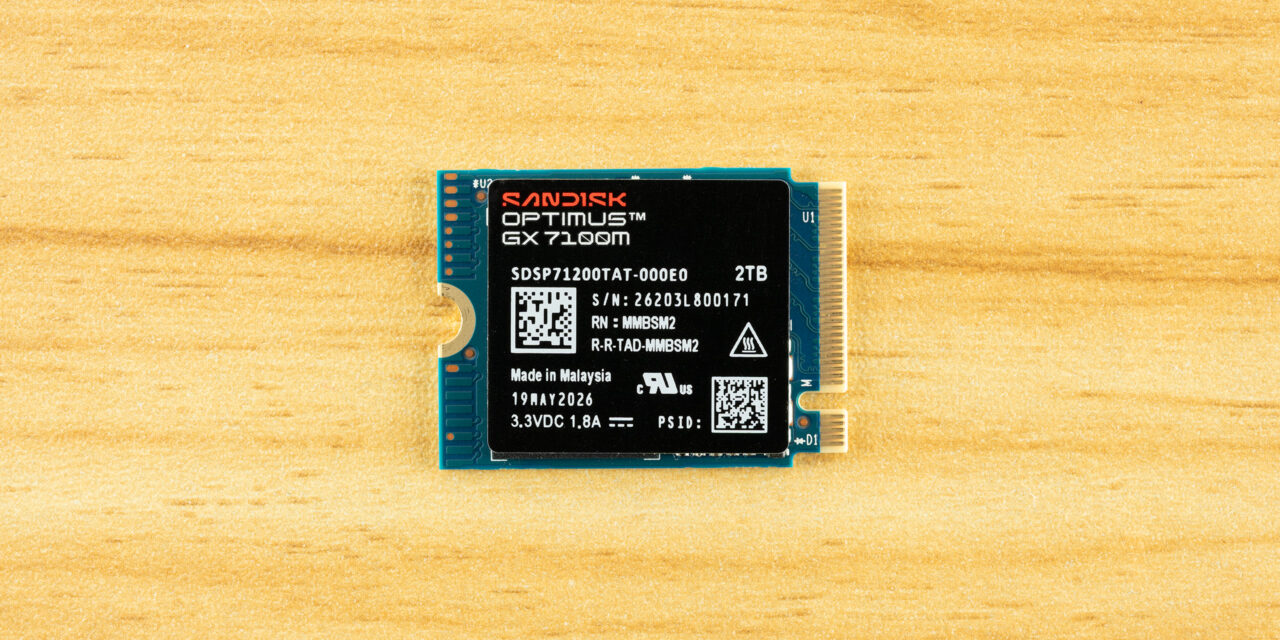
Sandisk Optimus GX 7100M 2TB SSD review: The best 2230 drive you can buy for the Steam Deck
Sandisk arrives running hot to the M.2 2230 SSD segment. A spiritual successor to the popular WD Black SN770M, the Optimus GX 7100M invokes memories of the laptop champion WD Black SN7100 with tested and true hardware. Does the class-leading responsiveness and power efficiency carry over to the smaller factor? Portable gaming system owners can rest easy knowing that it does.
We don’t want to confuse WD and Sandisk here, even if the hardware – and software, for that matter – is similar and often shared. Sandisk is making its own mark, and the Optimus GX 7100M, or 7100M for short, is proof of that. While there were few options available in the M.2 2230 form factor when the Steam Deck launched, there would soon be almost too many. Sandisk didn’t have to release this drive, but we’re glad it did, because it does fill an important hole in the lineup where alternatives have become harder to find.
This is a high-end Gen 4 drive, or as high-end as this segment gets. It’s still DRAM-less but can push the full bandwidth of the interface at both capacities. Where it shines is in its random read performance. That’s the key metric for responsiveness or real-world feel, and especially for game-focused hardware, it means the fastest loading times possible. Portable systems also need to use as little power as possible to reduce heat generation and prolong battery life. The 7100M’s pedigree is great there, too. And while 2TB was once hard to find in this form factor, because drives need to be single-sided with just one NAND flash package, the 7100M handles that and does it with faster TLC rather than lower-endurance QLC flash.
It’s a powerhouse of a product. The reason we say it fills a hole is that the alternatives are hard to find. The Crucial P310 still tends to be a great choice, but the parent company is moving away from the retail space due to AI and enterprise demand. The P310 is also QLC-based, which, while not a big deal anymore, does limit its performance in some cases and means reduced endurance. TLC-based alternatives with Phison’s E27T controller, like the Corsair MP600 Mini, are harder to find and don’t quite match that random read performance. SMI’s competing controller is more often used in budget products, where you can find it, like the Kingston NV3. The 7100M is left as the clear winner if you want the very best – especially if you like its strong software package – with no real drawbacks.
Sandisk Optimus GX 7100M Specifications
|
Product |
1TB |
2TB |
|---|---|---|
|
Pricing |
$229.99 |
$449.99 |
|
Form Factor |
M.2 2230 (Single-sided) |
M.2 2230 (Single-sided) |
|
Interface / Protocol |
PCIe 4.0 x4 / NVMe 2.0 |
PCIe 4.0 x4 / NVMe 2.0 |
|
Controller |
SanDisk Proprietary |
SanDisk Proprietary |
|
DRAM |
N/A (HMB) |
N/A (HMB) |
|
Memory |
Sandisk 218-Layer TLC (BiCS8) |
Sandisk 218-Layer TLC (BiCS8) |
|
Sequential Read |
7,250 MB/s |
7,250 MB/s |
|
Sequential Write |
6,900 MB/s |
6,900 MB/s |
|
Random Read |
1,000K |
1,000K |
|
Random Write |
1,300K |
1,300K |
|
Security |
TCG Pyrite 2.01 |
TCG Pyrite 2.01 |
|
Endurance (TBW) |
600TB |
1,200TB |
|
Power (R/W) |
3.5W / 3.8W |
3.7W / 4.0W |
|
Part Number |
SDSP71100TAT |
SDSP71200TAT |
|
Warranty |
5-Year |
5-Year |
M.2 2230 SSDs are generally limited to a small range of capacities, and the Sandisk Optimus GX 7100M is no different. Lower capacities don’t make sense for an upgrade when base models typically come with at least 512GB of storage. Larger capacities, 4TB or more, are difficult to achieve in such a small form factor. The 7100M only being available at 1TB and 2TB, therefore, makes sense. We will add that 4TB is possible with slightly longer M.2 2242 SSDs like the Corsair MP700 Micro and, also, 4TB for 2230 will be possible in the future. Furthermore, if devices were designed for double-sided drives, then all these limits would be effectively doubled. From the other side of things, rising memory and storage costs mean that base units might arrive with less storage, making smaller drives relevant again. It’s a push-pull situation.
At the time of review, the 1TB was going for $229.99 and the 2TB for $449.99. At 1TB, you could get the P310 for a little bit less, but otherwise, you will be giving up performance to save money. Considering the P310 is QLC-based, the 7100M isn’t too badly priced there. At 2TB, the price gap is more significant, as you can get slower alternatives for $50 to $150 less. Unfortunately, maximum performance at 2TB is the holy grail, so paying the premium could be worth it. Right now, it’s $50 or 12.5% over the last-generation WD Black SN770M, for instance, and on paper, that sounds reasonable for a drive that’s faster and more efficient.
Both capacities of the 7100M have the same peak performance level: up to 7,250 / 6,900 MB/s for sequential reads and writes and up to 1,000K / 1,300K random read and write IOPS. Both sets of numbers are excellent for a drive in this form factor, and the drive even exceeds what the Phison E27T-based Corsair MP600 Mini can achieve. This is top-tier performance for this segment and a full notch above the WD Black SN770M and effectively matches the 7100M’s forebear, the WD Black SN7100. While the Black SN7100 did not particularly stand out for us with its performance, its power efficiency is fantastic. That bodes well for the 7100M.
SanDisk has the drive pulling 4W or less under typical workloads, which puts the drive into a good spot for mobile devices. We test with a mixed workload, which can push a drive a little bit harder than this. Either way, this isn’t a lot of power for a full-fledged Gen 4 device – the drive’s 7,250 MB/s is near the limits of the interface – so we can expect good power efficiency.
Sandisk backs the drive with the standard 5-year, 600TB of writes per TB warranty. The drive supports the TCG Pyrite 2.01 specification and only has software encryption. This is perfectly normal for a drive of this type. The TBW is, however, higher with TLC versus QLC flash.
Sandisk Optimus GX 7100M Software and Accessories
Sandisk has you covered with its software. The Sandisk Desktop App, which works on Windows and macOS, is useful for general file transfer and password protection – software encryption, as well. The Sandisk Dashboard is Sandisk’s take on WD’s Dashboard, an SSD toolbox application with a wide range of features. An SSD toolbox like this gives you information on your system and drives, including SMART and health information. It lets you test and benchmark the drive. Importantly, this software also helps you update the firmware, if necessary, and use other features such as Game Mode. Sandisk also offers an Acronis True Image download, which is great for backing up files and your OS or for cloning drives.
Sandisk Optimus GX 7100M: A Closer Look
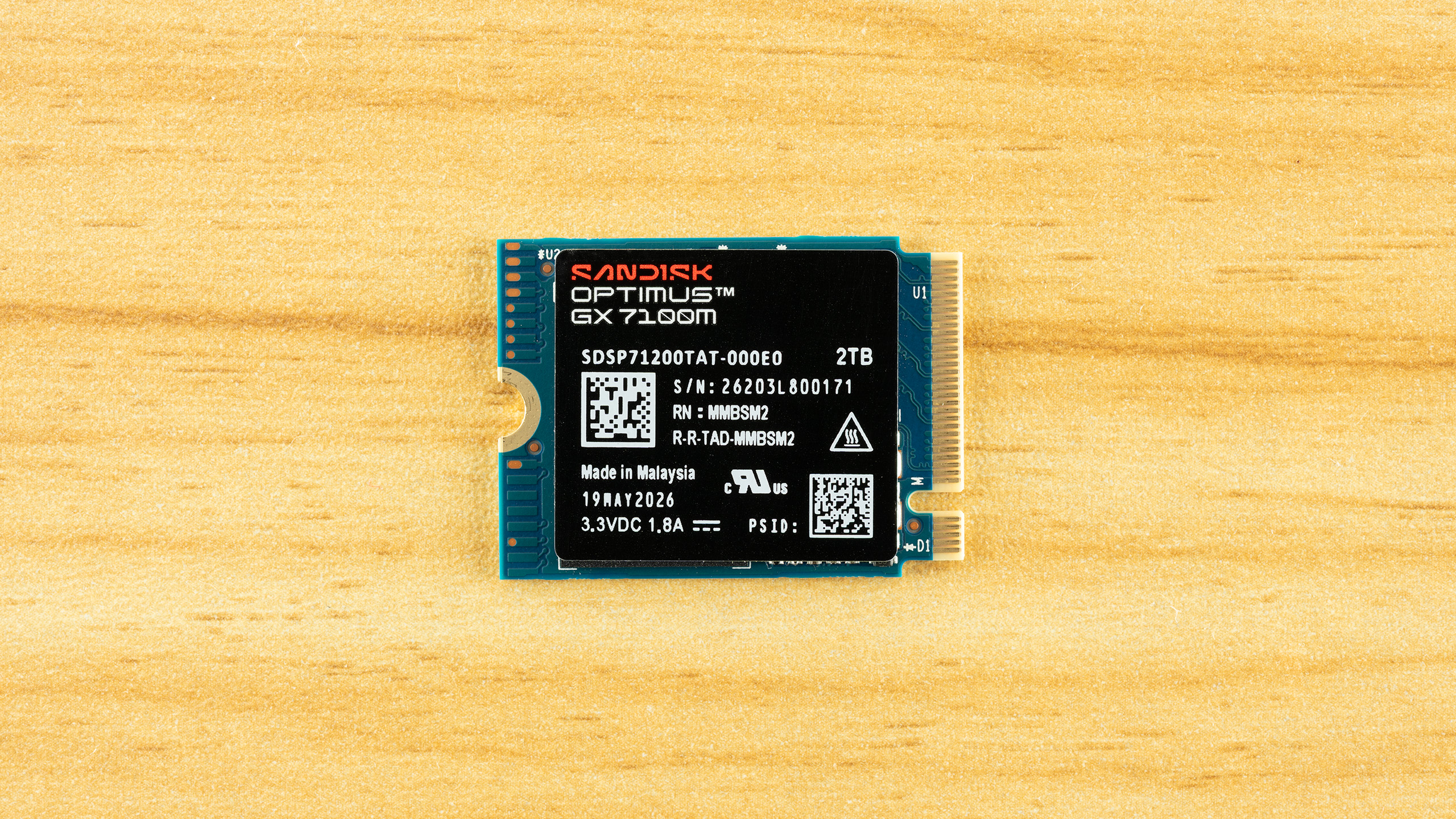
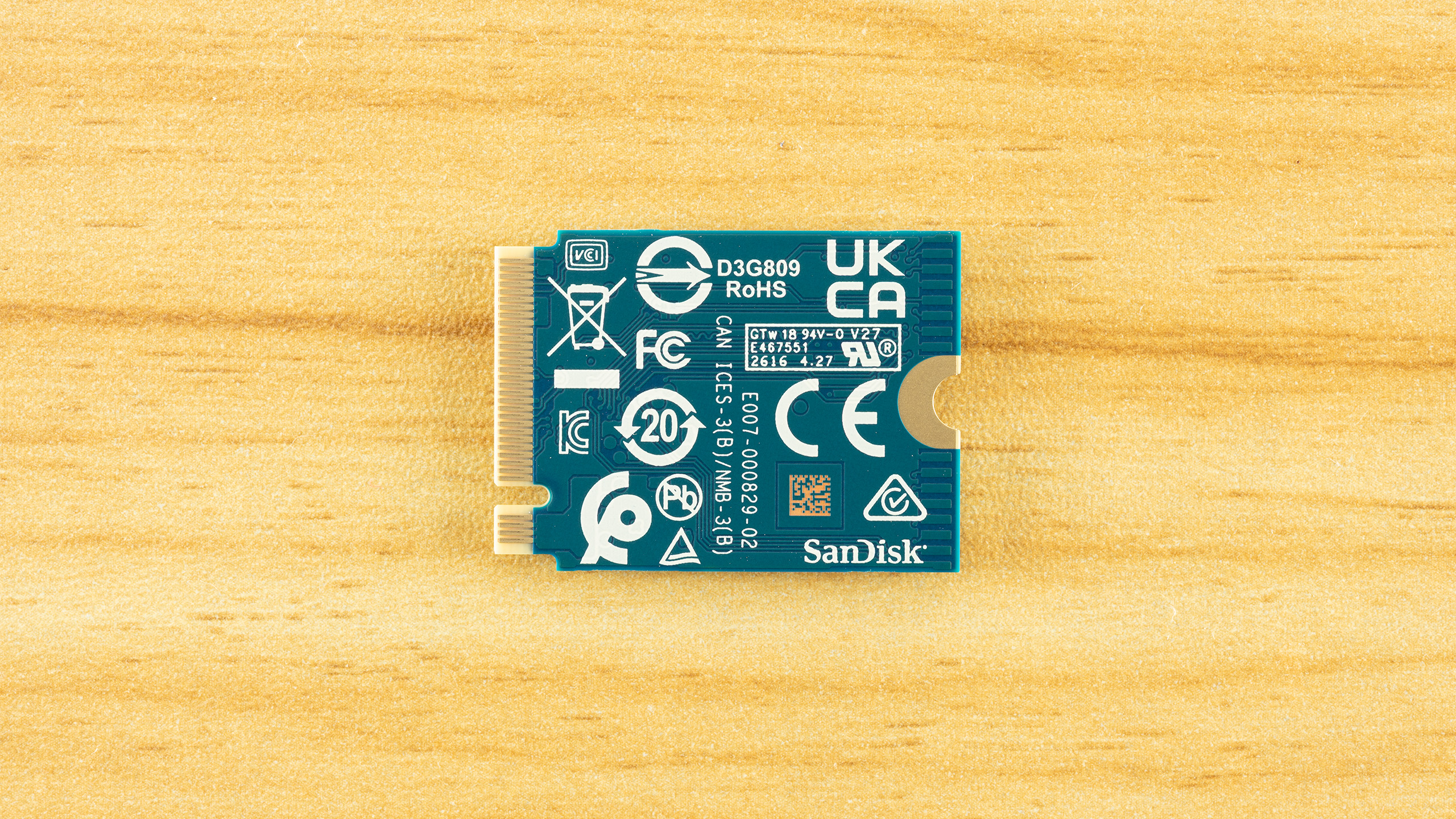
The 2TB Optimus GX 7100M is a single-sided drive, optimized for device compatibility. This does limit it to a single NAND flash package, which puts a cap at 2TB. This is because the most common dies widely available are 1Tb, or 128GB, apiece, and typically a single package – which has to stack the dies on top of each other, might have dummy dies for stability, and has to carefully maintain signal quality without exceeding height limitations – can only hit sixteen dies.
According to the specification sheet, this drive uses the M.2 2230-S3-M form factor. The M.2 format is easily recognizable as the way consumer SSDs are made these days, in contrast to the old 2.5” SATA drives. Other form factors meet the needs of the enterprise. 2230 tells us the length and width in millimeters. This is a common size for portable devices like the Steam Deck, the Asus ROG Ally, and the Lenovo Legion Go. The “M” part means it’s M-key, which we expect these days as NVMe drives using a full four lanes are common. Some drives can drop back to two lanes, like the Samsung 990 EVO and Samsung 990 EVO Plus, but are still capable of using four.
The “S3” is the part we’re looking for here, which tells us it’s single-sided rather than double-sided with a “D.” The number tells us the permitted height of the components. S1 allows for 1.2mm, S2 1.35mm, and S3 1.5mm. We would expect this drive to be S3 since it needs to pack in sixteen dies. The nominal PCB thickness for M.2 is 0.8mm, so this puts the drive at ~2.3mm, and the datasheet lists 2.38mm. This isn’t too interesting on its own, but it could be useful if you know the exact limitations of your device or need to make other measurements, such as for custom cooling. Some devices can take double-sided devices, which, as you can imagine, have similar height thresholds but with components on both sides.
One other interesting thing is the rated power: 3.3V at 1.8A puts the peak power around 6W. This is well higher than the specification sheet, which, again, is for average and also with read and write separately rather than mixed, as well as what’s listed by SMART and in our testing. We reckon this drive will always be below 5W, which normally would ensure there won’t be any heat issues. For M.2 2280, that’s broadly true, but heat is always an issue for 2230.
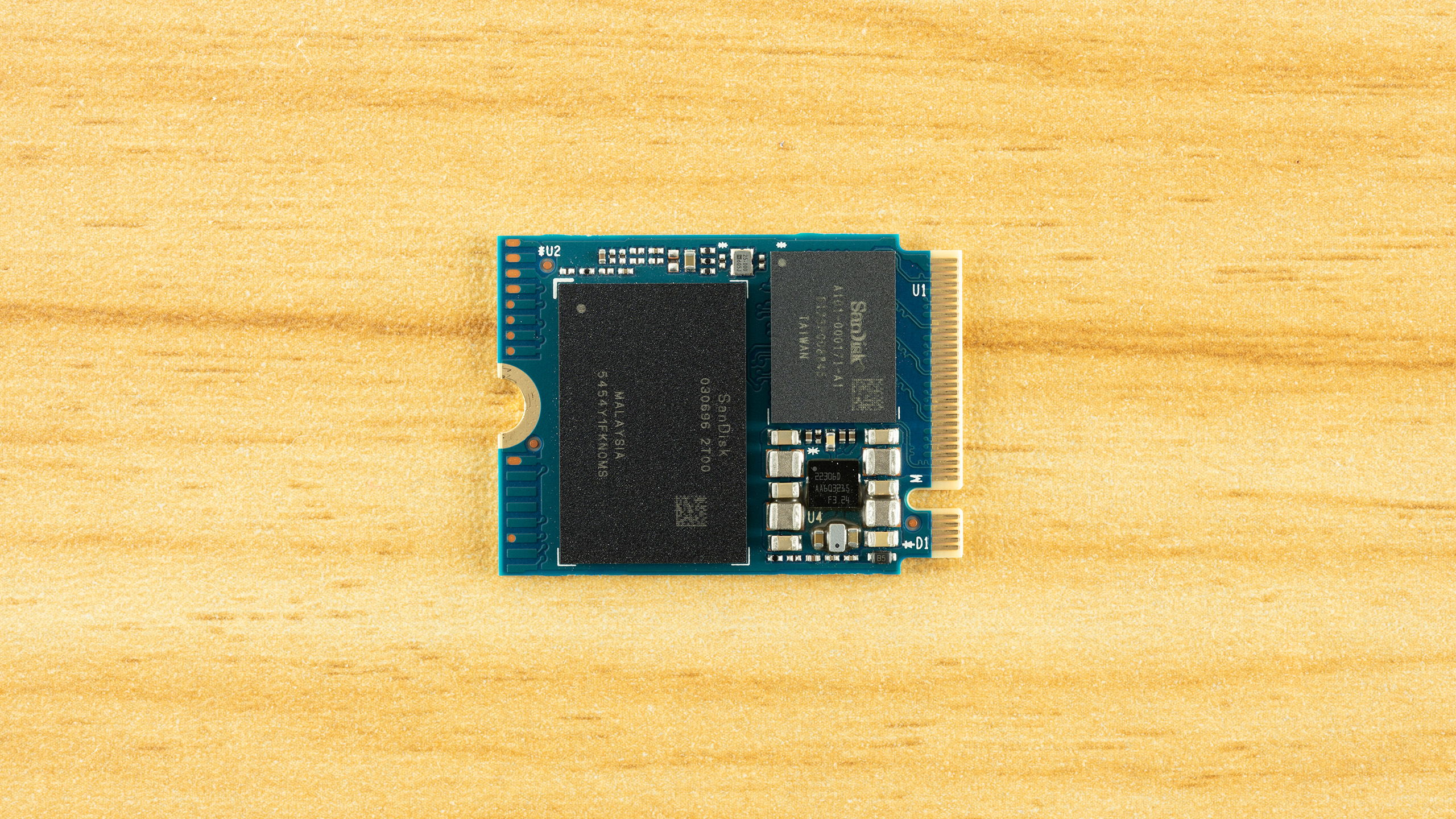
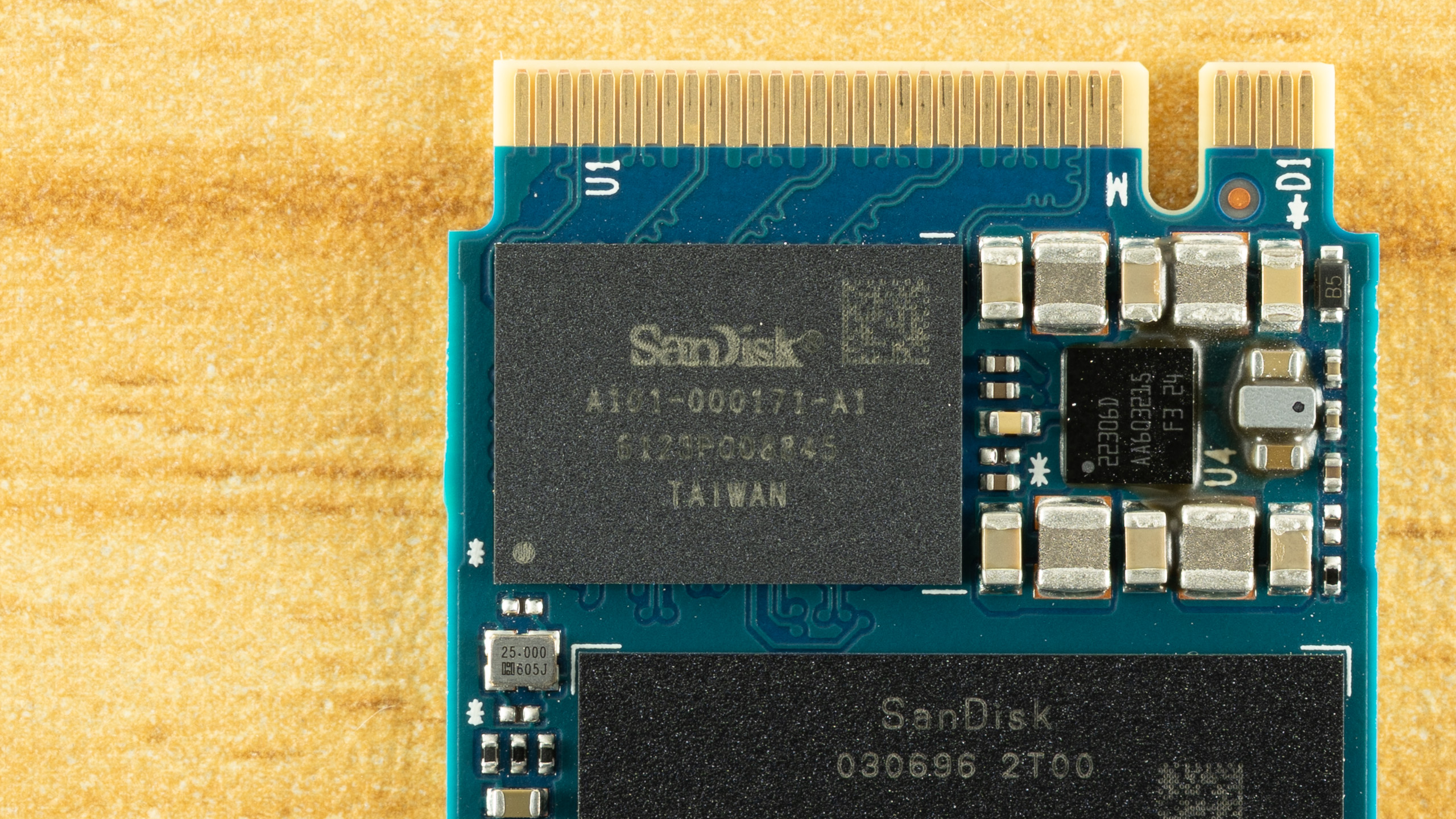
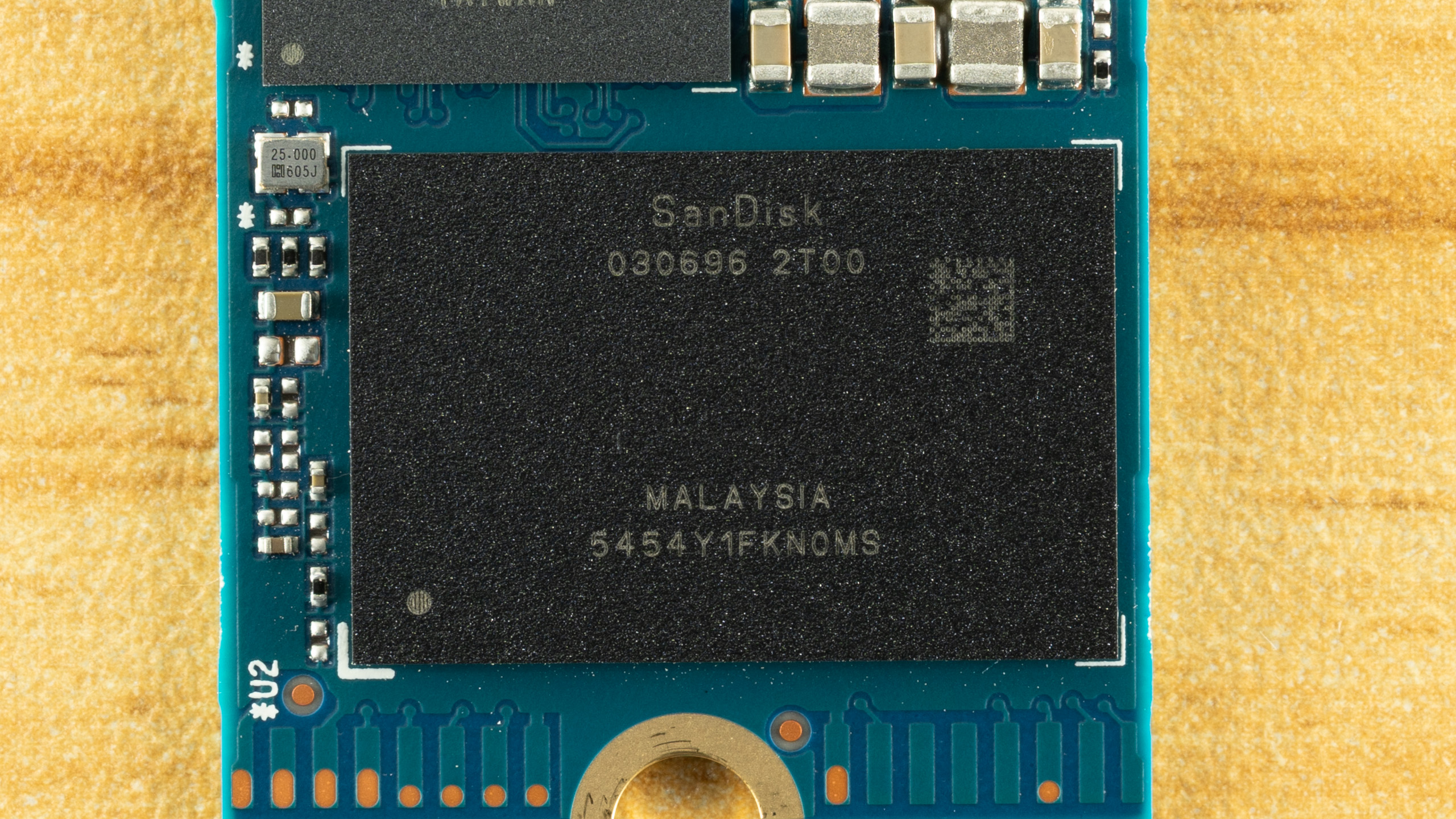
In addition to the sole NAND flash package, the drive also has a DRAM-less SSD controller and power management circuitry. The controller is proprietary Sandisk technology, listed as the A101-000171-A1. Similar to the WD Black SN7100’s A101-000172-A1, which is a four-channel controller that can take fast enough flash to saturate PCIe 4.0. We would expect the drives to share the same flash, too, which would be Sandisk’s 218-Layer TLC. BiCS8 flash, whether TLC or QLC, has proven to have fantastic random read latency and also excellent power efficiency. This makes it great for the M.2 2230 segment.
The 7100M is still DRAM-less, as it can be difficult to make a DRAM package work in this form factor. In the past, it was not uncommon to see DRAM at least in M.2 2242, but modern host memory buffer (HMB) solutions are quite good. A quick look at the random 4KB results for this drive will dispel any illusions that you need DRAM to make a drive feel fast. In fact, it’s very unlikely DRAM would ever make a difference in the type of device this drive is made for, although there are always exceptions. Yes, there are some odd drives that have DRAM as part of the controller package – SK hynix’s BC711 comes to mind –, but these are rare and relegated to the Gen 3 era. An OEM Gen 3 drive is perfectly enough for a Steam Deck, but we’re in the business of gauging modern retail options.
The older Black SN770M, which is a retail version of the OEM SN740 – an extremely popular drive when the Steam Deck was still young – and a shortened version of the Black SN770, struggled with power efficiency. At least, in comparison to some of the newer 2230 drives on the block. With that problem out of the way, thanks to more efficient flash, the 7100M might very well be the best drive of its type available. We certainly think so, but knowing the pedigree of the hardware can help explain why this is.
MORE: Best SSDs
MORE: Best External SSDs
MORE: Best SSD for the Steam Deck
Comparison Products
The Sandisk Optimus GX 7100M is slated to be the top for M.2 2230 SSDs, so we are putting it up against our best drives. These include the Crucial P310, which, despite being QLC-based, is the fastest all-around 2230 drive up to this point, and the Corsair MP600 Mini with the Phison E27T. The Phison E27T controller, when paired with TLC flash, as is the case with the Corsair drive, is about as fast as you can get, but more importantly, it has the advantages of TLC. This means more consistent performance and better endurance. The Optimus GX 7100M, also with TLC flash, is therefore the ultimate challenger.
For other hardware, we have the Kingston NV3 that uses a comparable SMI controller. We have an SMI controller in the Lexar Play, too, although at a lower speed. The 7100M’s predecessor, the WD Black SN770M, is also in play. This drive and its OEM counterpart became popular picks after the Steam Deck came out, offering, at the time, the best performance possible at the cost of higher power consumption. Alternatives here generally use the Phison E21T controller with various TLC and QLC flash choices. These include the Silicon Power UD90, the Sabrent Rocket Q4, and the Teamgroup MP44S.
Trace Testing — 3DMark Storage Benchmark
Built for gamers, 3DMark’s Storage Benchmark focuses on real-world gaming performance. Each round in this benchmark stresses storage based on gaming activities, including loading games, saving progress, installing game files, and recording gameplay video streams. Future gaming benchmarks will be DirectStorage-inclusive, and an evaluation for future-proofing is included where applicable.
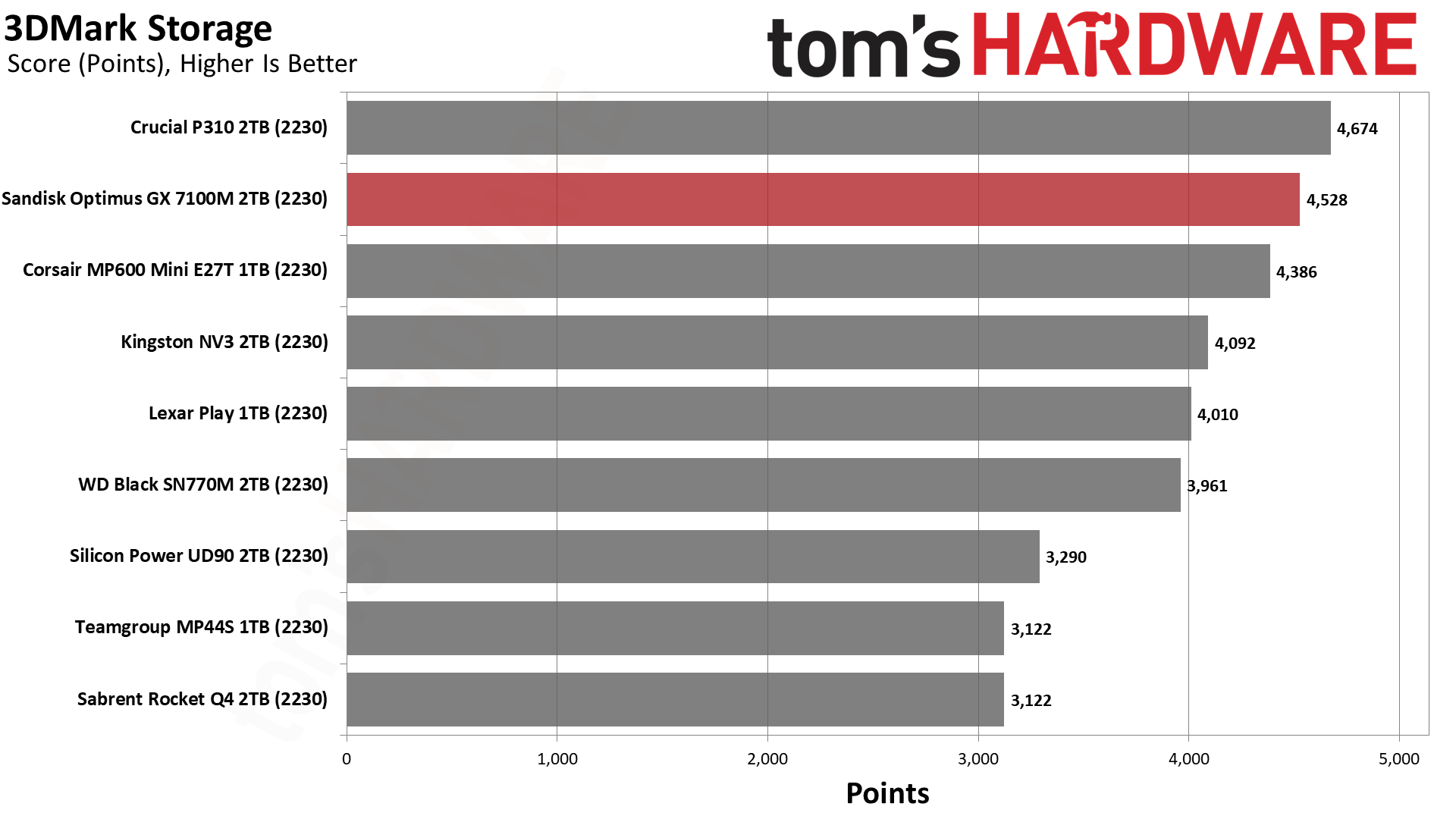
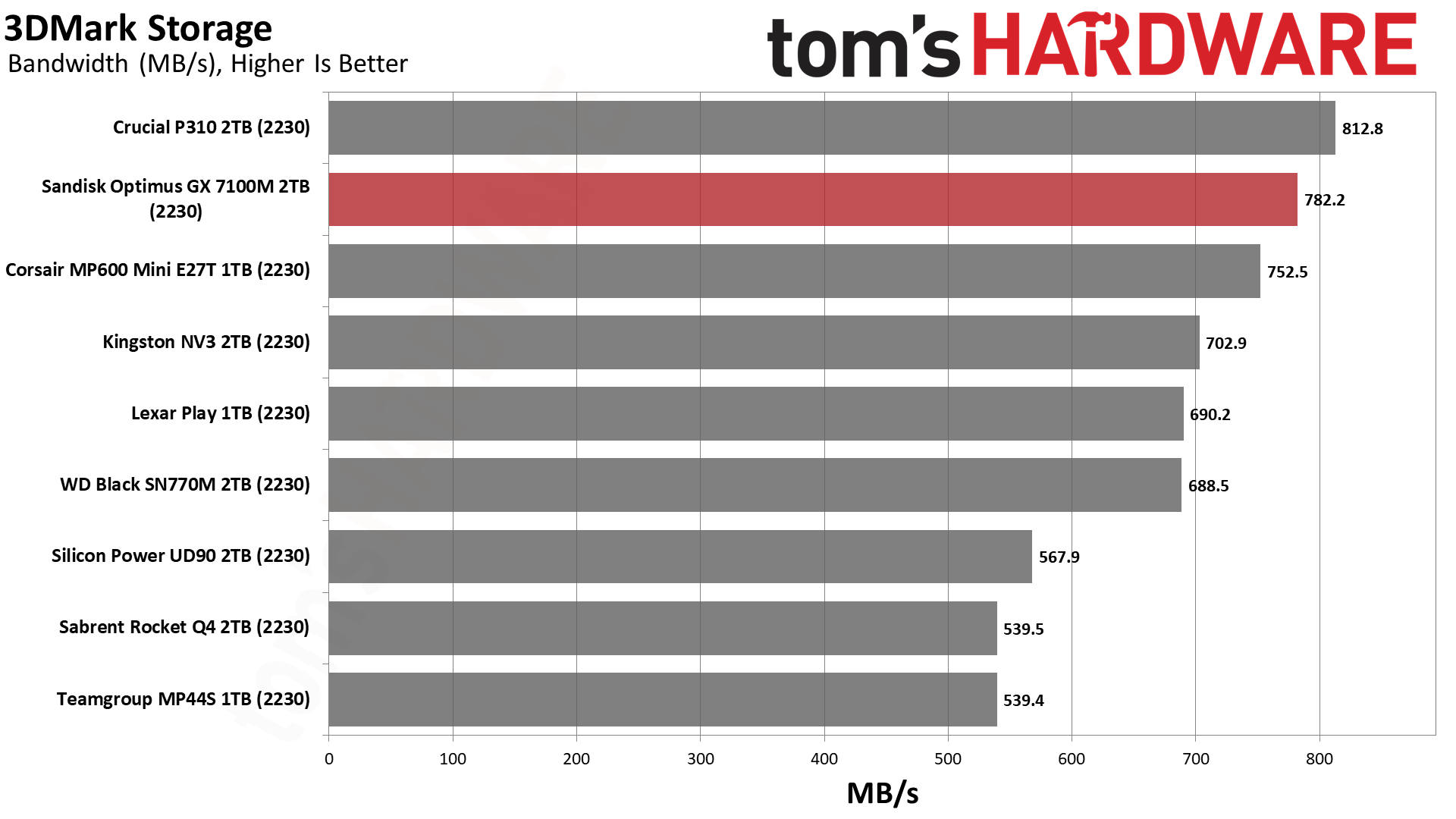
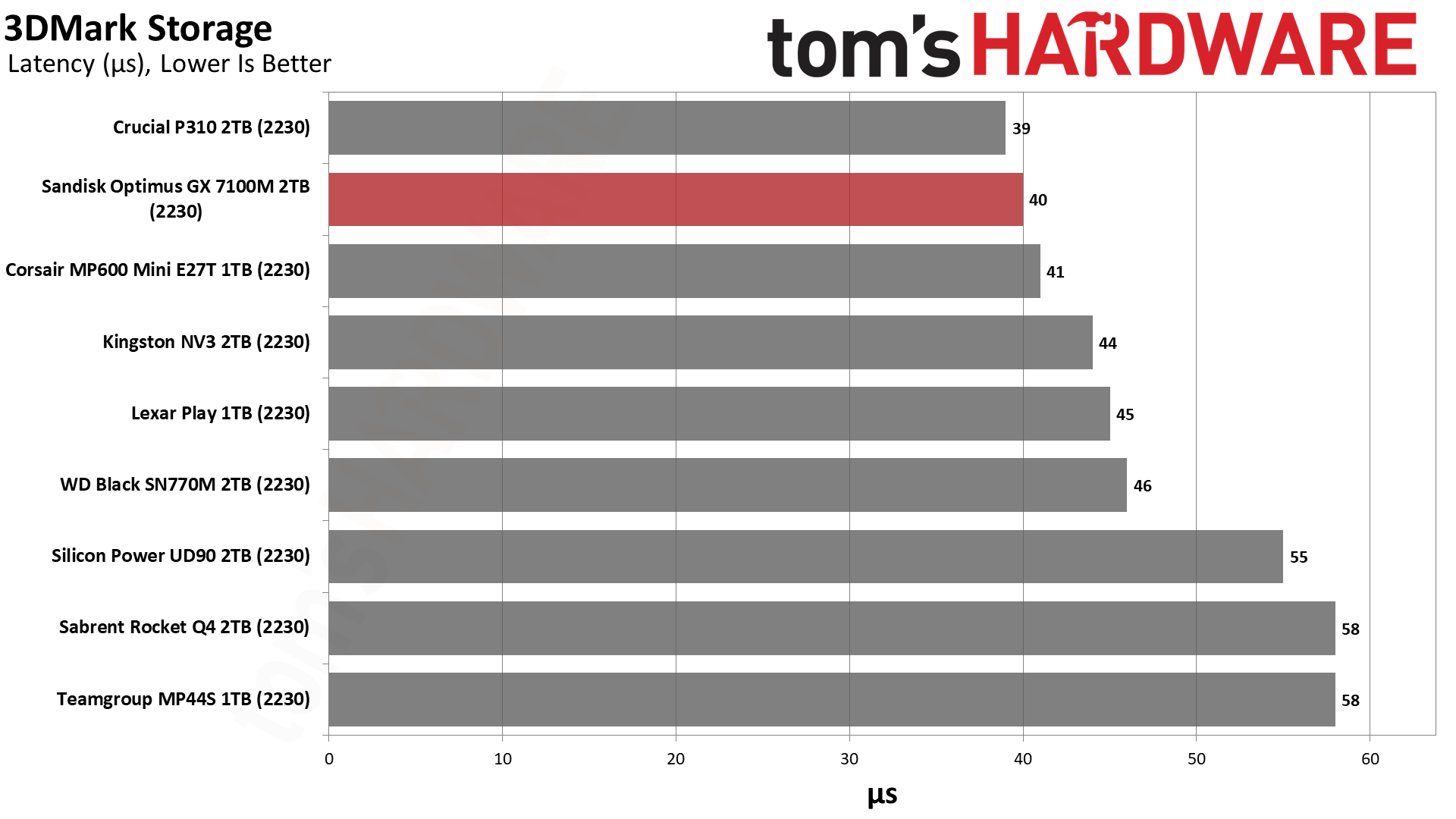
If you’re buying an M.2 2230 SSD, you’re probably buying it for gaming. Yes, there are productivity machines with small form factor SSDs, and you could buy this drive and use it with an extender for a random system, but gaming is the one place it has to do well. Frankly, we’re impressed with how well the 7100M does here. It’s second only to the P310 and is first among TLC-based drives. Beating the TLC-equipped, E27T-based MP600 Mini is an accomplishment. This drive will be very responsive for gaming, and we’d even put it above the P310 for that, in fact. This is because the P310 is using QLC flash – with a fuller drive, with a lifetime of transfers and wear, it should suffer more, meaning you’d pick the 7100M for peace of mind. At the very least, it’s a deciding point if the prices are close.
As a side note, this drive is supported by the Sandisk Dashboard and, as such, has the Game Mode feature. This mode works by disabling the drive’s idle power states, improving responsiveness. This can slightly improve game loading times. The Dashboard is designed for Windows.
Trace Testing — PCMark 10 Storage Benchmark
PCMark 10 is an industry standard trace-based benchmark that uses a wide-ranging set of real-world traces from popular applications and everyday tasks to measure the performance of storage devices. The results are particularly useful when analyzing drives for their use as primary/boot storage devices and in work environments.
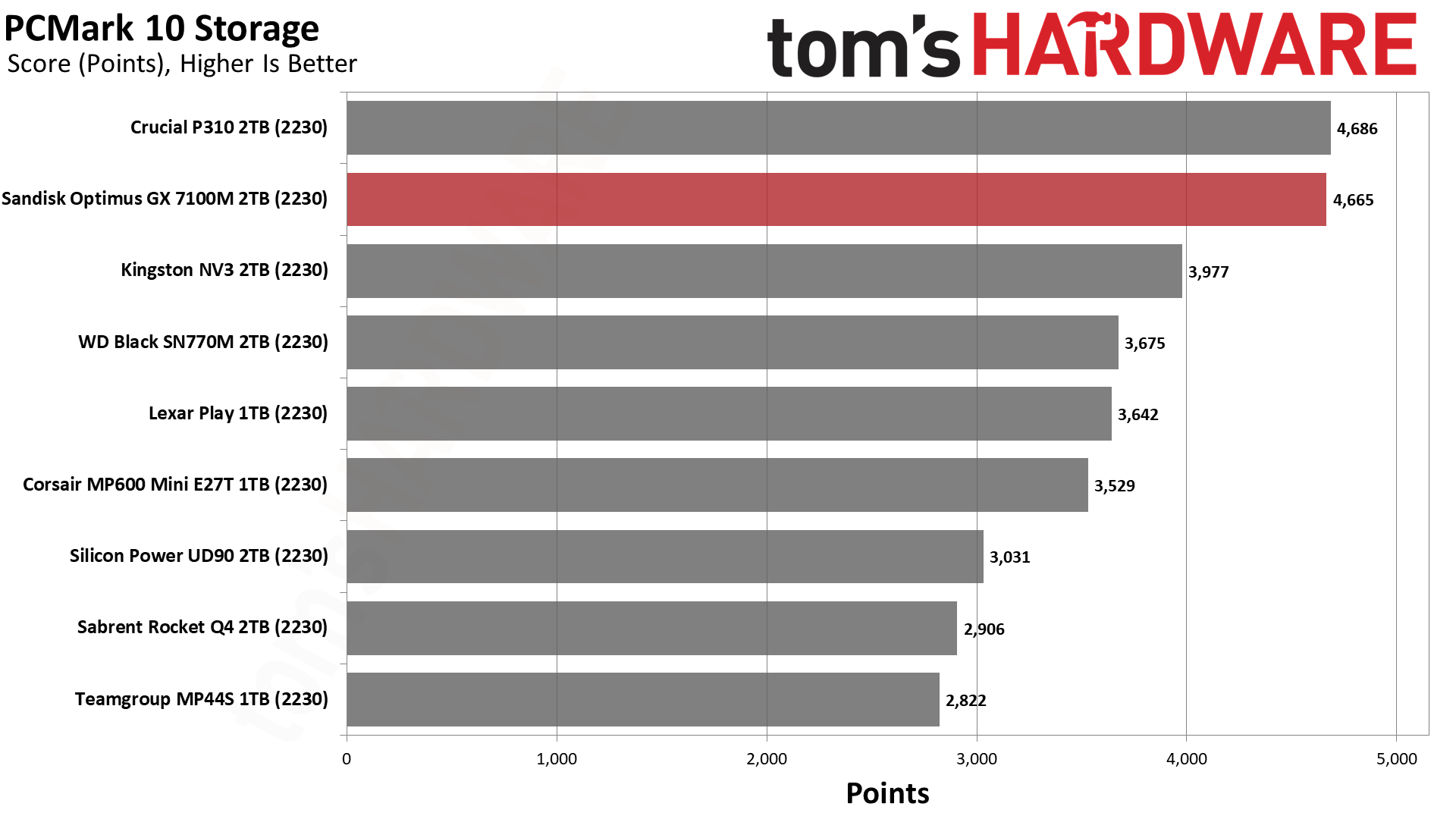
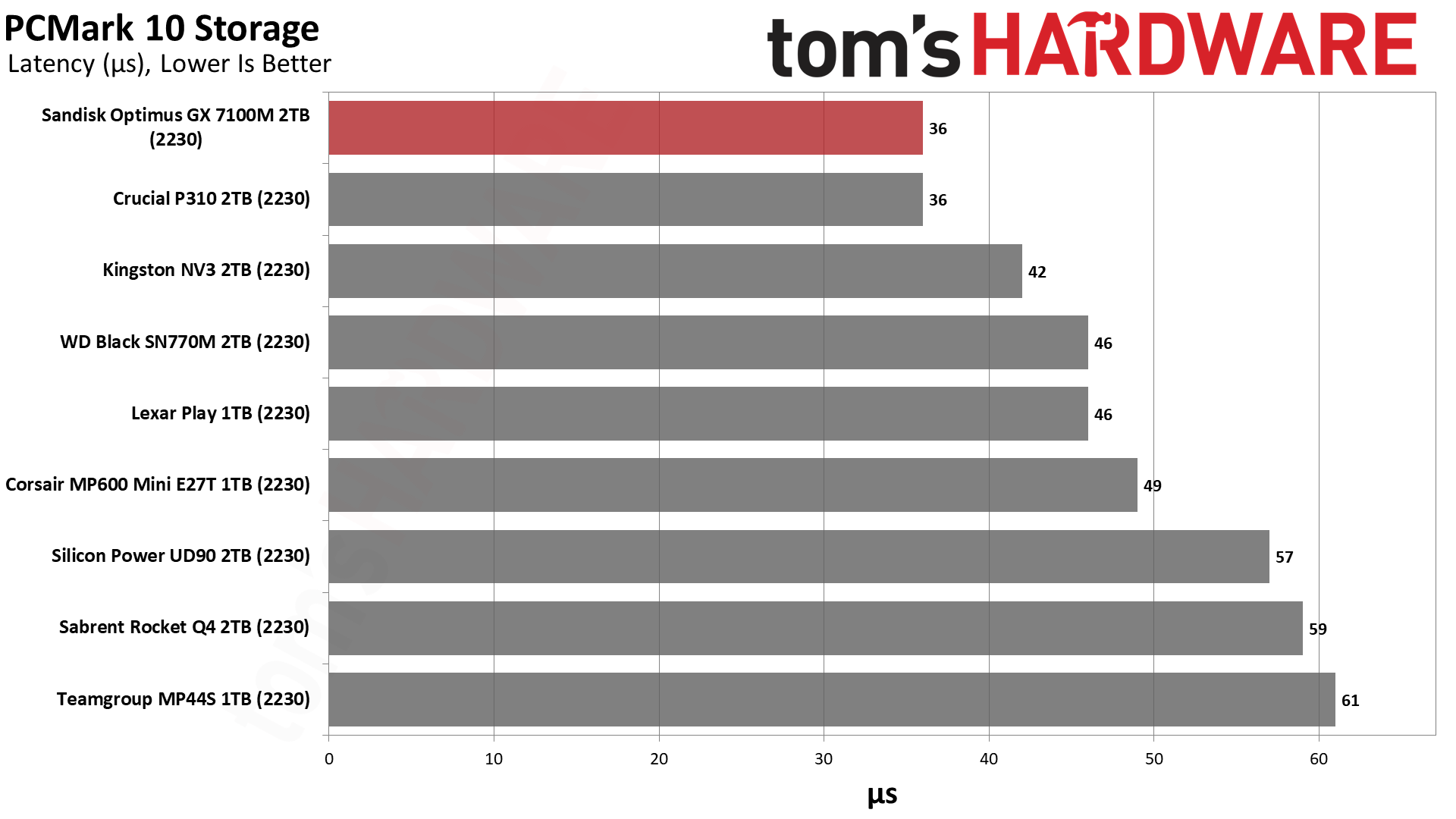
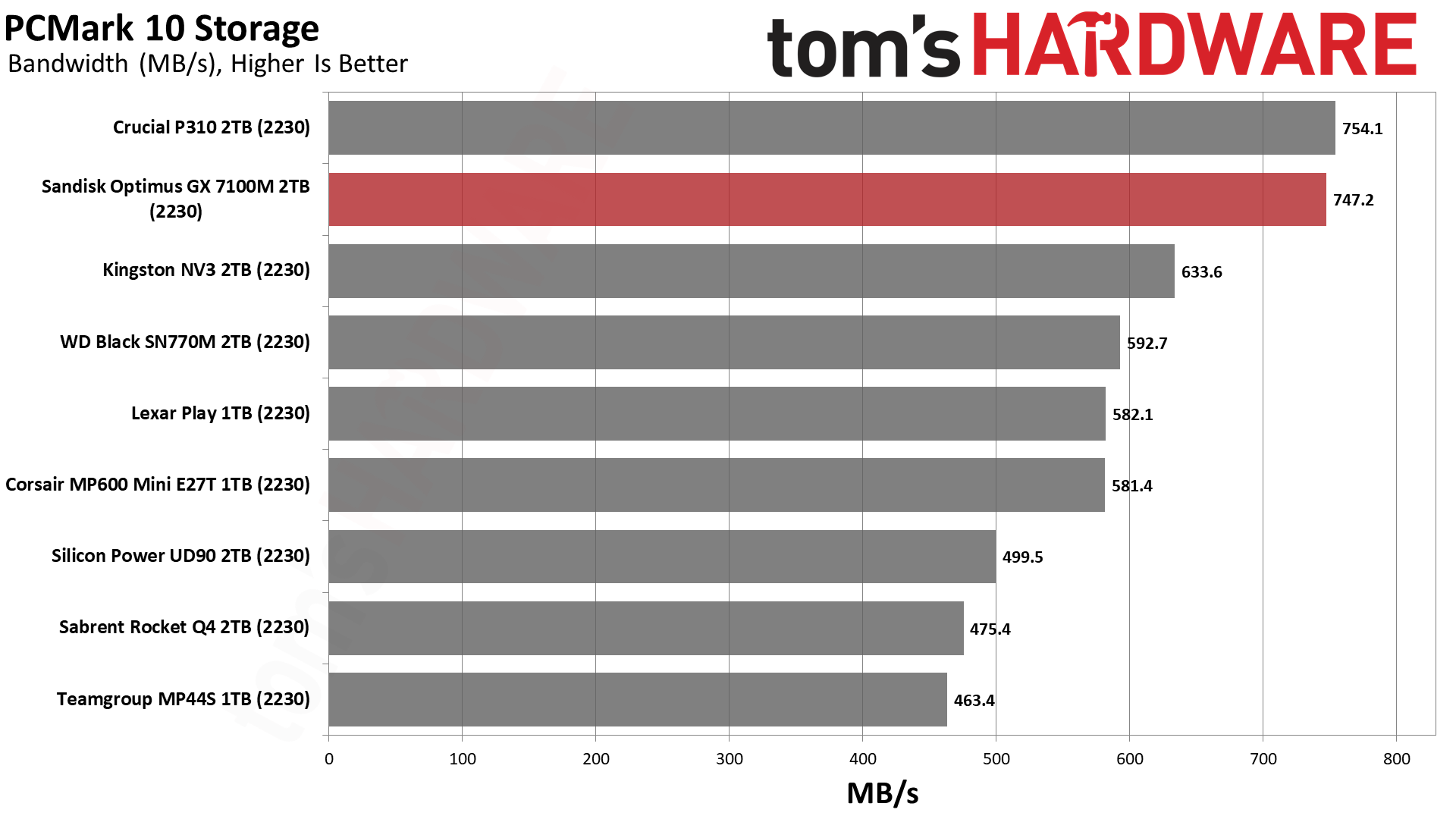
The 7100M proves to be great at productivity, too, more or less tied for first in PCMark 10 with the P310. Our QLC caveat applies again: all else being equal, you’d probably pick the TLC 7100M over the P310. We want to emphasize that there are many good DRAM-less drives that can get near this performance level, but you don’t see that hardware in this form factor. For example, we don’t see the Maxio MAP1602 controller here, for a variety of reasons. That controller does tend to run hot, for one thing, and that’s always a looming concern for this form factor. We also don’t see much from SMI, and when we do, it’s usually for budget drives. This reduces the amount of direct resistance to the 7100M.
Phison exists, but the E21T and controllers of that class were and remain much more present in this form factor. That’s partly because the M.2 2230 form factor took off around the same time that such drive technology came out, and now we have a very uncomfortable memory market. Also, the Steam Deck is PCIe 3.0, so you only need so much performance for the most popular destination device. Even with 4.0 devices, a 5 GB/s drive is plenty of performance for a portable system. That means that a drive like the 7100M has less direct competition than you might expect if we’re talking about performance. It’s nearly peerless, in fact. If that’s what you want, then this drive should be at the very top of your list.
Steam Deck Testing — Gaming, KDiskMark, and Temperature
The Steam Deck is not the only portable gaming system in town, but it was the first and most popular to take M.2 2230 SSDs. While some systems have moved on to fit 2280-length drives, 2230 remains popular for many systems, and such drives will work fine in longer slots with the proper standoff or extender. The Deck operates in PCIe 3.0 mode for its SSD, limiting maximum bandwidth, but that has less of an impact on responsiveness/latency, and the Deck is still useful for gauging drive temperature and power efficiency.
Our current testing for the Deck involves analyzing game load times for some popular games. This is probably the most important metric for gamers, but the difference between one SSD and another can be small. We also use KDiskMark, a CrystalDiskMark-like substitute that uses the flexible I/O (FIO) tester instead of diskspd for its underlying benchmarks. We also check the drive’s maximum temperature during this test.
The tests in this section are run under the stock Arch-based SteamOS Linux platform, but our other tests are conducted as per our normal reviews, using Windows. Many portable gaming systems today use or can use Windows with multi-boot as an option. This testing section is instead designed to give an idea of Linux performance, which does involve the use of Proton.
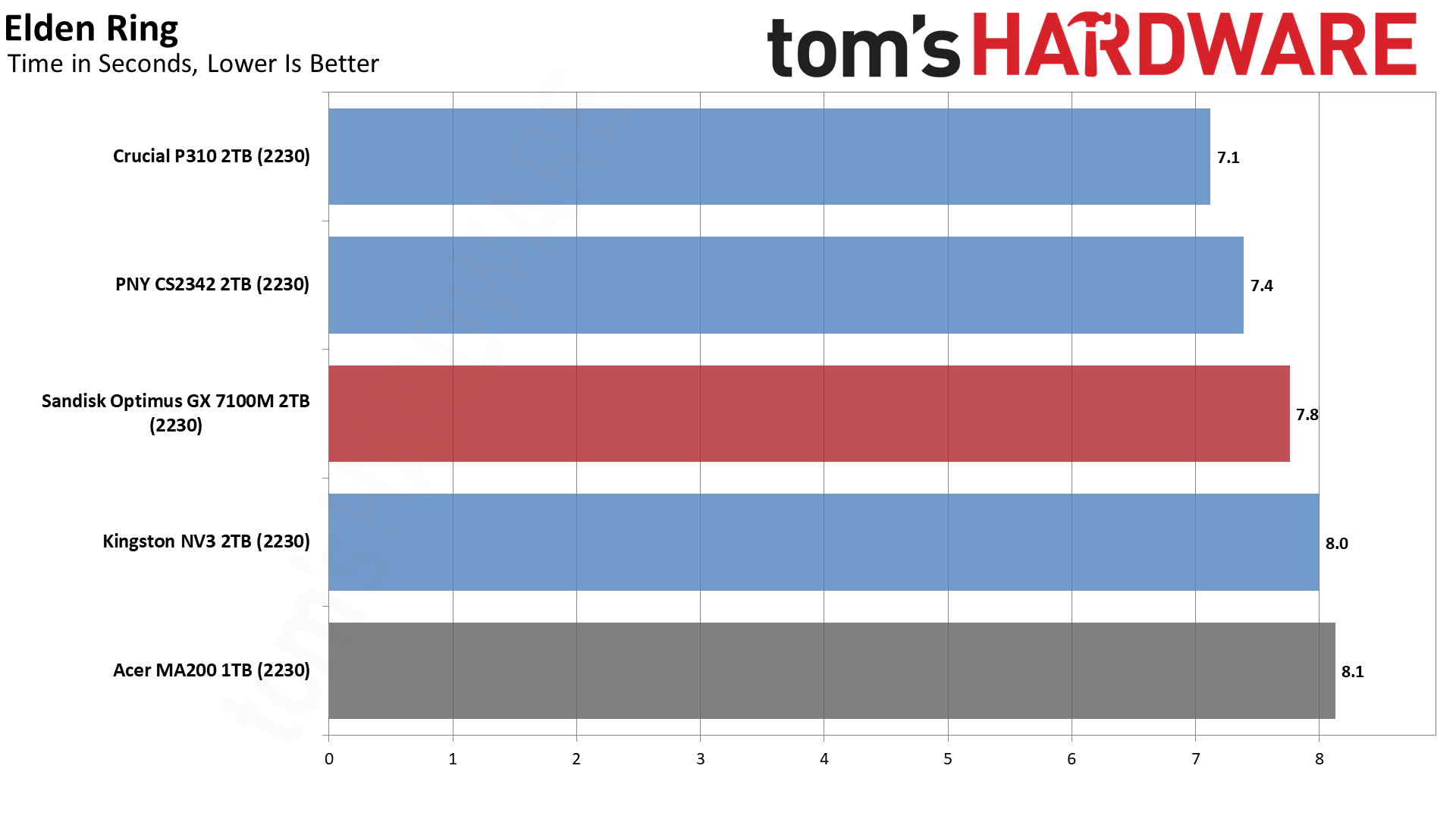
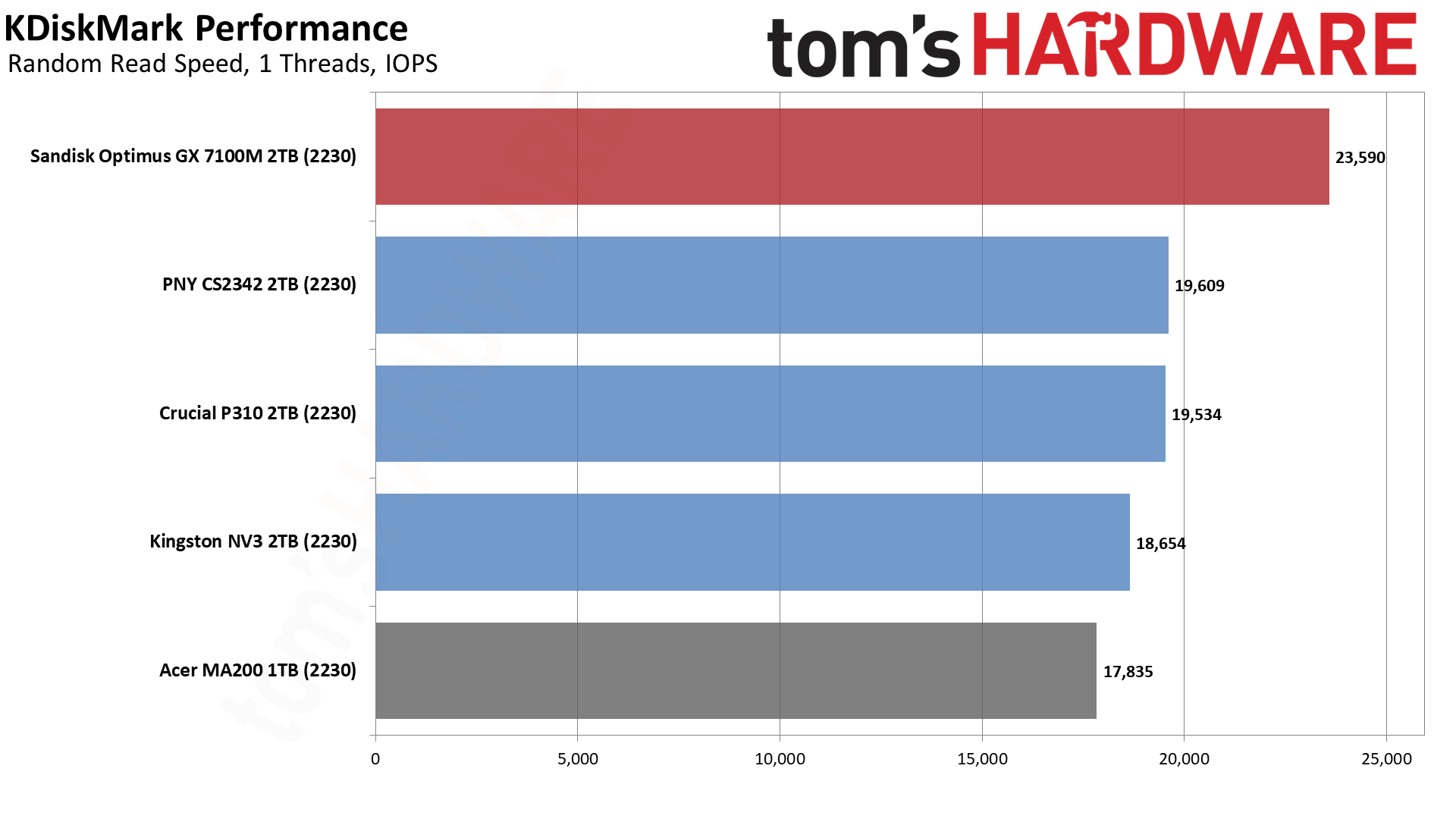
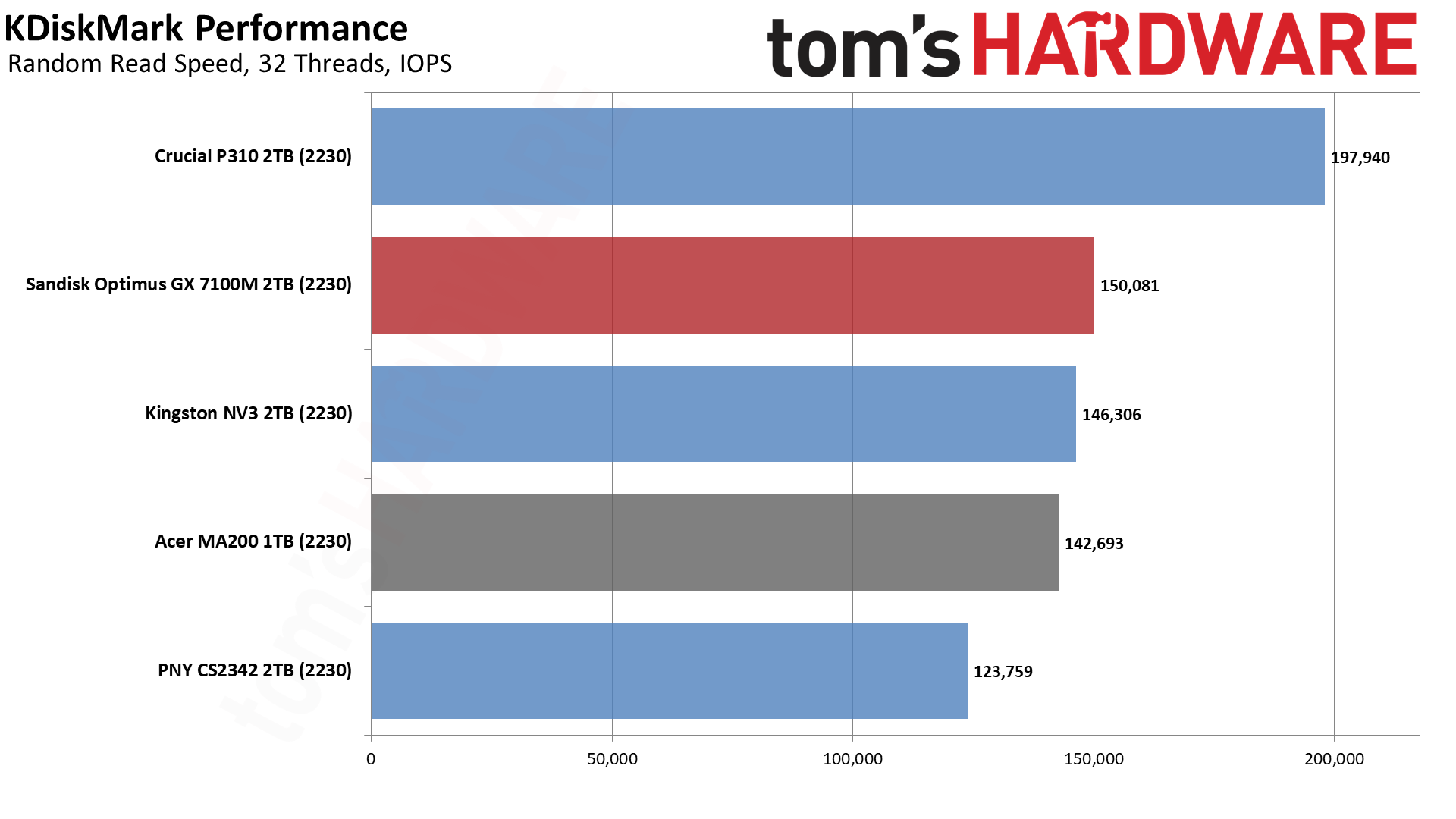
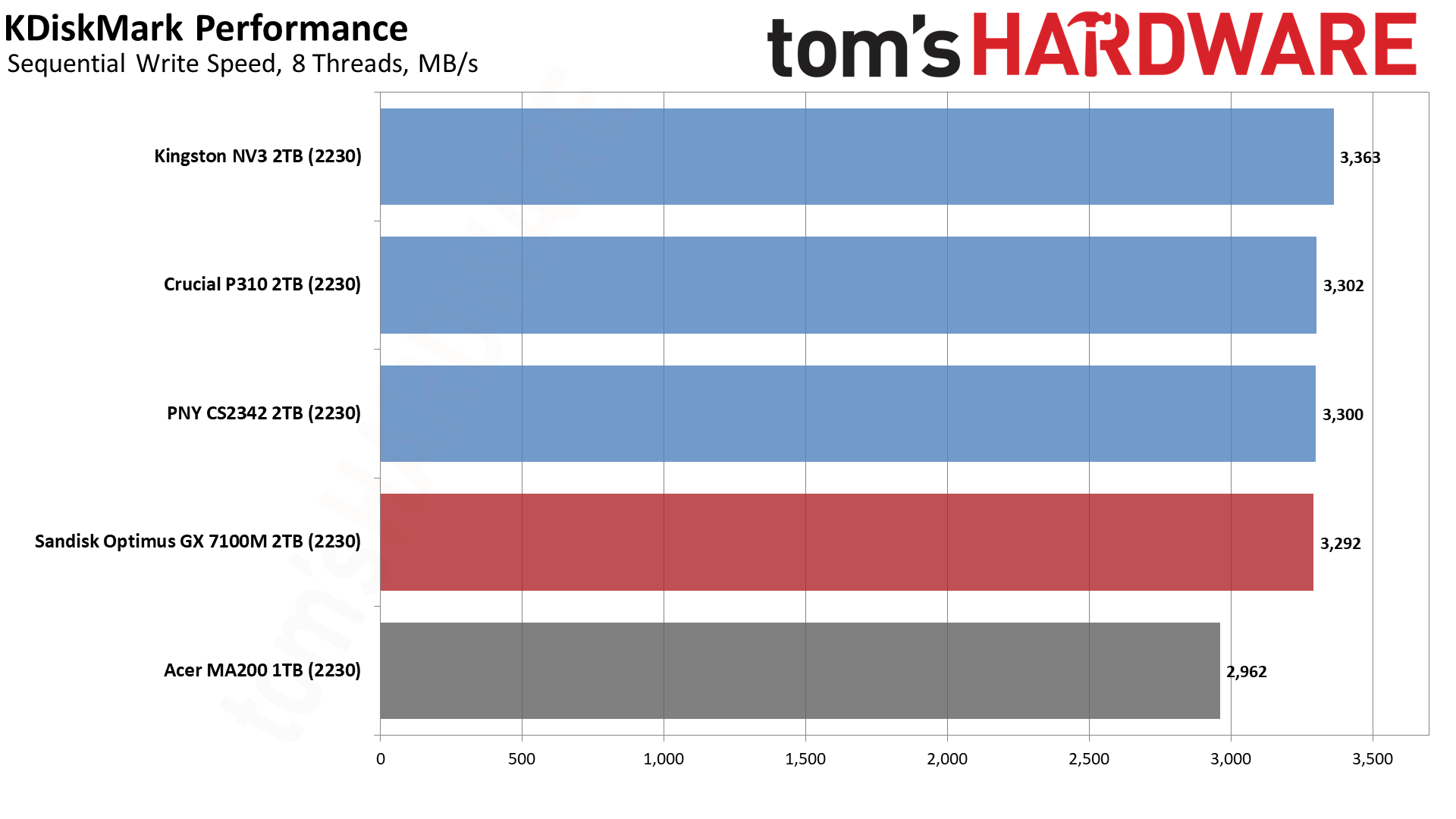
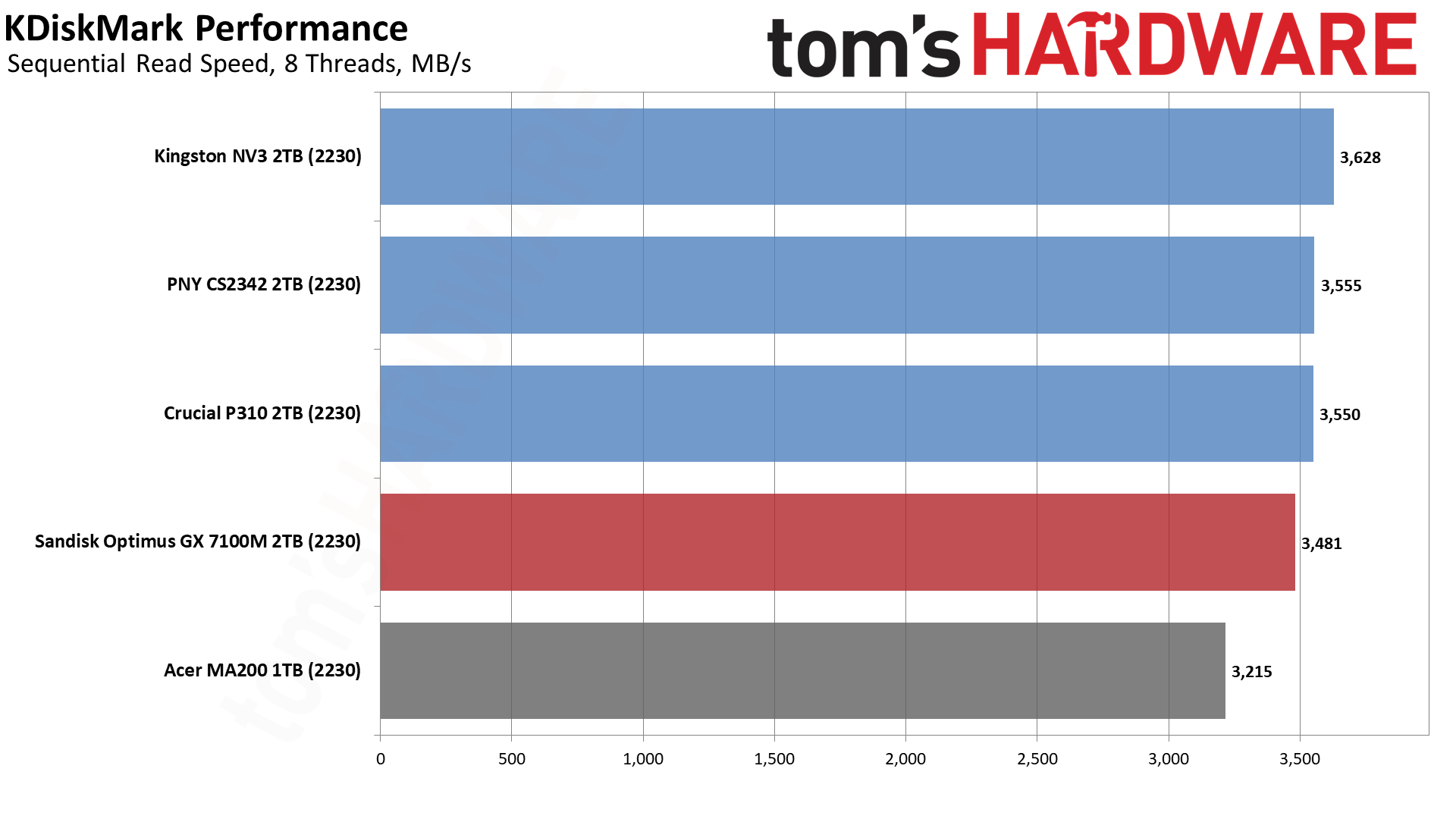
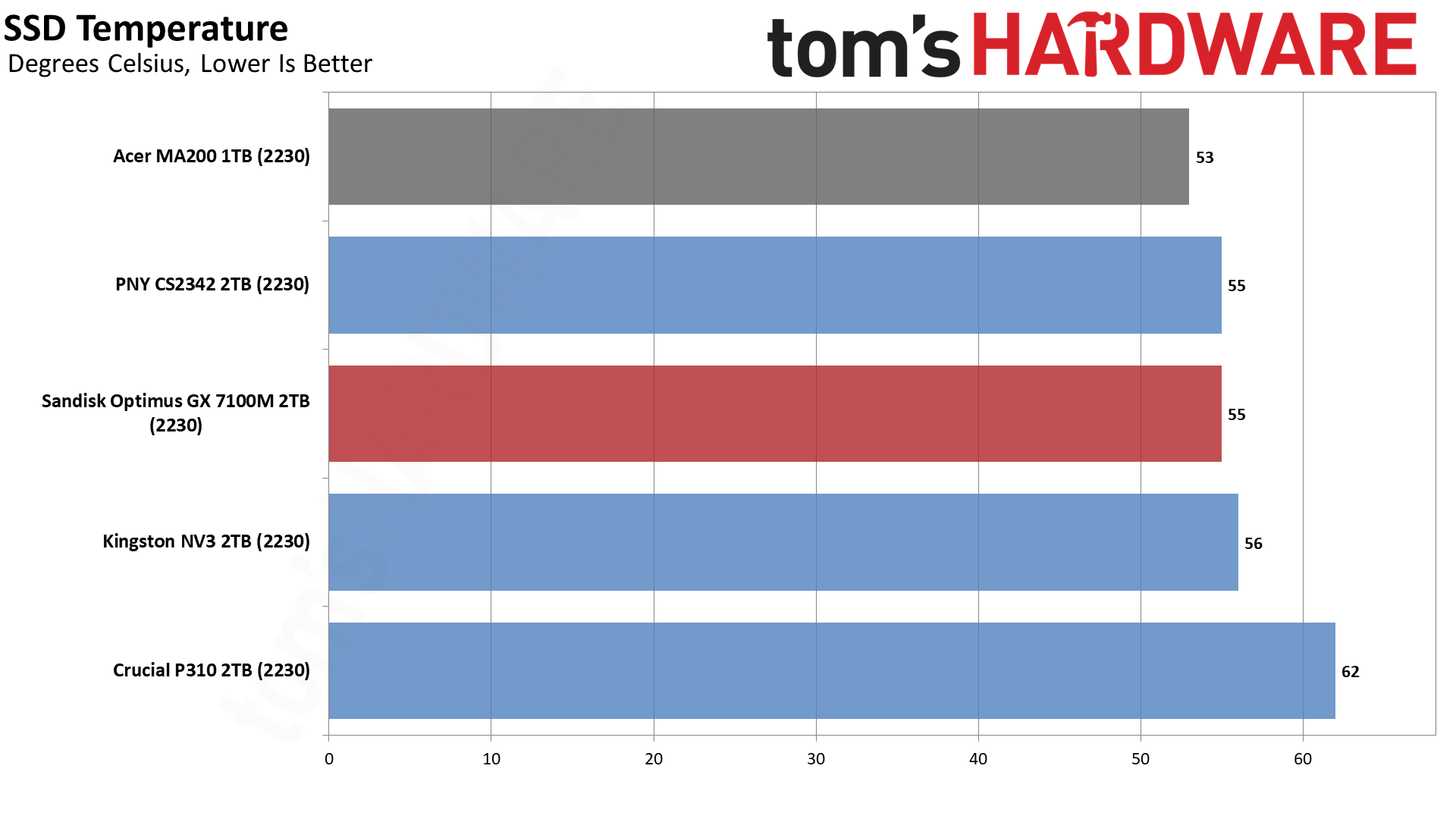
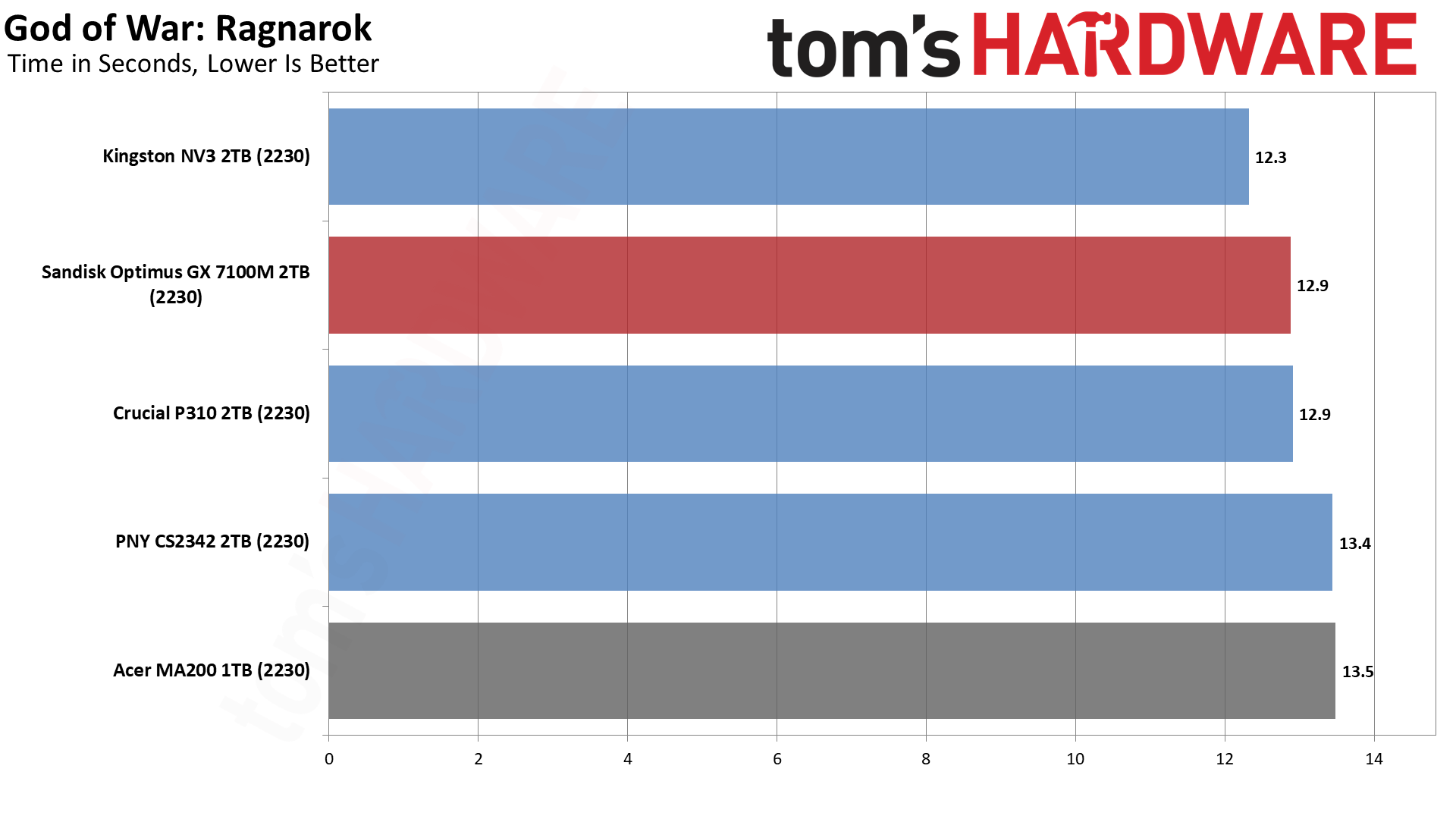
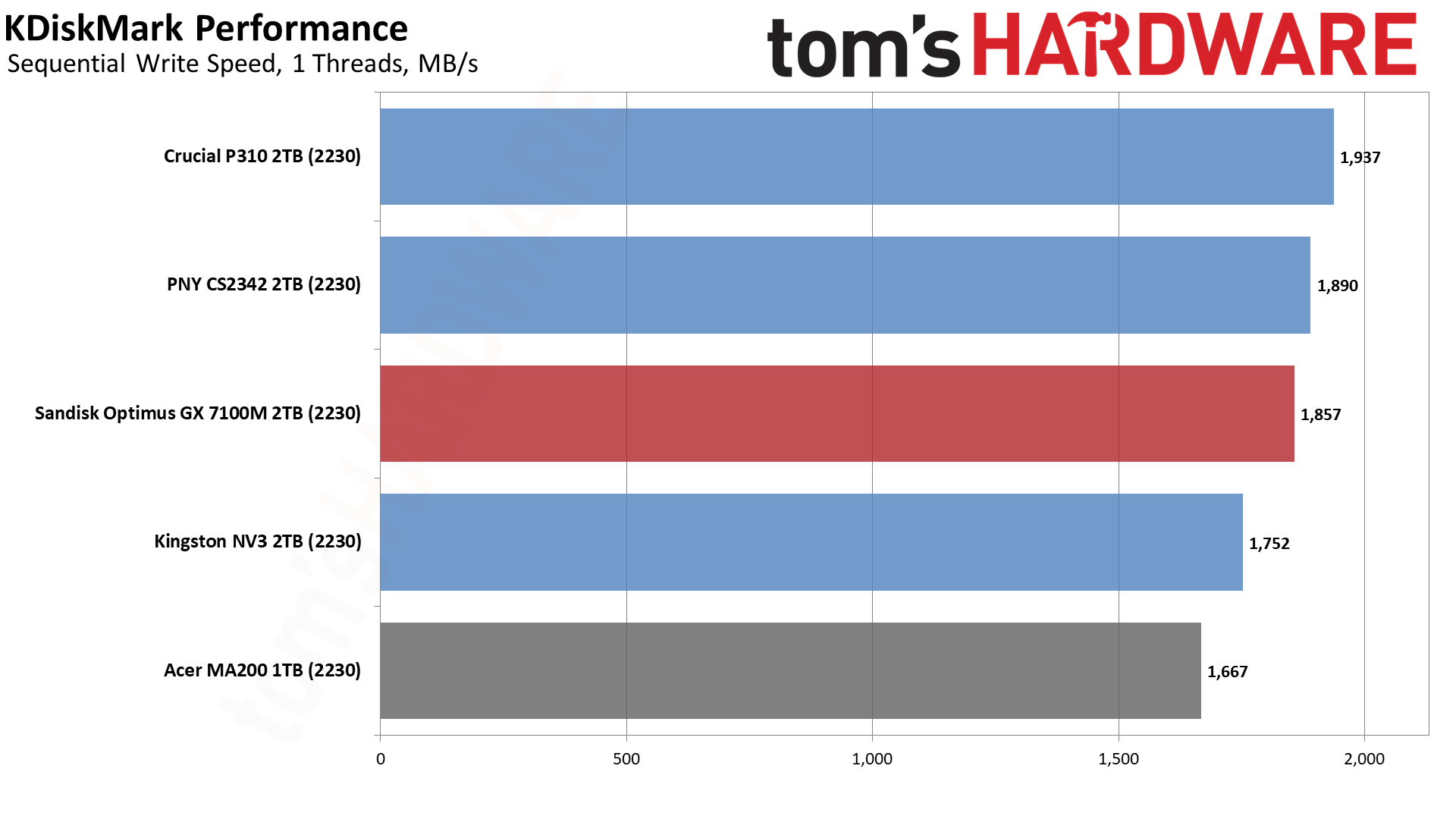
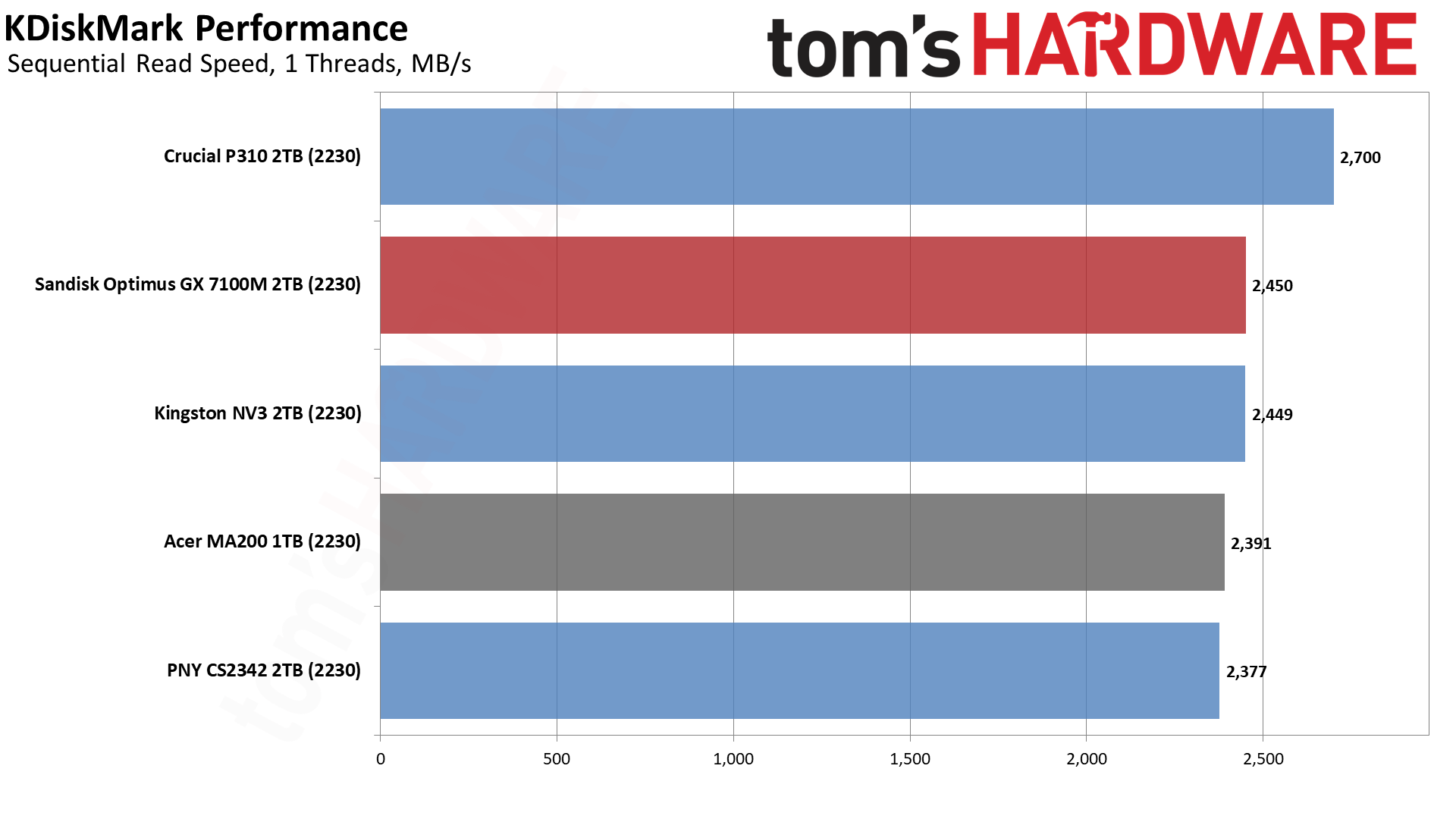
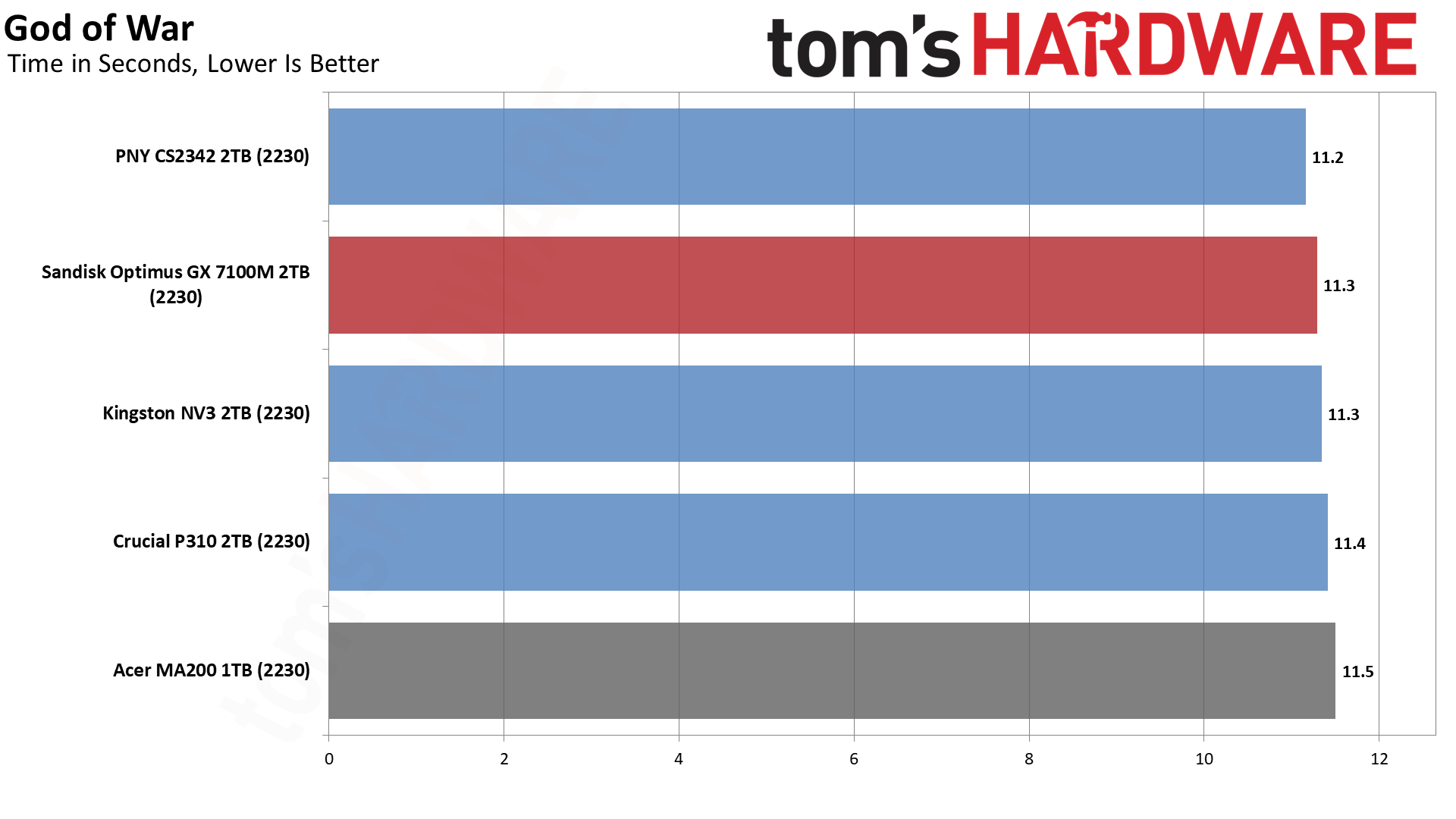
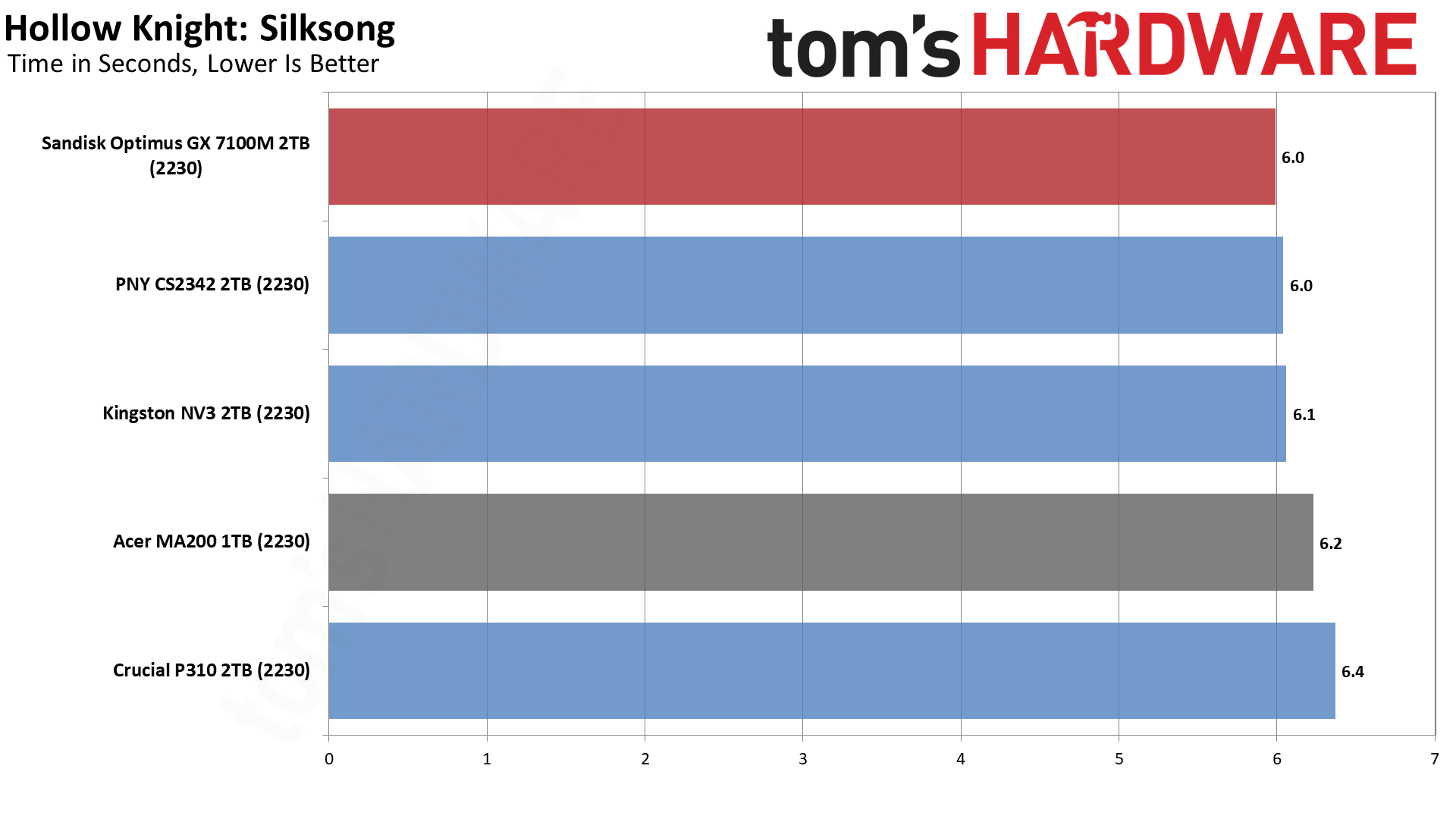
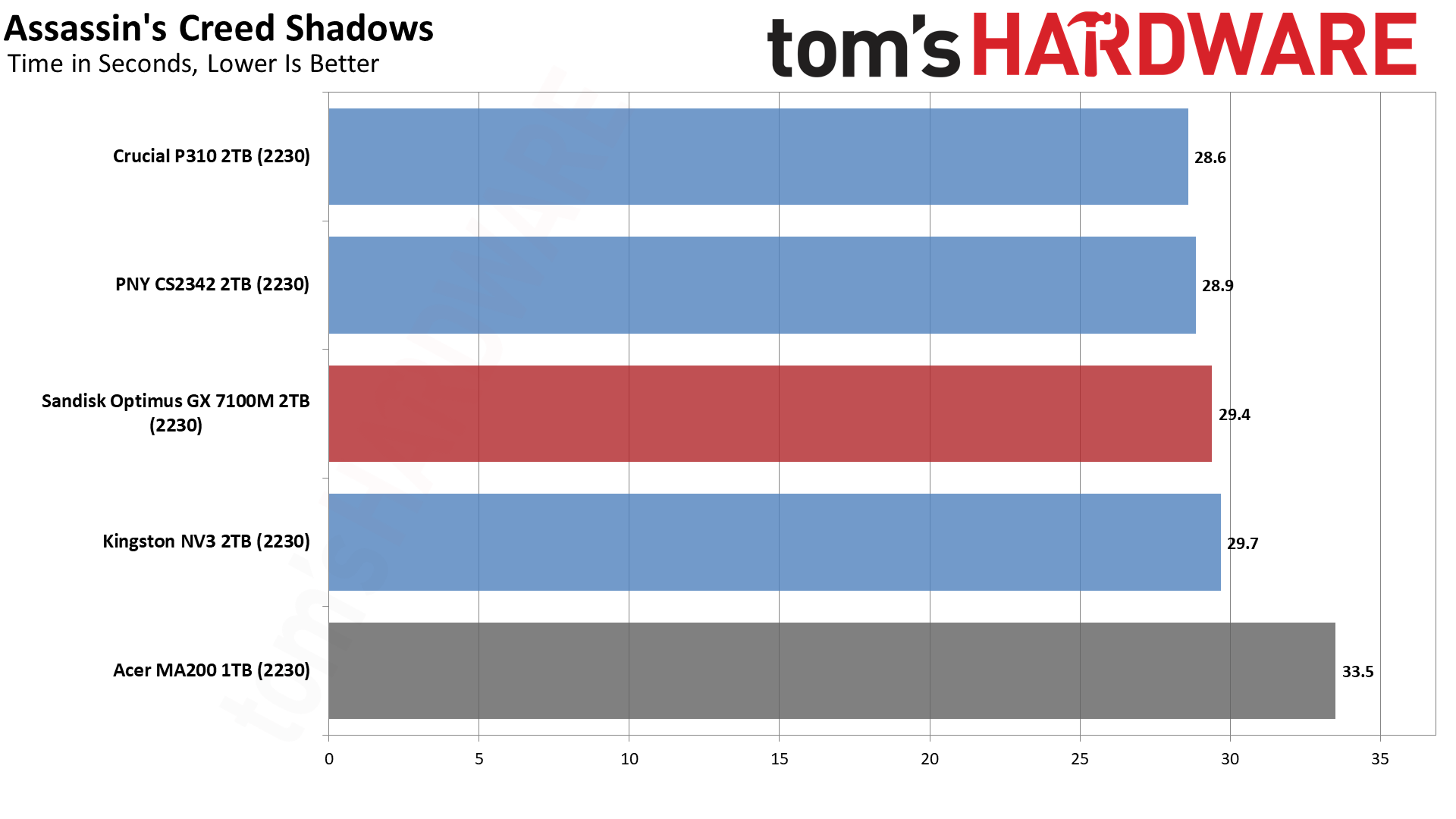
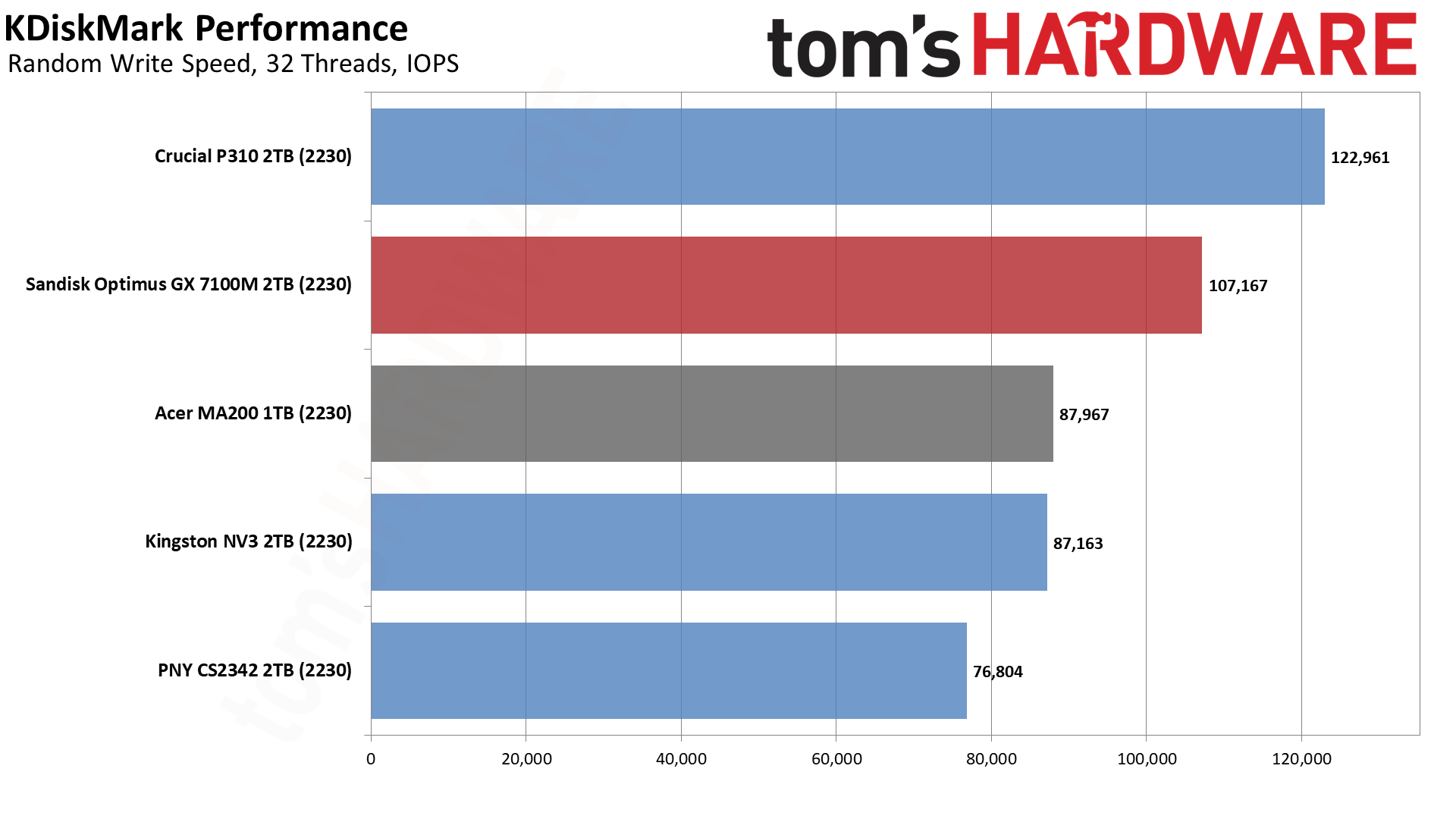
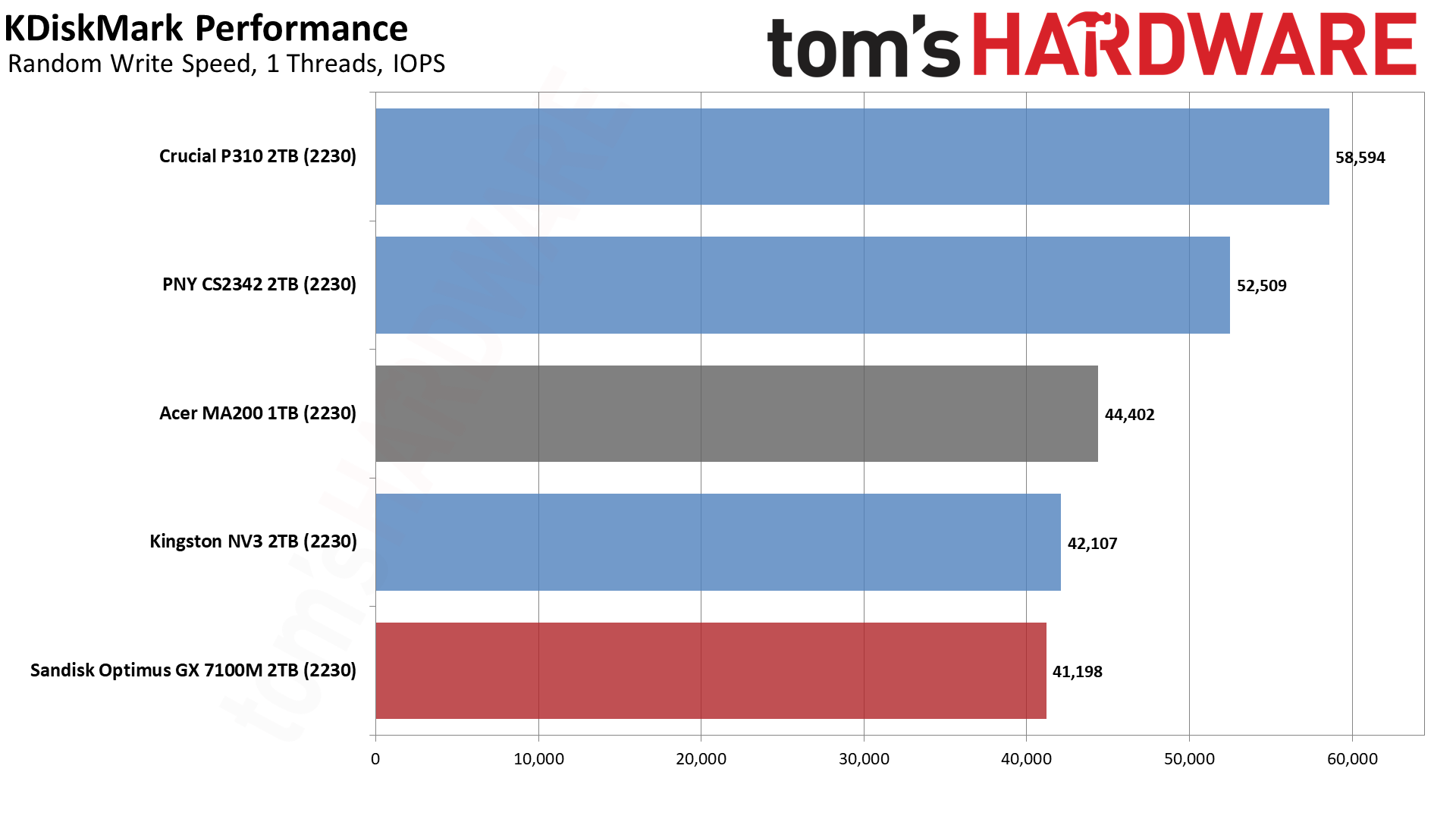
The 7100M does well in all of this testing and runs relatively cool, too. We specifically want to point out its excellent random read performance at QD1, a metric that most readily correlates with responsiveness or “feel.” The P310 pulls away at a higher queue depth, but this is mostly not relevant to what this drive needs to do. We’d say the 7100M’s biggest weak point is the QD1 sequential read speed, merely good but significantly below the P310’s. Many apps and games have low QD sequential reads for loading, and it’s possible the P310 will be slightly quicker for some titles. The magnitude of this, on average, across apps and games will likely be tiny, to say the least, and further, we think that a fuller and realistically worn drive might favor the TLC-based 7100M in the long term. Then again, you probably won’t be fully wearing out any drive in a portable gaming system. We’d probably focus more on heat and power draw, which we address further below.
We do want to point out that QD1 sequential read performance is excellent in our CrystalDiskMark test below. KDiskMark is running on Linux and is built on FIO, which is a different I/O stack. Additionally, on the Deck, we’re testing drives only at PCIe 3.0 speeds. Furthermore, in some cases, weak CPUs – and this applies to many APUs – as well as different platforms, can impact storage performance results. If your portable device is running on something more modern with Windows and PCIe 4.0, it’s quite possible your results will align more with CDM.
Transfer Rates — DiskBench
We use the DiskBench storage benchmarking tool to test file transfer performance with a custom 50GB dataset. We write 31,227 files of various types, such as pictures, PDFs, and videos to the test drive, then make a copy of that data to a new folder, and follow up with a reading test of a newly-written 6.5GB zip file. This is a real-world type workload that fits into the cache of most drives.
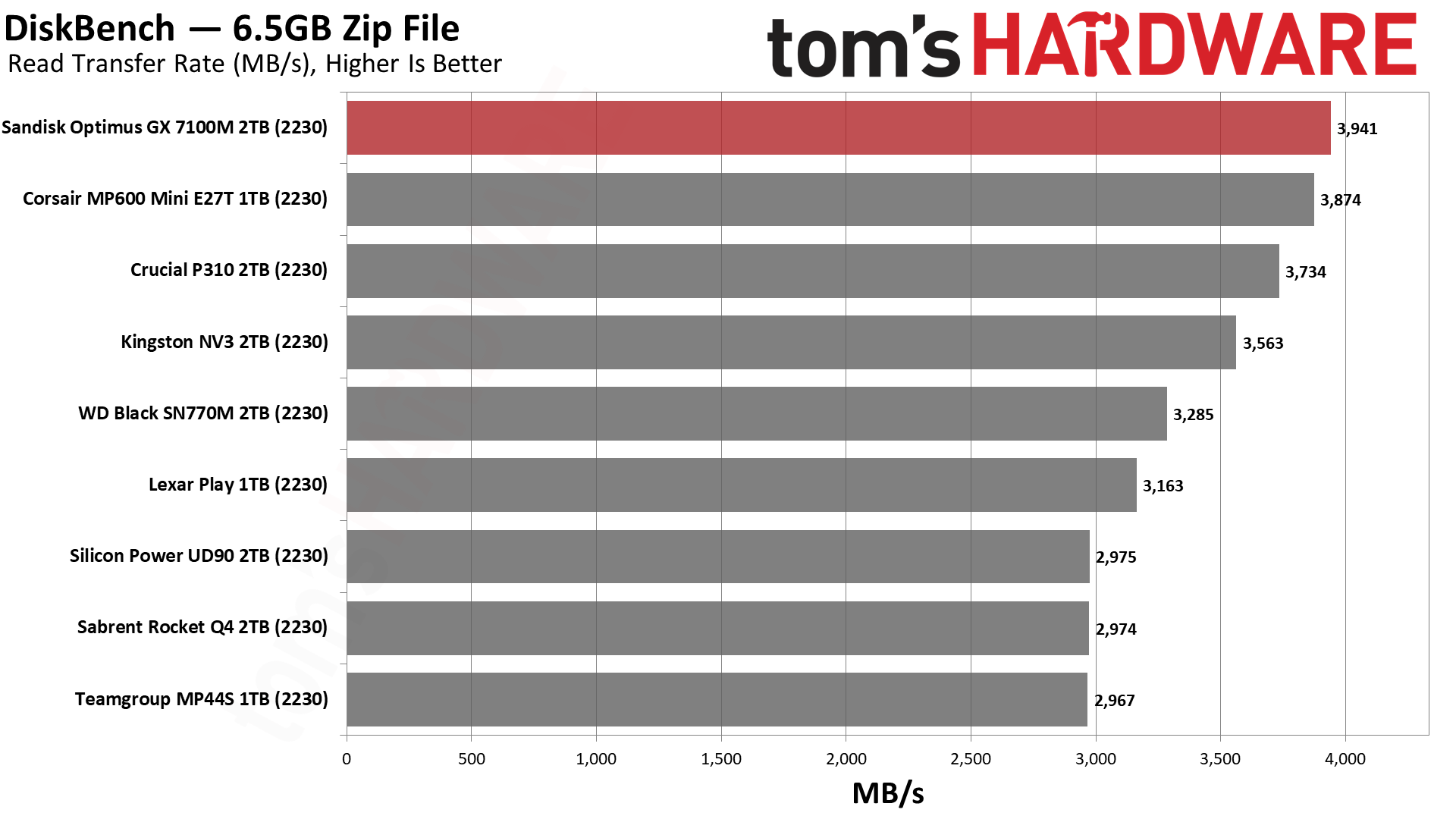
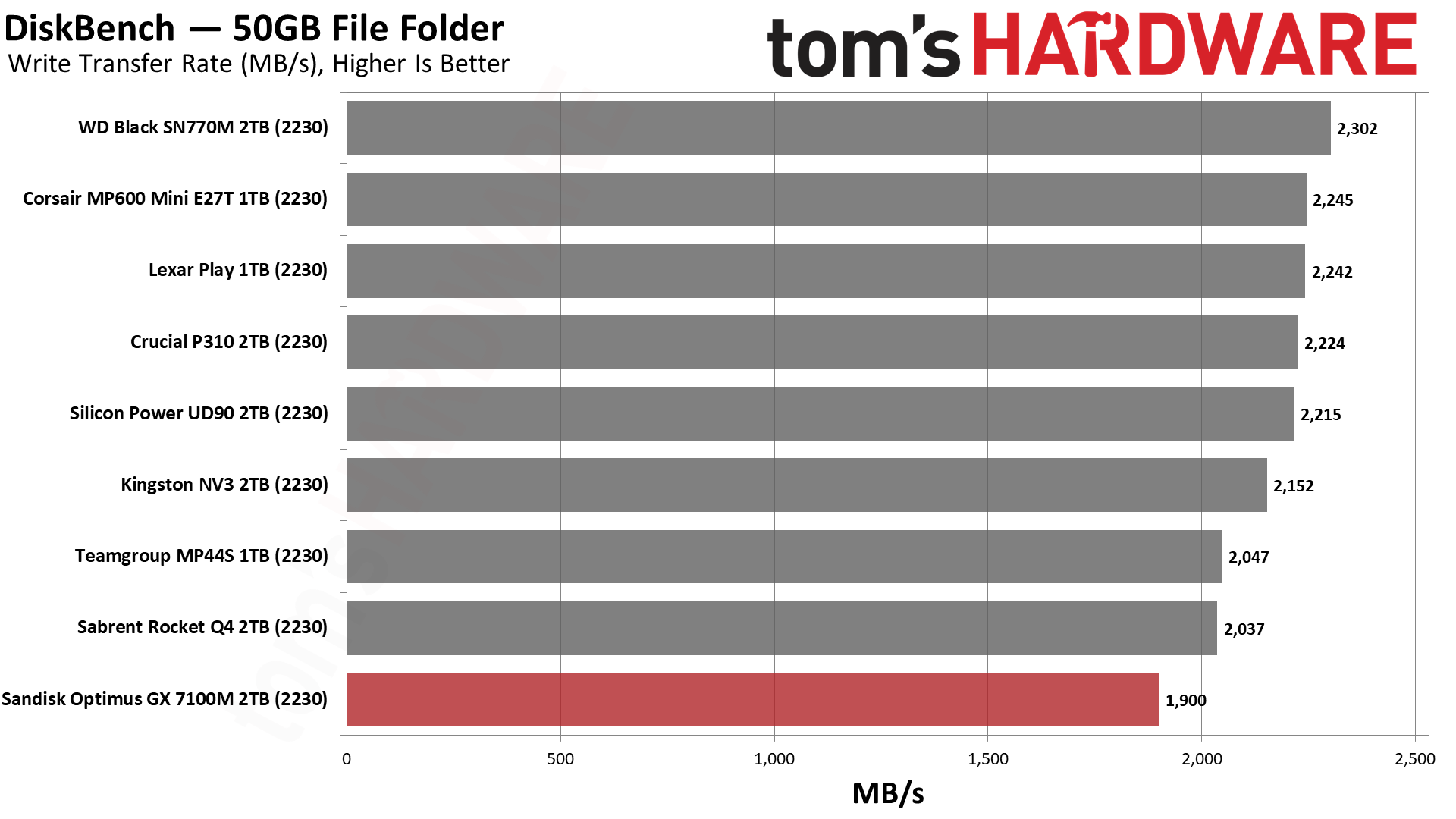
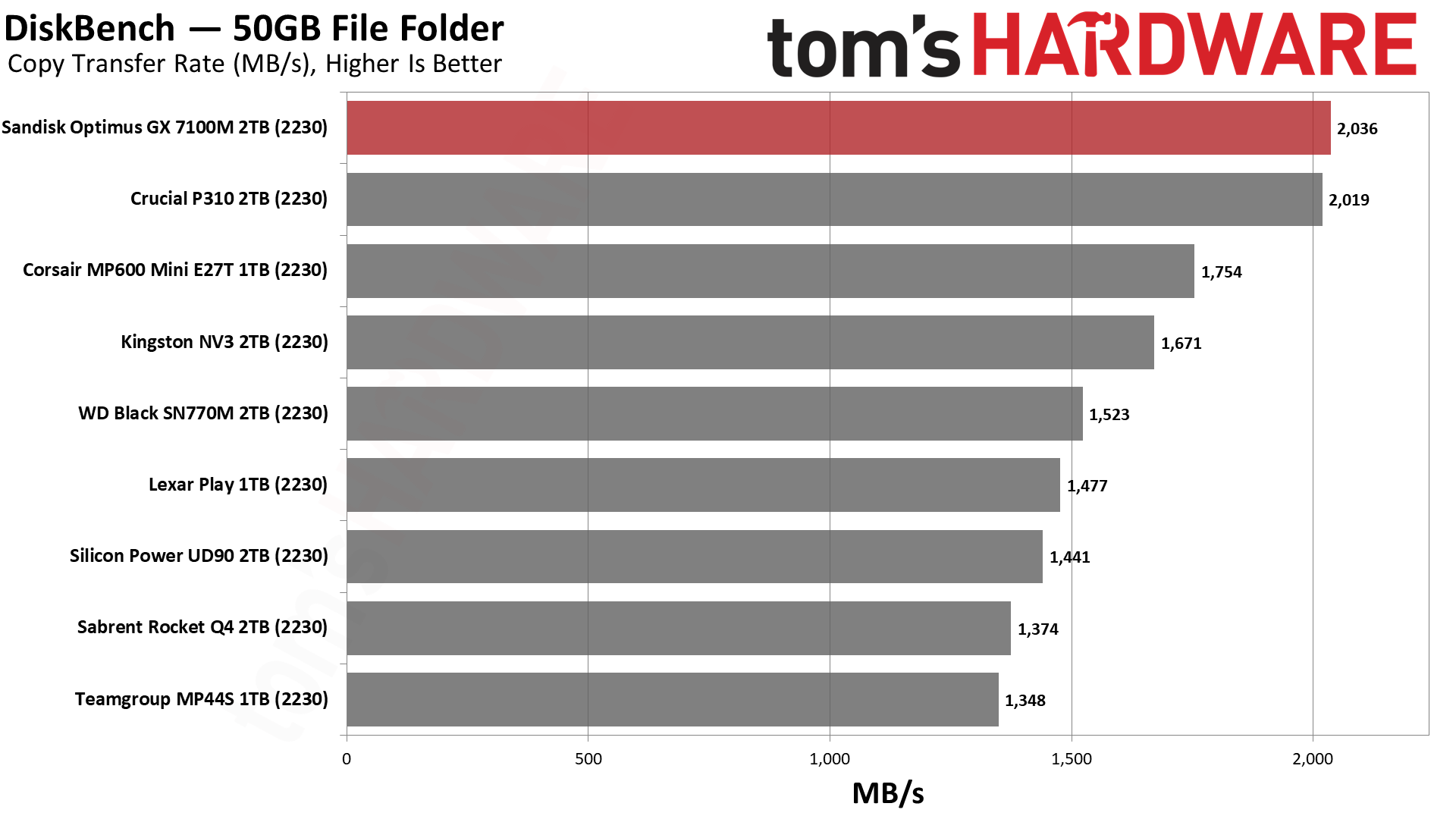
The 7100M delivers the highest copy rate in DiskBench, along with the highest read transfer rate. In a portable device, such as one that would take a primary M.2 2230 drive, you often don’t have a lot of fast transfer sources. You might have only a 10Gbps external drive, a relatively slow microSD card, and so forth. Copying on the same drive still occurs with updates and other procedures, and you are essentially relying on a single drive to manage most things on the system. For this reason, the DiskBench results are still useful for gauging how well a drive can manage mixed workloads. The 7100M handles that like a champ, and the high read performance – considering you do a lot of reads – is also a bonus.
The only anomaly here is the write speed, which was also a bit low in our previous Steam Deck test section. Write performance can be misleading for many reasons. Most pertinently, modern drives use pSLC caching, which can “hide” the true performance of the native flash. This can mean performance is not always consistent. Manufacturers can optimize the drive firmware with this in mind, making trade-offs such as varying the cache size to improve sustained performance. Drives ultimately have to move data over from the cache to the native flash, so test results don’t always align with expectations. To get a fuller idea of write performance, you should check our Write Saturation section.
Synthetic Testing — ATTO / CrystalDiskMark
ATTO and CrystalDiskMark (CDM) are free and easy-to-use storage benchmarking tools that SSD vendors commonly use to assign performance specifications to their products. Both of these tools give us insight into how each device handles different file sizes and at different queue depths for both sequential and random workloads.
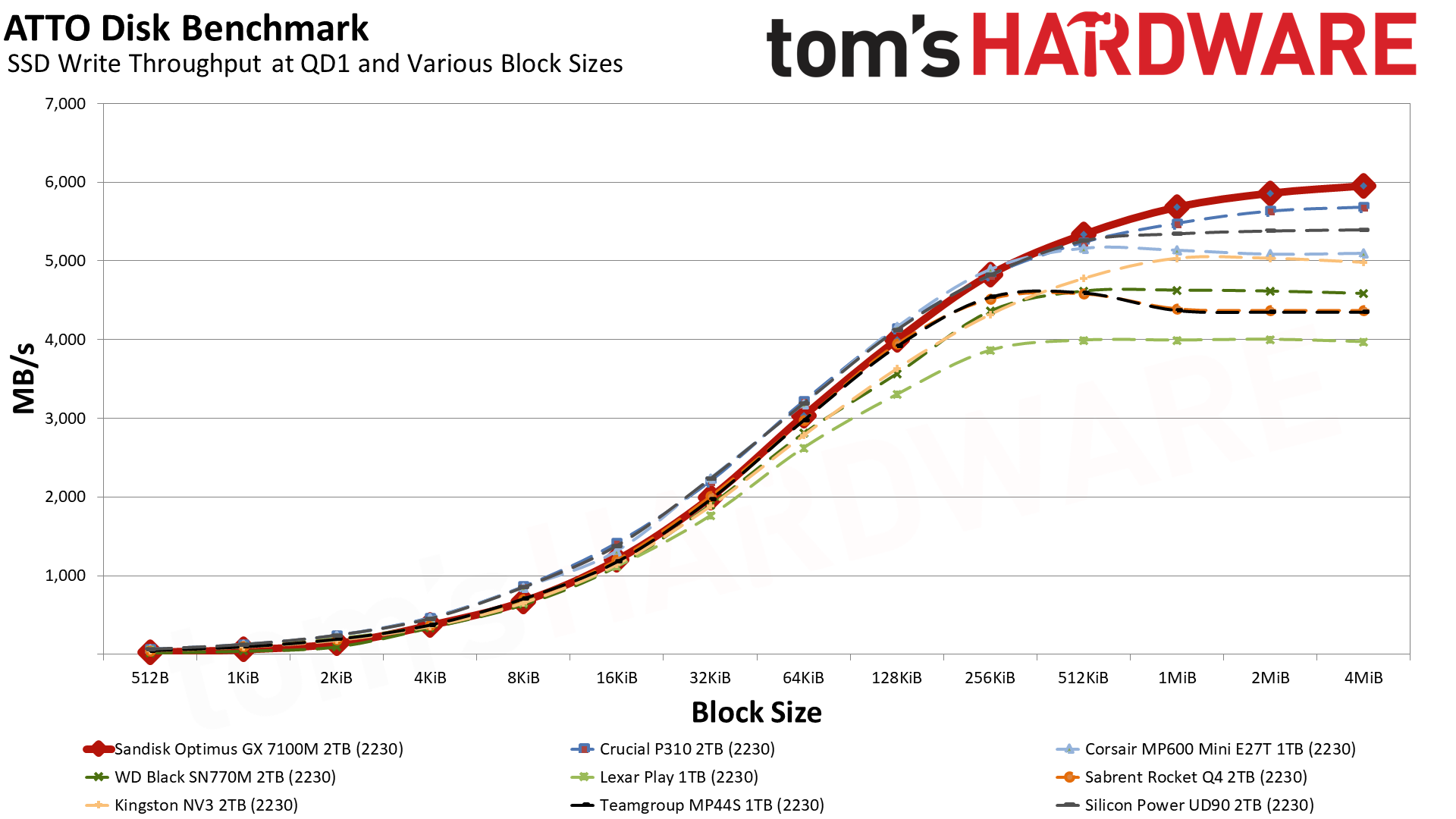
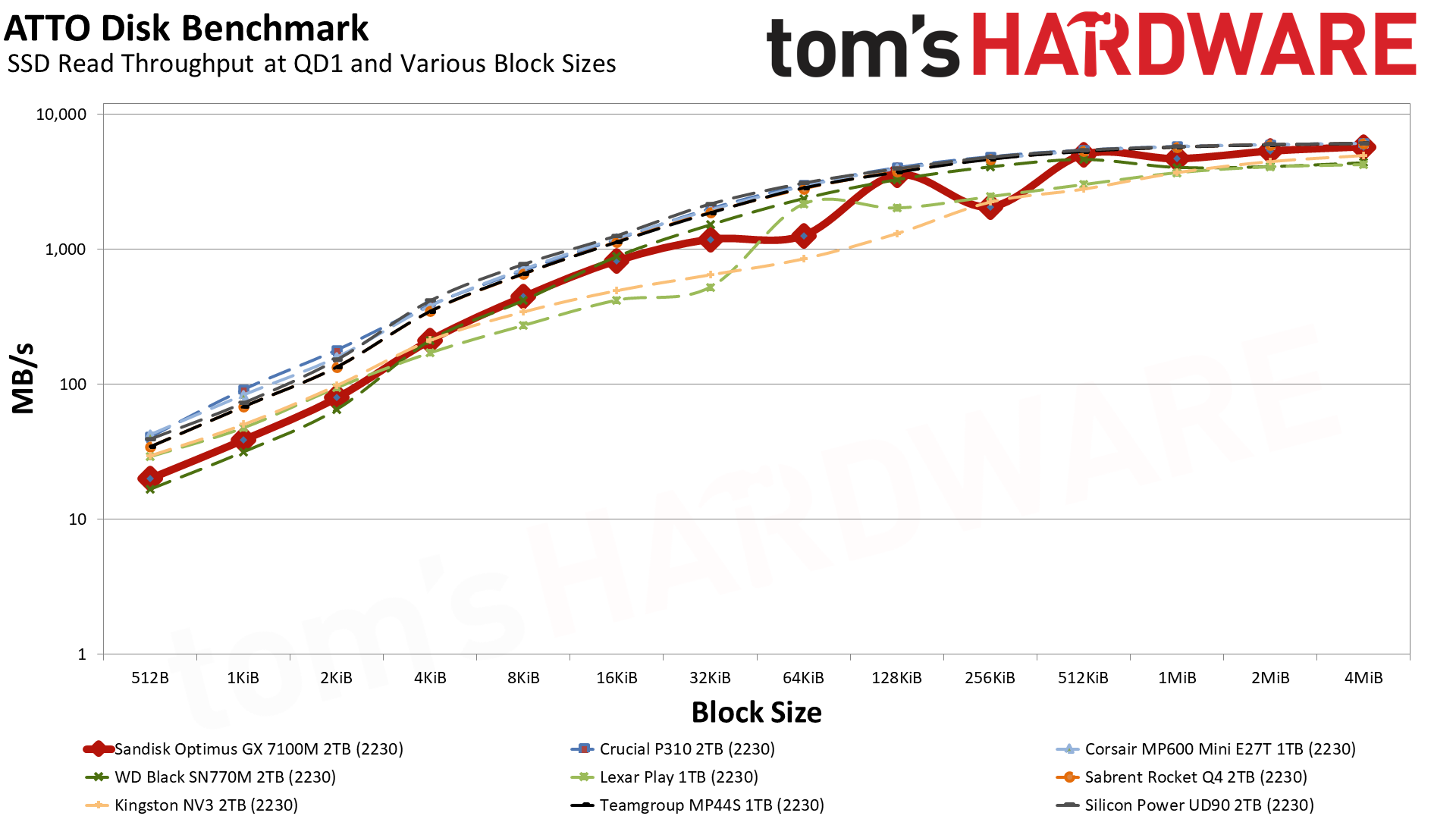
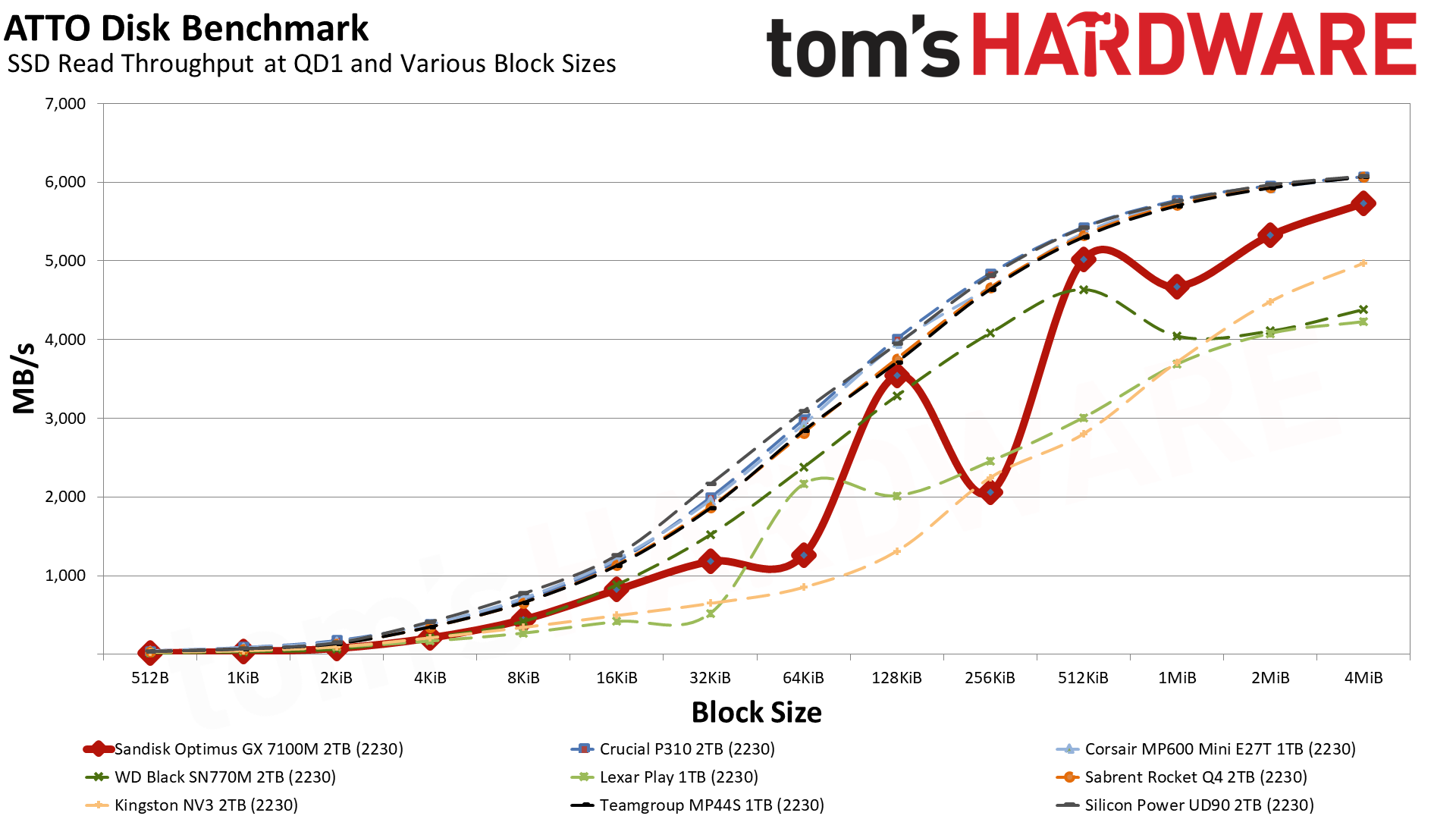
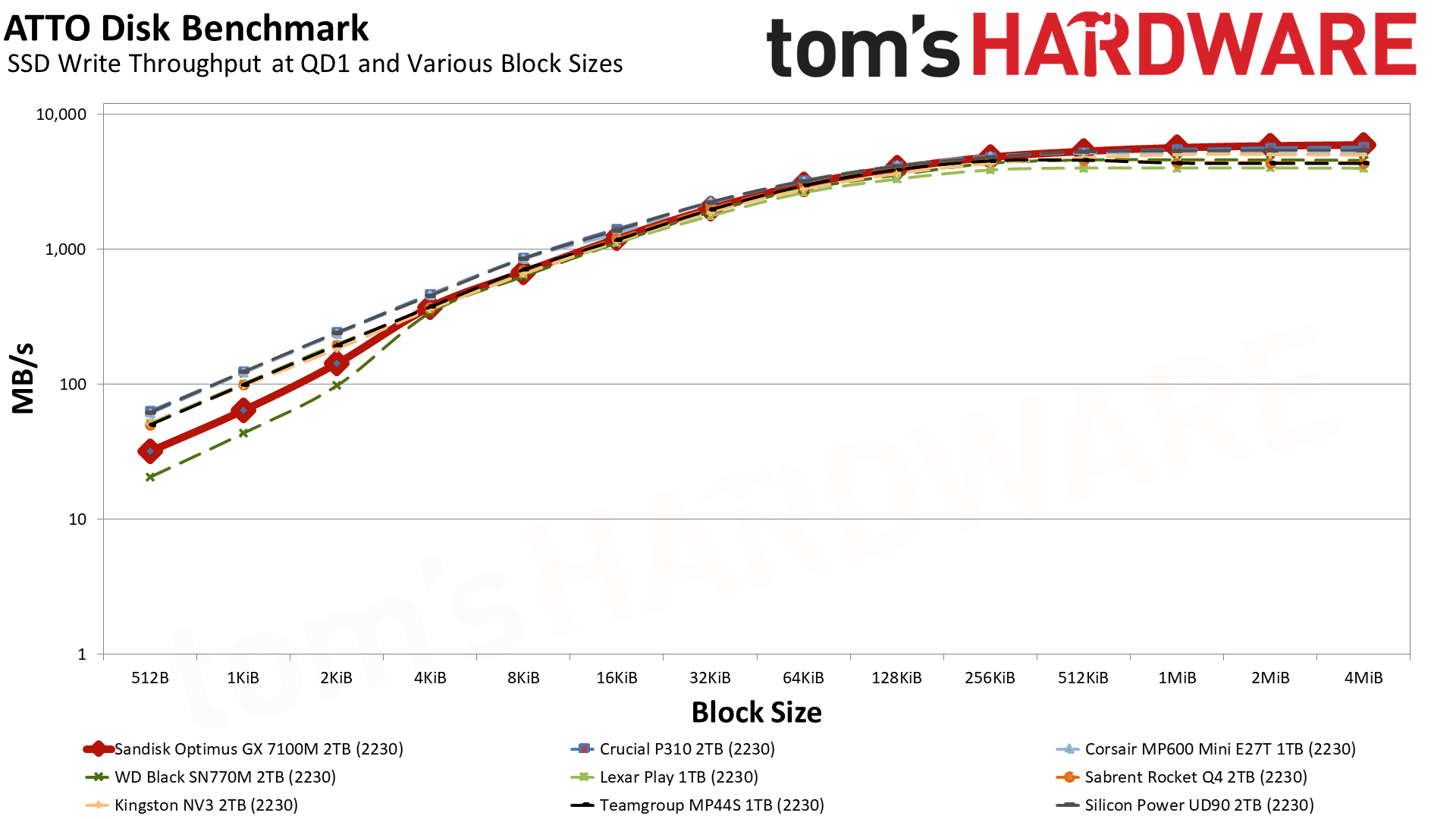
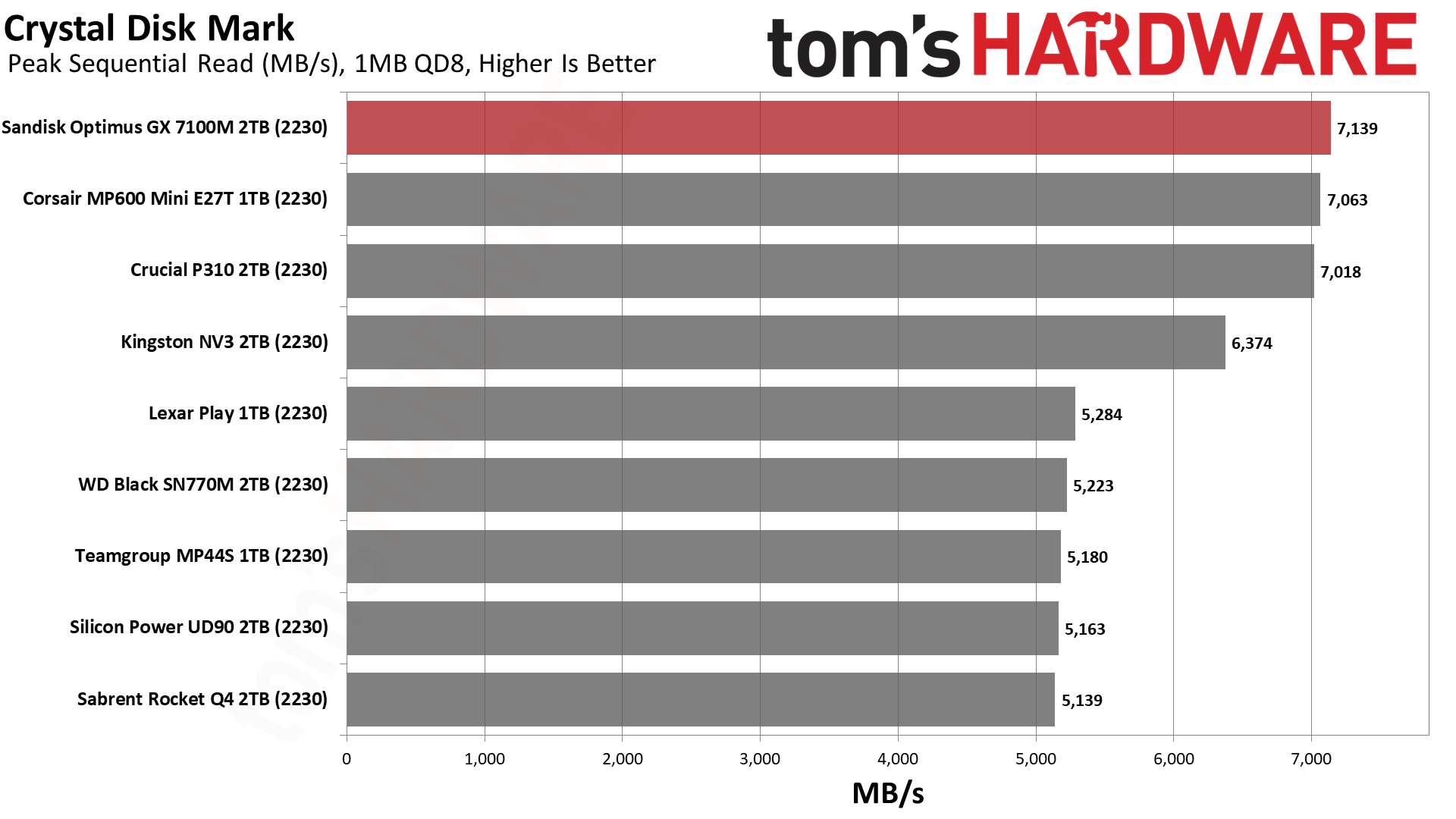
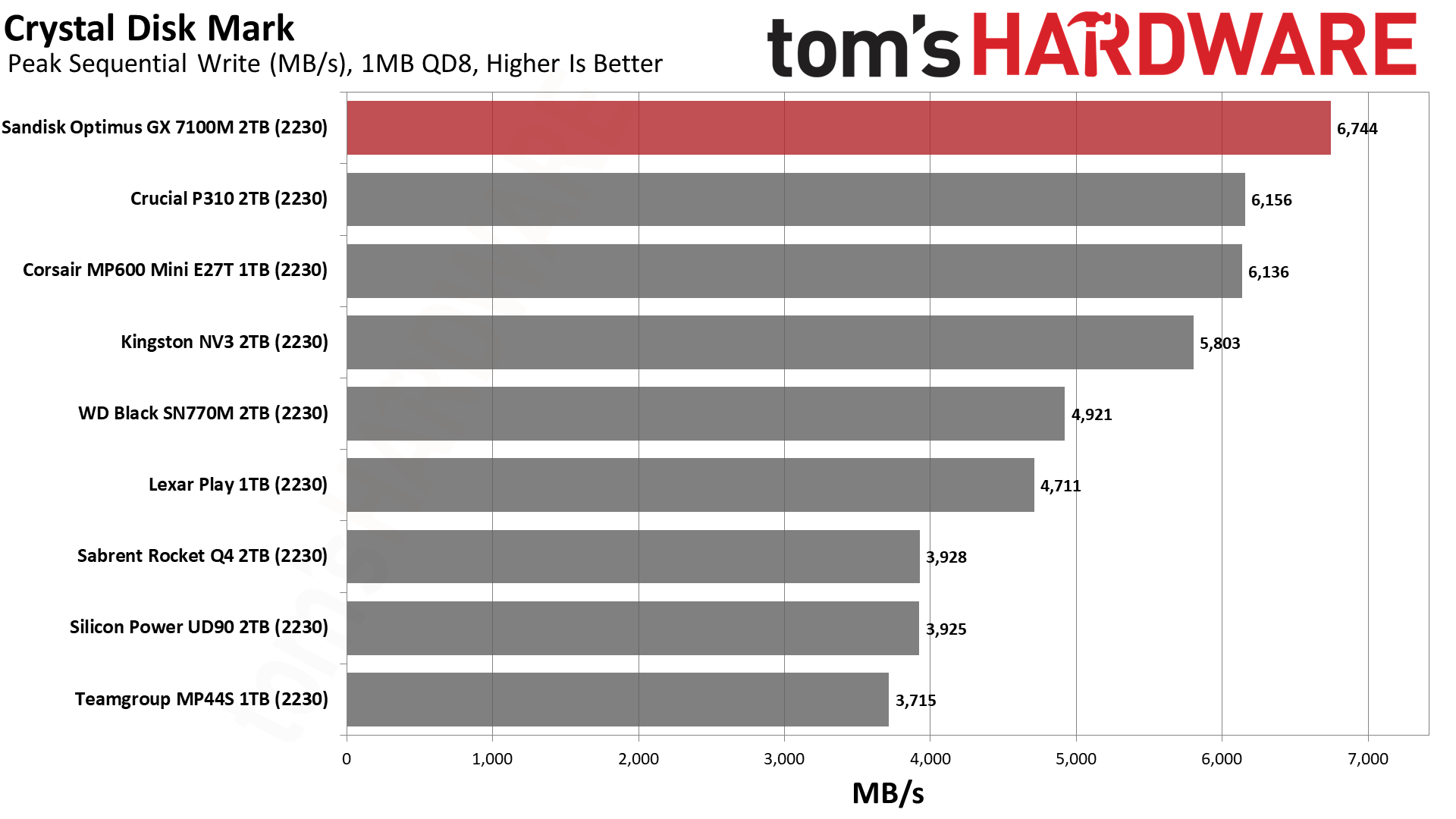
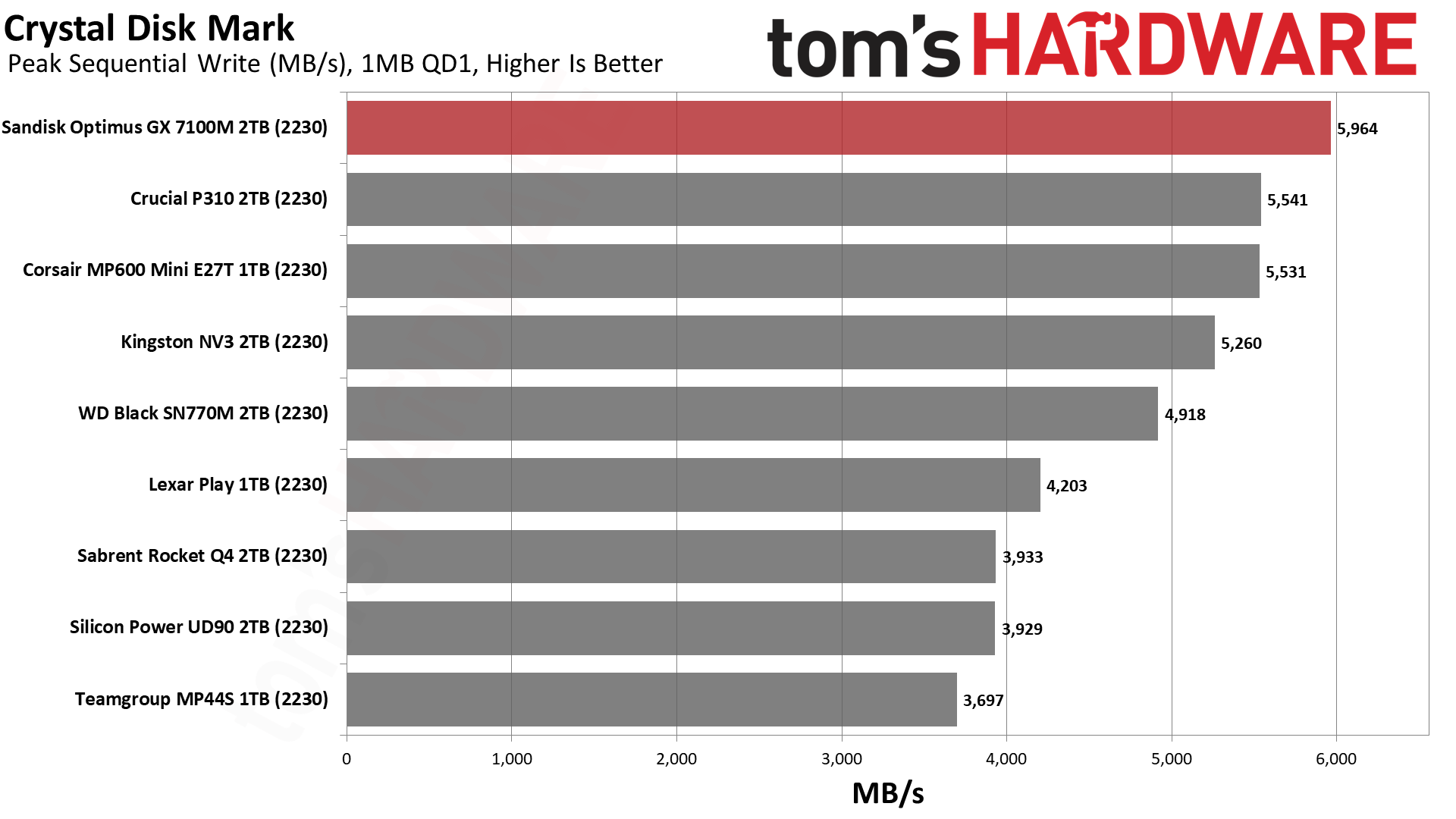
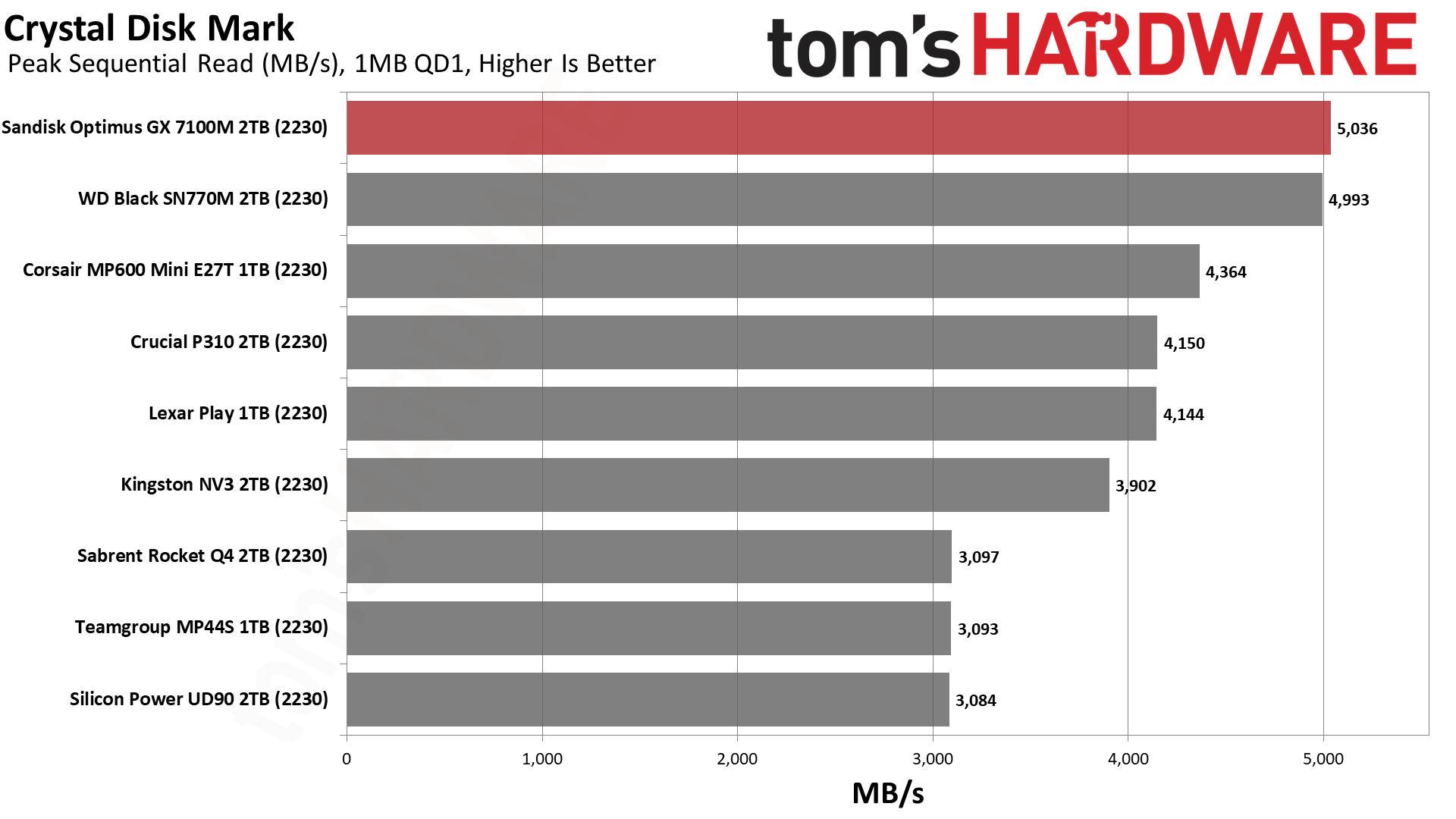
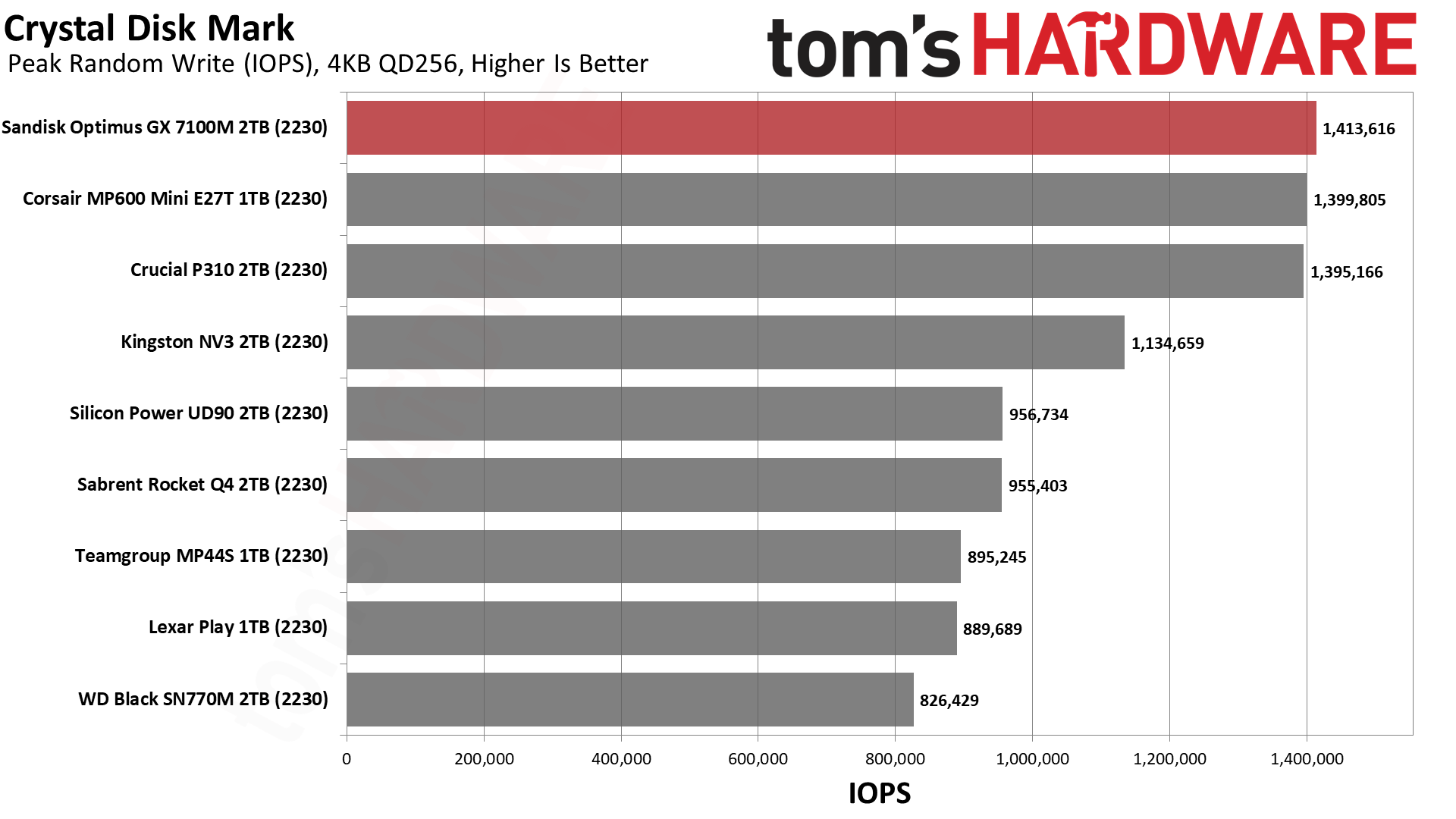
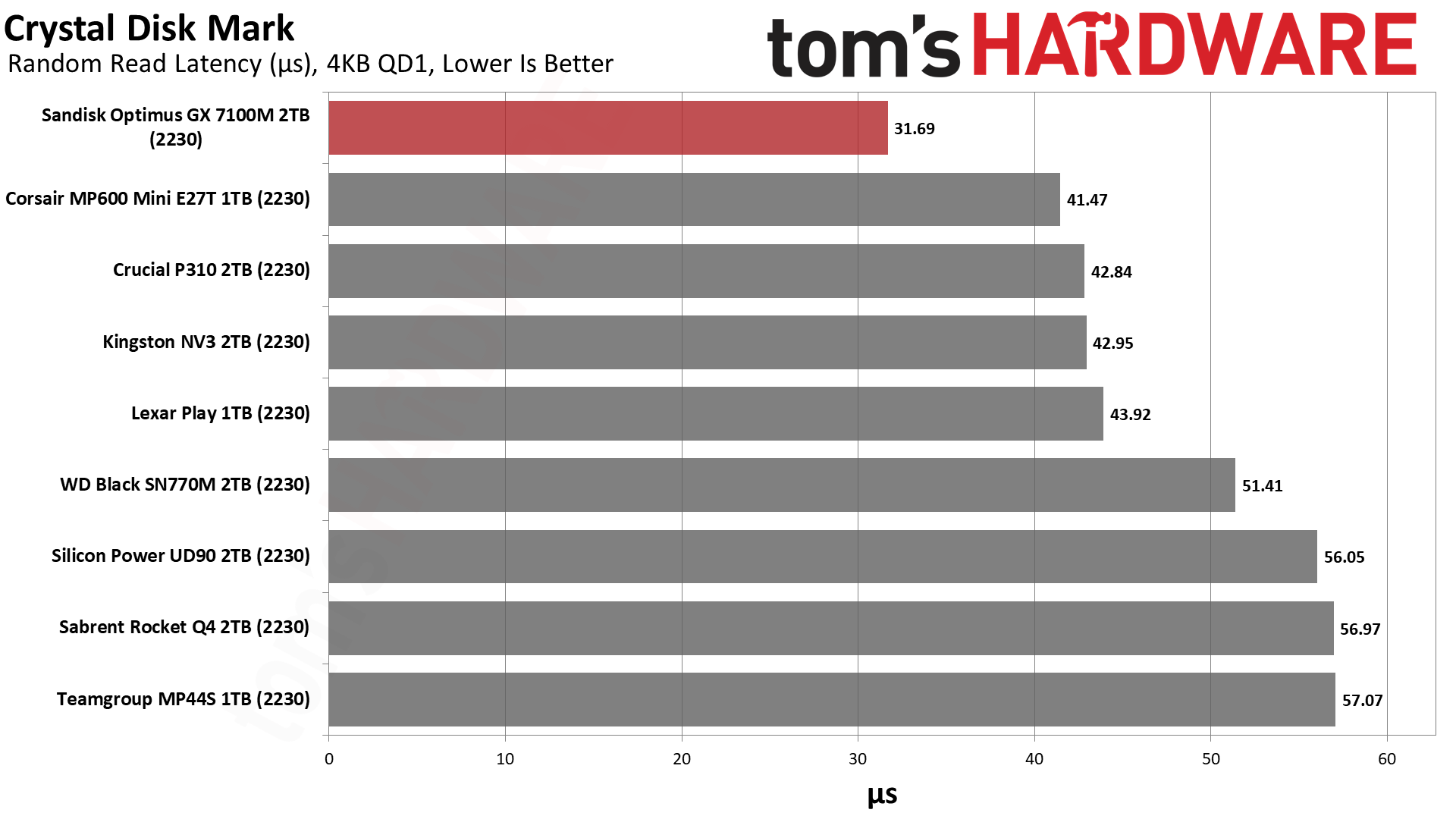
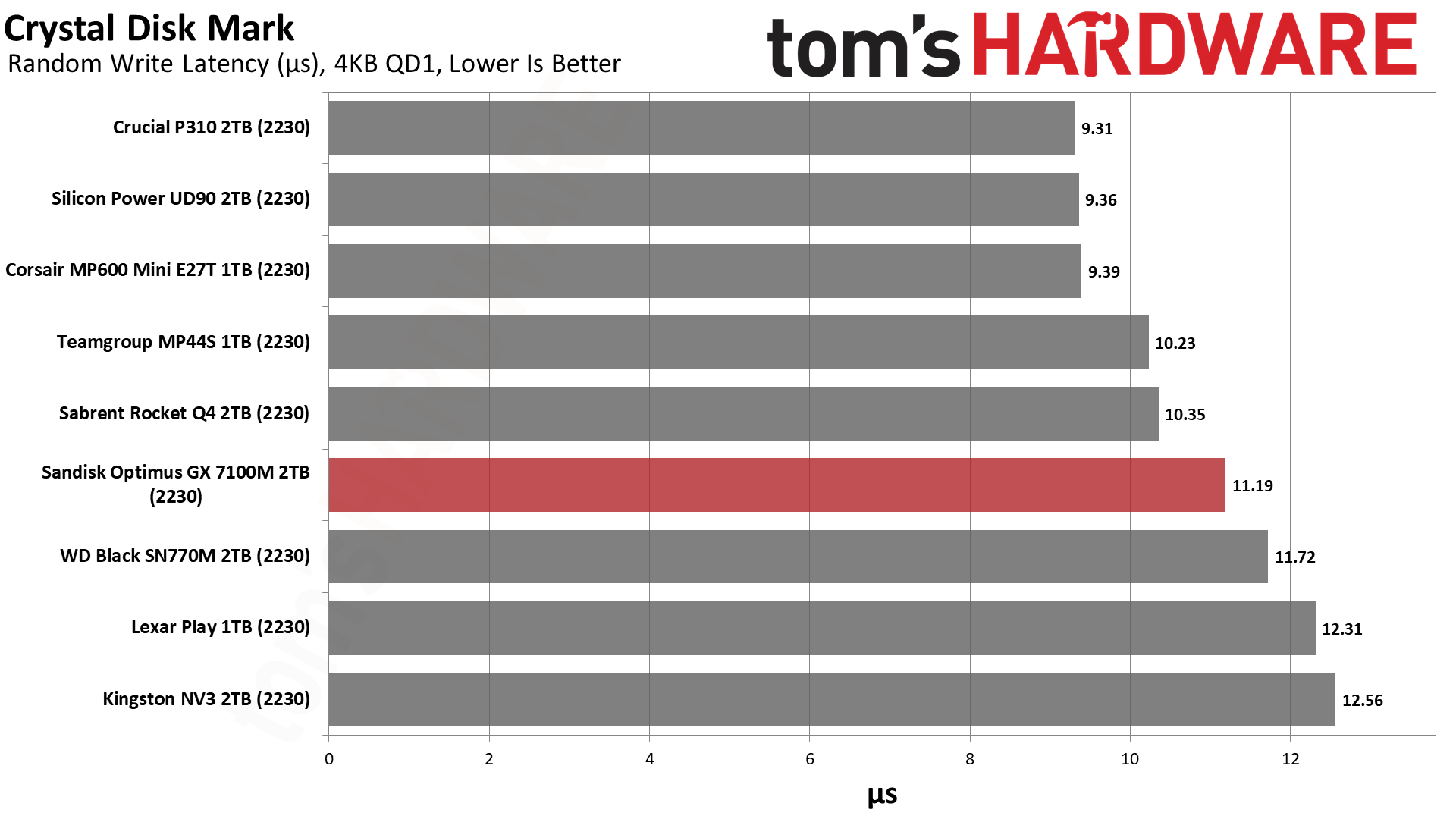
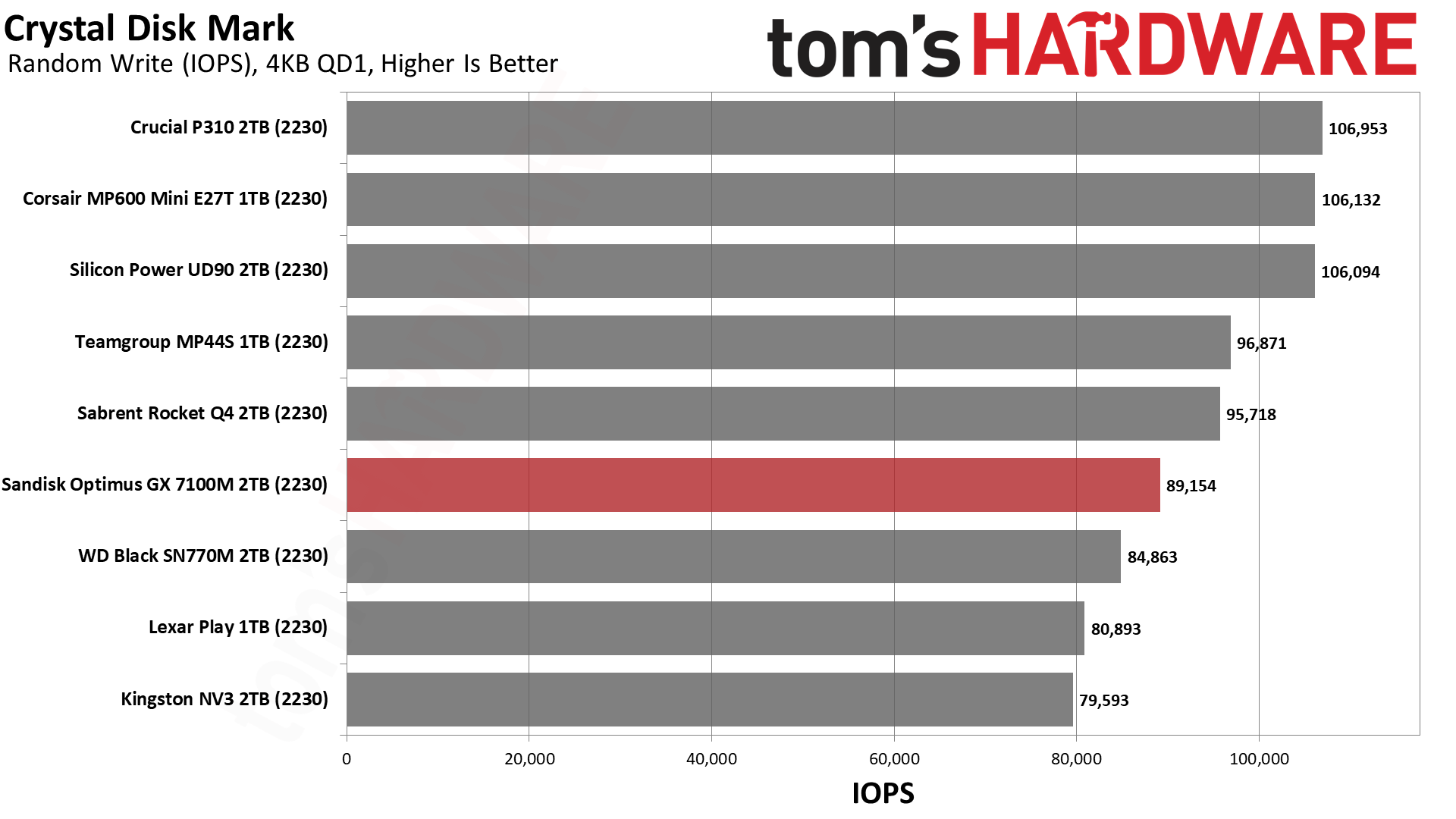
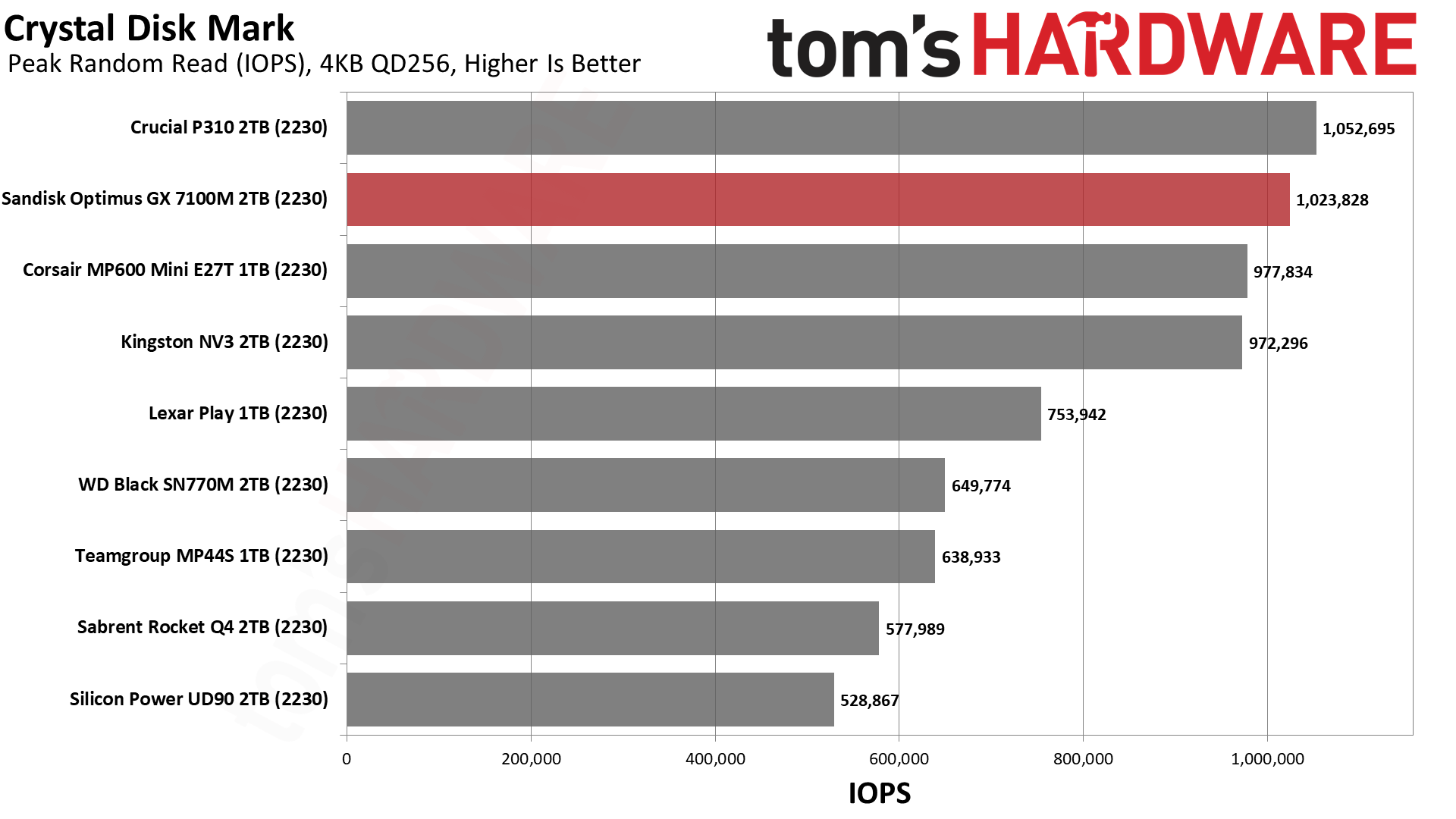
The first signs of weakness on this drive appear in ATTO, but things are not as bad as they first appear. We’re talking about read performance, and when looking at our logarithmic chart, the jumps up and down don’t seem as bad. While throttling could affect this test, generally, that’s not the case. It helps that we see the same pattern with the WD Black SN7100, as we can rule out any randomness.
However, we don’t see it with the WD Blue SN5100, which uses BiCS8 QLC and a comparable controller, so this is probably a feature of BiCS8 TLC. We also don’t see it on the WD Black SN8100 or Corsair MP700 Pro XT, drives with that flash but controllers from SMI and Phison, respectively, so it’s not the flash on its own, either. Given the drops are at 64KiB and 256KiB – with 16KiB pages, this is with 4-way and 16-way interleaving, which aligns both with the flash channel count and the four-plane count dies – it’s likely an artifact of how the proprietary controller manages the reads. Sandisk has some interesting optimization going on, which you can see most clearly with random reads and power efficiency, so we don’t want to jump to conclusions, especially as long as real-world performance remains strong.
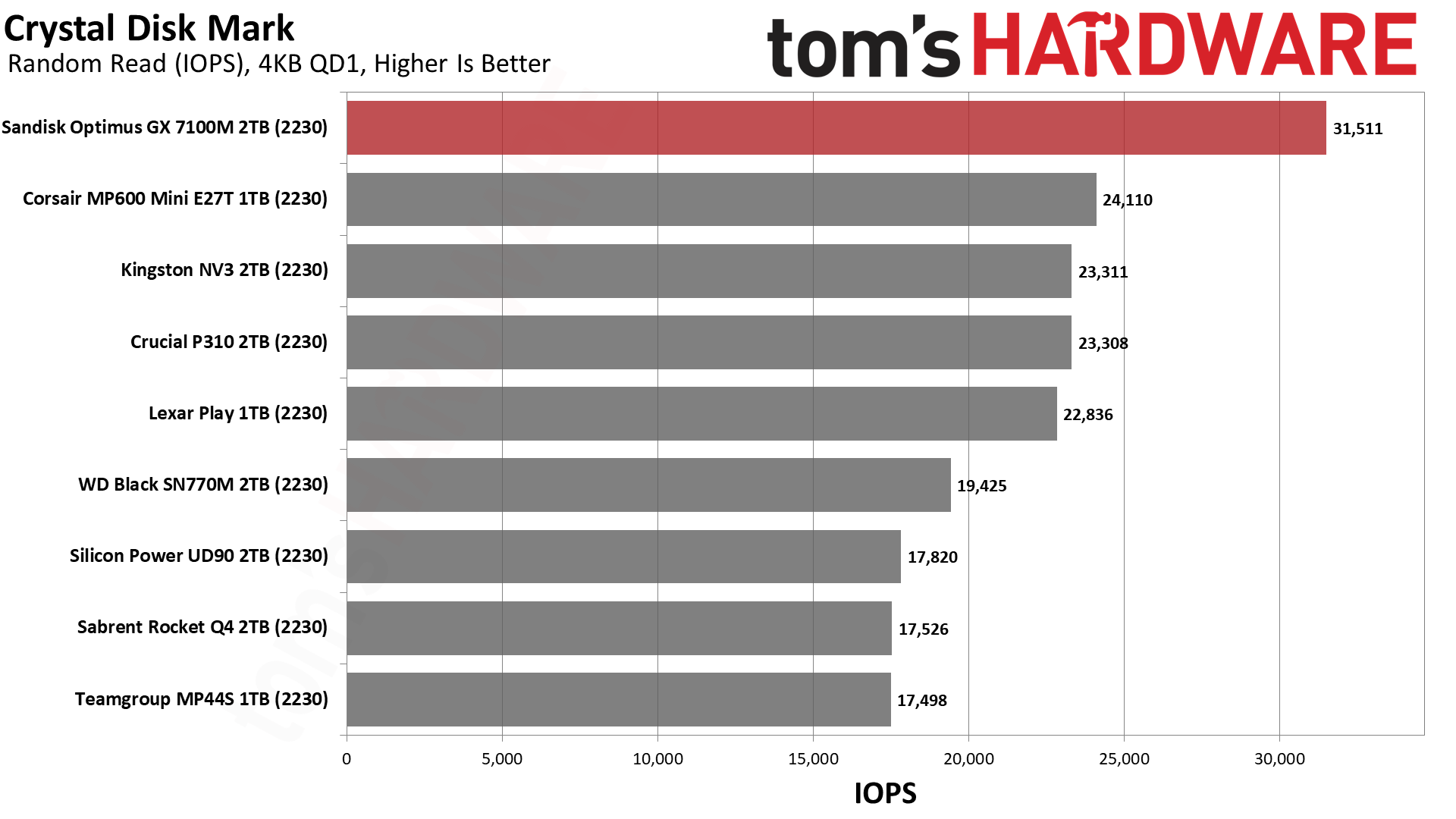
Thankfully, it does. The 7100M has incredibly low 4KB random read latency at QD1 in CDM, blowing away the rest of the 2230 drives. As we pointed out above, the competition here is more limited in comparison to full-length drives, which helps the 7100M stand out even more. In many cases, you could look only at this result and be convinced that this is the drive to get. However, as we’ve stated in the past, a good rule of thumb is ~45µs if you want a top-notch experience, and other drives hit that. The 7100M just takes it to a new level.
Sequential read performance at QD1 is also very important; in fact, it is sometimes overlooked with regard to game and app load times. It often deserves to be weighted alongside random 4KB. Luckily, the 7100M is tops here, too. WD and Sandisk have this mastered, as the SN770M is a monster as well. Given that the 7100M can push even more bandwidth with efficient flash, just chef’s kiss.
Sustained Write Performance and Cache Recovery
Official write specifications are only part of the performance picture. Most SSDs implement a write cache, which is a fast area of pseudo-SLC (single-bit) programmed flash that absorbs incoming data. Sustained write speeds can suffer tremendously once the workload spills outside of the cache and into the “native” TLC (three-bit) or QLC (four-bit) flash. Performance can suffer even more if the drive is forced to fold, the process of migrating data out of the cache in order to free up space for further incoming data.
We use Iometer to hammer the SSD with sequential writes for 15 minutes to measure both the size of the write cache and performance after the cache is saturated. We also monitor cache recovery via multiple idle rounds. This process shows the performance of the drive in various states including the steady state write performance.
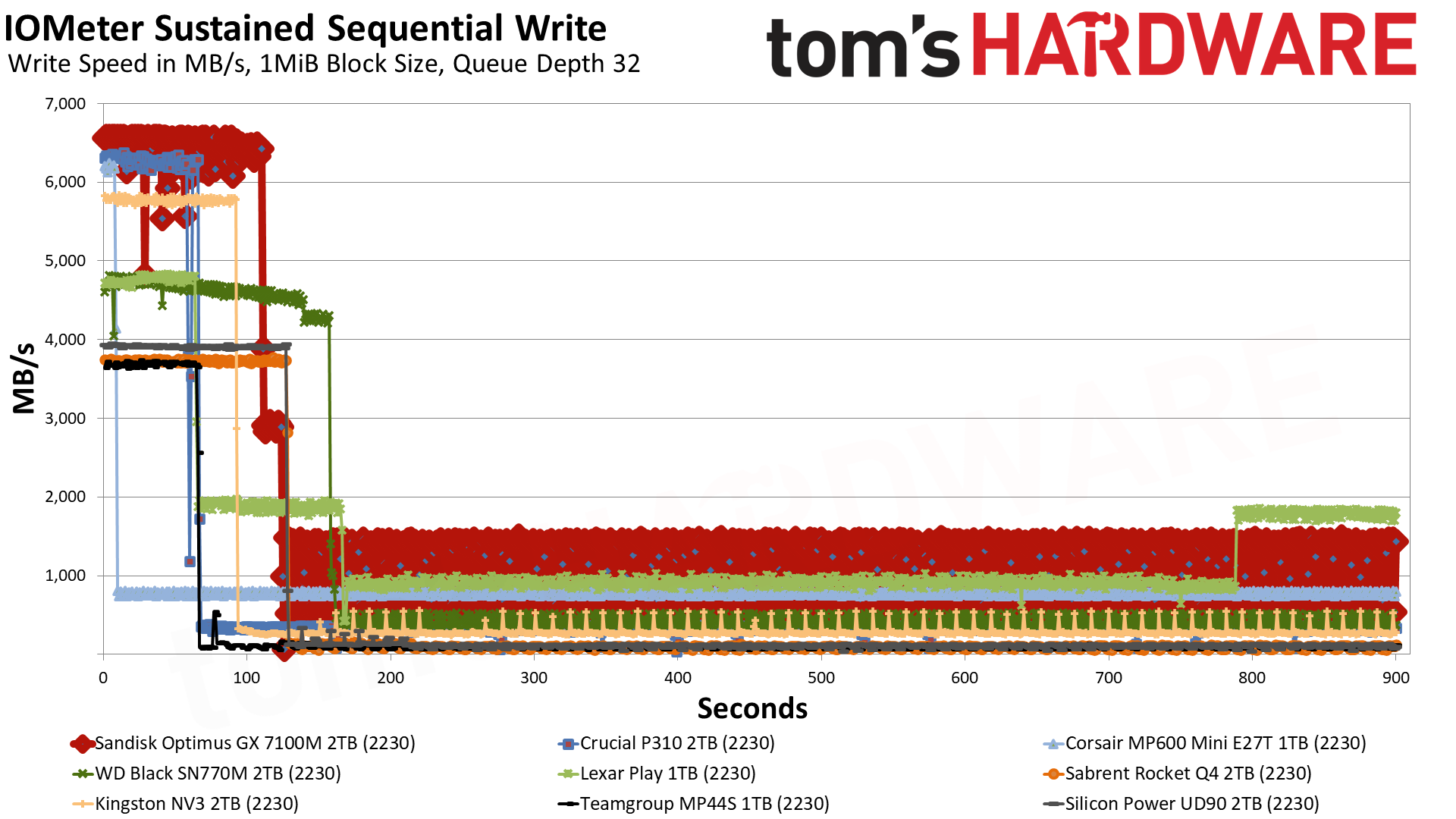
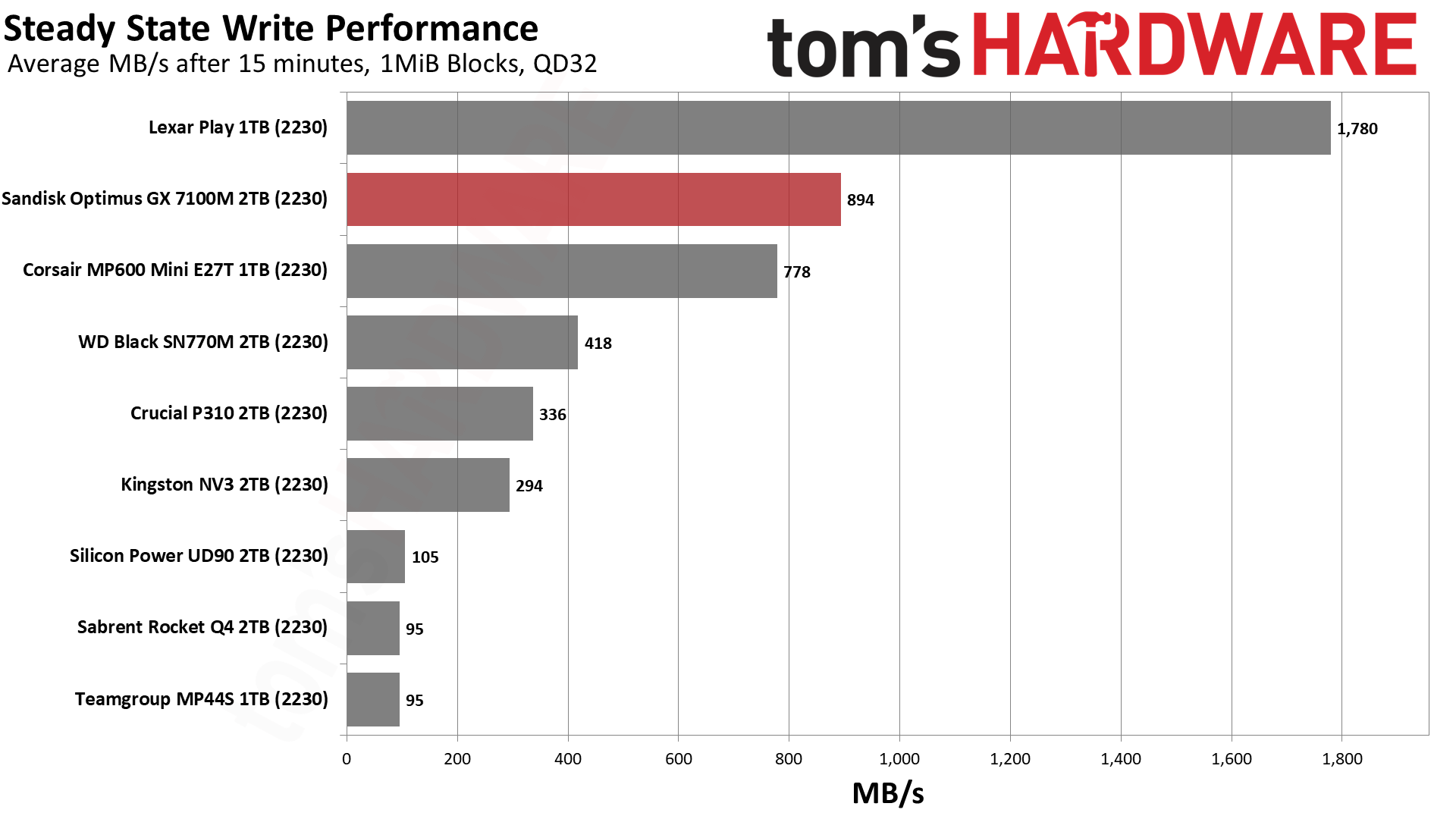
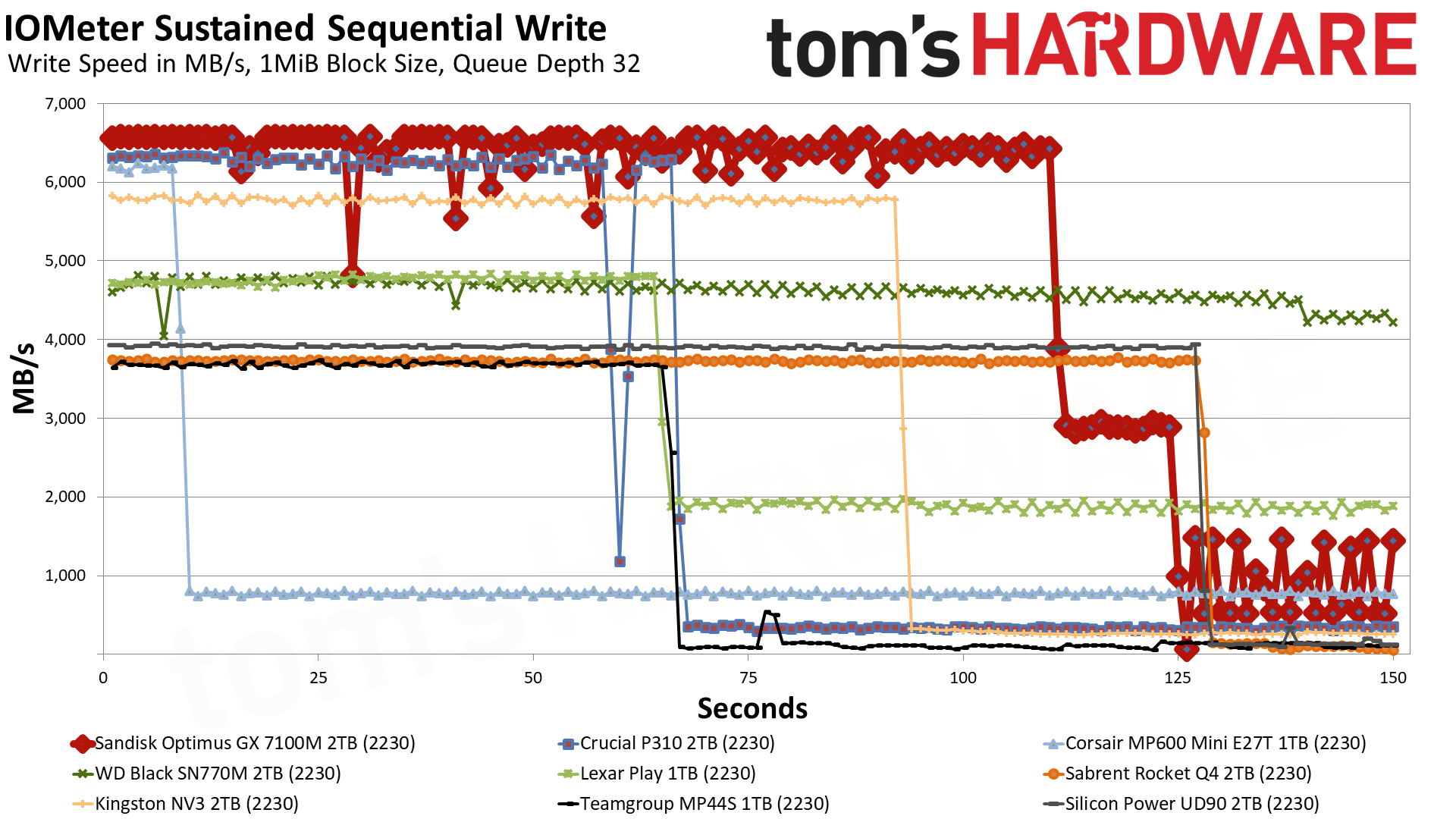
Modern drives tend to write in three states: the pSLC cache, direct to the native flash, and in a folding mode. The first mode is temporary and fast, converting native flash into single-bit mode to trade capacity for speed. When space gets tight, the drive can choose to write straight to the flash. This is slower and can be worse for endurance in some cases. When space is completely exhausted, the drive is forced to wait for data to go through the pSLC cache and be “folded” over to the native flash, is far slower and decreases drive consistency and responsiveness. Most of the time, you want to be in the cache, especially with an M.2 2230 drive, but it’s worth seeing how the drive might behave if it’s left in a fuller state after sustaining writes.
How the pSLC cache is handled varies from drive to drive. A larger cache can handle larger bursts of traffic, but this can leave the drive more vulnerable in some cases. A smaller cache can result in more consistent drive performance. There are also two types of pSLC cache, static and dynamic, with different characteristics. Generally speaking, the static portion is always available, while the dynamic portion is altered with the amount of free space. Proprietary solutions such as Samsung’s TurboWrite and WD’s or Sandisk’s nCache – with nCache 4.0 on this drive – use both types in tandem.
WD’s and Sandisk’s most recent drives have opted for larger caches. This is also true for Samsung, which, with the Samsung 990, has significantly increased the size of the cache. In the 7100M’s case, the cache takes up almost the entire drive. The drive wrote at over 6.4 GB/s for 110 seconds, implying a ~708GB cache. With three bits in TLC needed per pSLC bit, this is quite large for a 2TB drive, although there is a little free space, which helps keep the drive from flatlining completely. Instead, the drive is able to maintain a middle mode around 2.9 GB/s for a small amount of time, which is, honestly, quite fast for such a mode. In most cases, this would be an adequate cushion.
After that, the drive oscillates when hitting the folding mode. Performance is much less consistent as space is periodically freed. We see an actual peak of around 1,450 MB/s here, which is about half of that 2.9 GB/s. This is a common ratio because when you’re folding, you’re essentially writing twice. However, the controller is juggling many things as it is attempting to remain responsive to incoming I/O while moving data in the background. Therefore, performance dips further with a bottom closer to 500 MB/s or so. Over time, this gives us an average of 894 MB/s, which isn’t too bad. By all standards, it’s better than any QLC-based drive and is respectable for a TLC drive with such a large cache.
Power Consumption and Temperature
We use the Quarch HD Programmable Power Module to gain a deeper understanding of power characteristics. Idle power consumption is an important aspect to consider, especially if you’re looking for a laptop upgrade, as even the best ultrabooks can have mediocre stock storage in terms of capacity and performance. Desktops are often more performance-oriented with less support for power-saving features, so we show the worst-case scenario for idle.
Some SSDs can consume watts of power at idle while better-suited ones sip just milliwatts. Average workload power consumption and max consumption are two other aspects of power consumption, but performance-per-watt, or efficiency, is more important. A drive might consume more power during any given workload, but accomplishing a task faster allows the drive to drop into an idle state more quickly, ultimately saving energy.
For temperature recording, we currently poll the drive’s primary composite sensor during testing with a ~22°C ambient. Our testing is rigorous enough to heat the drive to a realistic ceiling temperature, but real-world temperatures will vary due to the environment and workload factors.
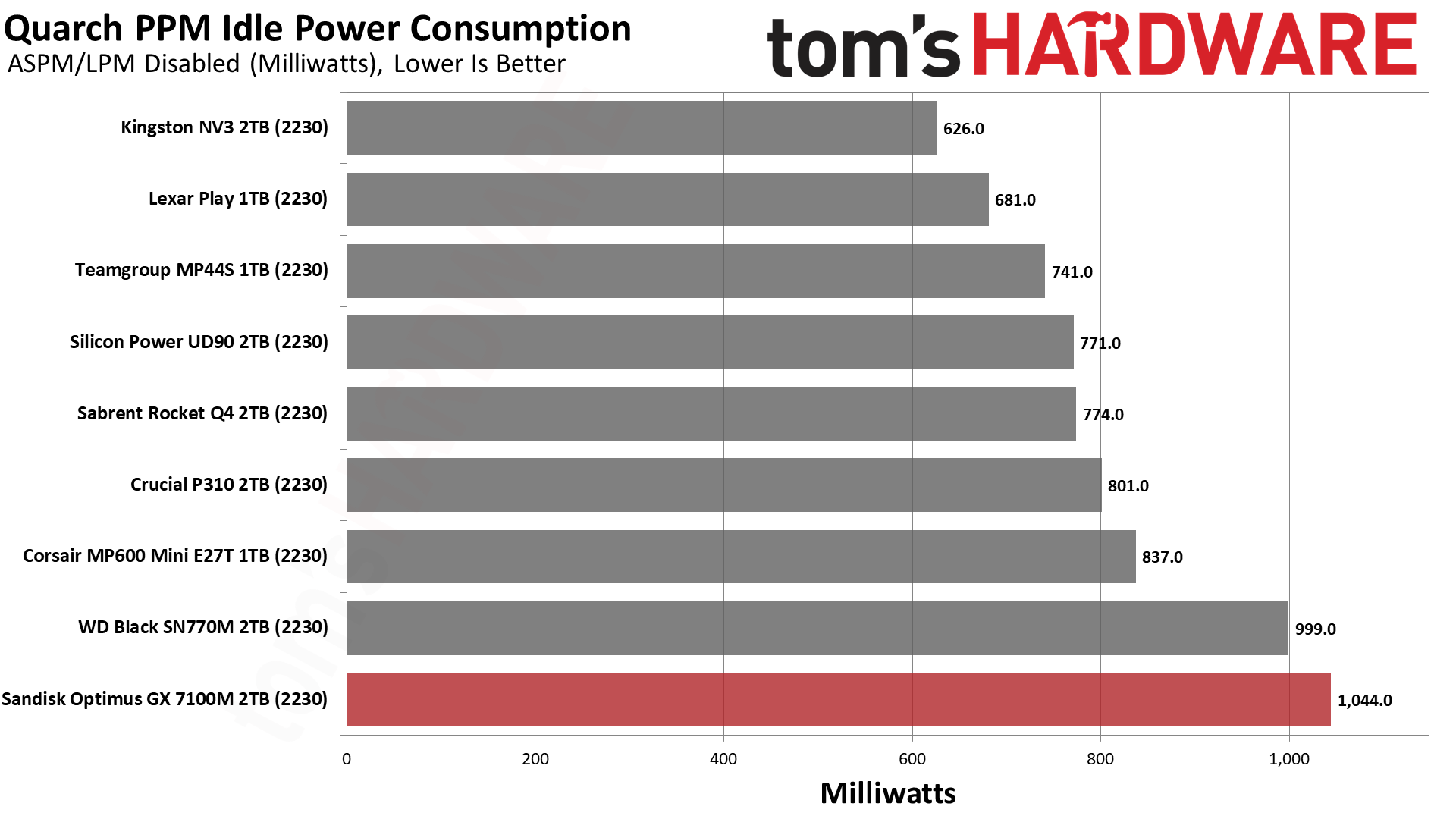
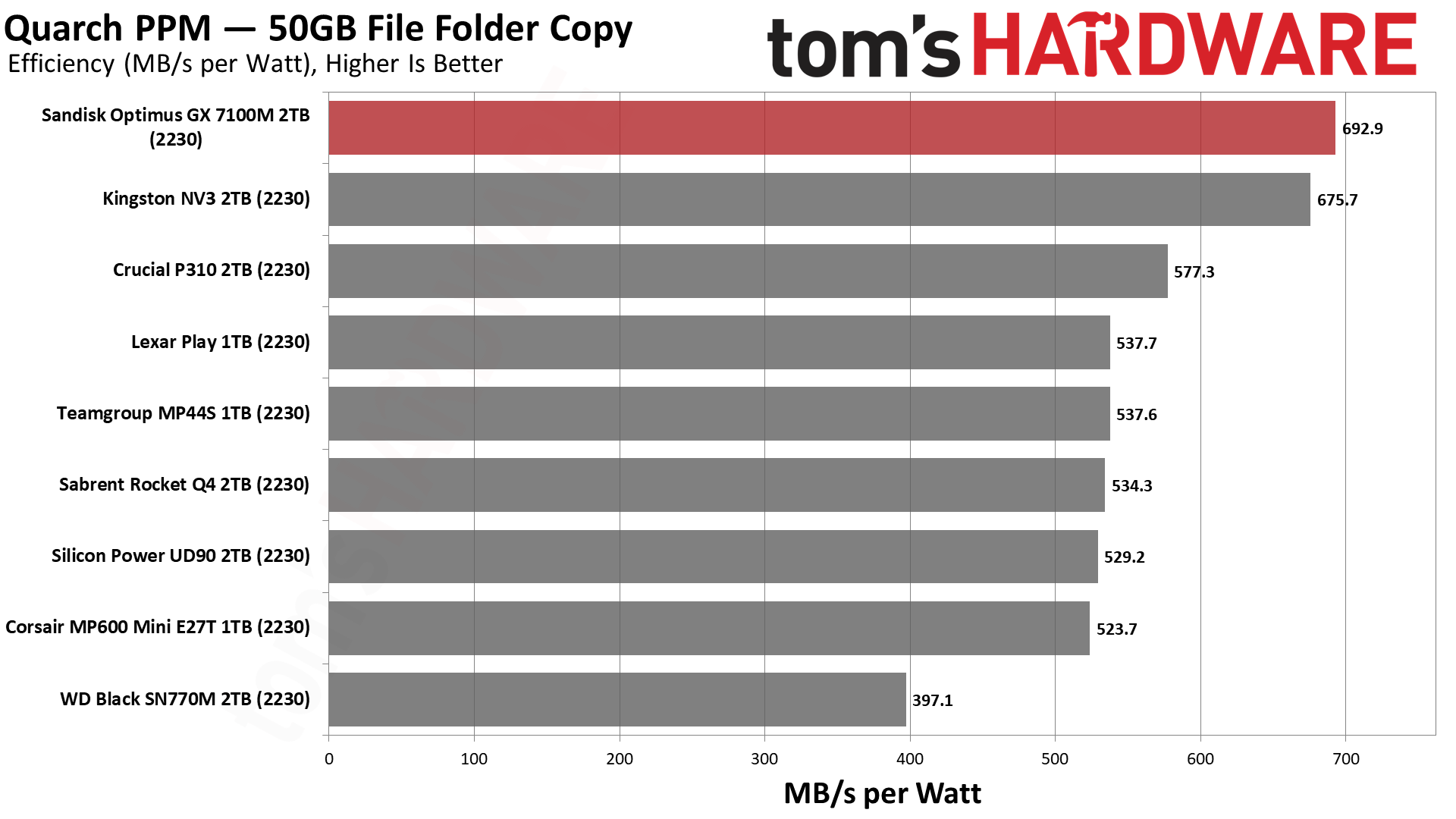
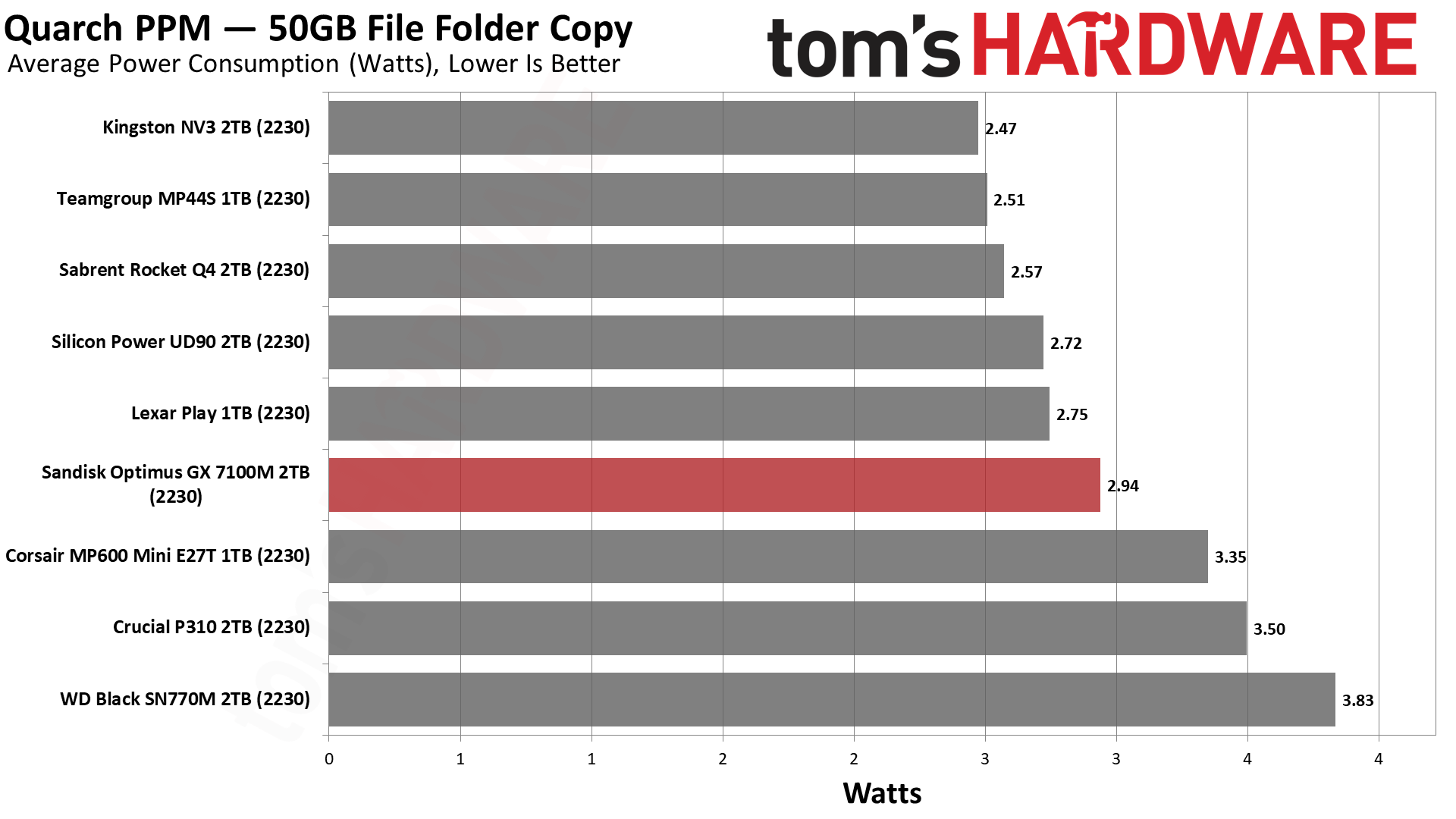
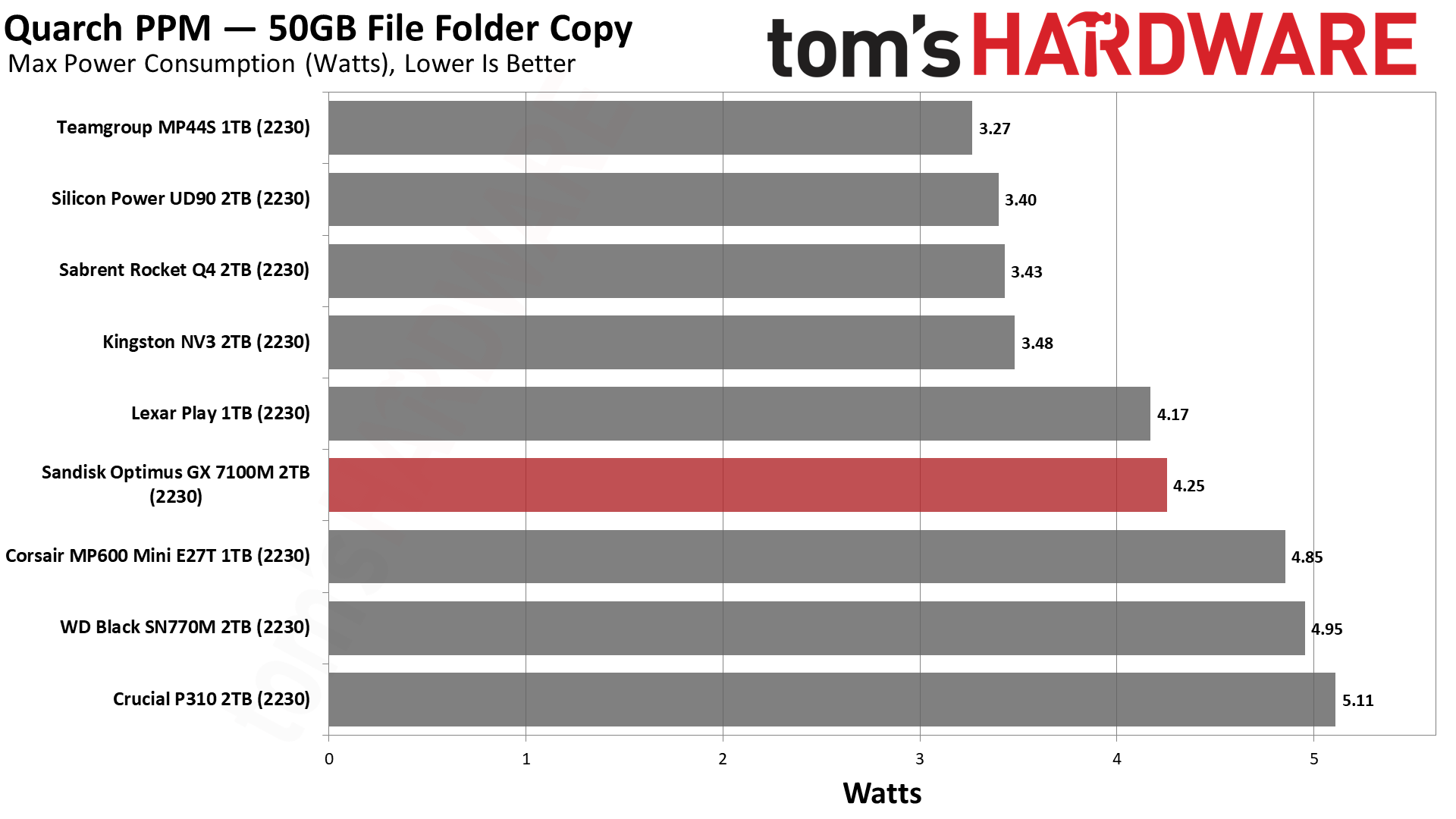
The 7100M does not disappoint in power efficiency. It’s the most power-efficient drive on this list and the most power-efficient M.2 2230 SSD that we’ve tested. We feel like anything over about 500 MB/s per watt is good enough for this segment, but getting above that into the P310 or NV3 range is better. It’s hard to argue with this result.
Drives can have multiple sensors for different things. Temperatures can be reported for the flash memory, the DRAM if present, the PMIC, and the controller. Typically, these values are not super accurate and certainly will be different from directly measured temperatures, as often they are a composite. This essentially means the drive reports a general temperature measured against a range for throttling.
Measured temperatures from the 7100M’s sensors came in at 73°C, 76°C, and 85°C for peak readings. The drive is rated to throttle at 90°C with a critical temperature of 94°C. Generally, we like to have at least 10°C of headroom and preferably twice that. So, the numbers here do give us pause, but they can be explained. If we compare the P310, for example, we have another very efficient drive that, in our testing, got within 5 degrees of throttling. The reason is simple: this short form factor has all the hardware pressed together. It’s hard to get around that fact, and it’s very common for 2230 drives to throttle or overheat in portable devices, especially when traveling in warmer climates. You usually have little to no cooling right next to a maxed-out APU, after all.
Another consideration is the workload. You’re unlikely to have sustained writes of the type we’re doing. If you’re on a Steam Deck or an older device, you’re also going to be running in PCIe 3.0 mode. Drives will run much cooler in that mode or with everyday workloads. To add to that, these temperatures don’t reflect actual internal ones or the real limits of the hardware. You should not assume that high temps like this mean the drive won’t have a long lifespan, especially since your host device will likely spend most of its time sleeping.
That said, we do recommend you treat your drive well. If it is at all possible to improve cooling – and this could be a simple matter of adding some thermal interface material or a low-profile heatsink – then you should consider it. Avoid breaking warranties, of course. A good example of what we’re talking about is the Apple MacBook Neo. The main chip on it runs notoriously hot, and DIYers have shown that even adding just some thermal padding can significantly improve performance. The chip still throttles, though. This is the reality of portable devices like this, and thankfully, your SSD won’t be running full blast like an APU any time soon. So we don’t think this is a major drawback of the 7100M – it’s just difficult to escape – but you should be aware that top-tier Gen 4 performance comes at a cost.
Test Bench and Testing Notes
|
CPU |
Intel Core i9-12900K |
|
Motherboard |
Asus ROG Maximus Z790 Hero |
|
Memory |
2x16GB G.Skill DDR5-5600 CL28 |
|
Graphics |
Intel Iris Xe UHD Graphics 770 |
|
CPU Cooling |
Enermax Aquafusion 240 |
|
Case |
Cooler Master TD500 Mesh V2 |
|
Power Supply |
Cooler Master V850 i Gold |
|
OS Storage |
Sabrent Rocket 4 Plus-G 2TB |
|
Operating System |
Windows 11 Pro |
We use an Alder Lake platform with most background applications, such as indexing, Windows updates, and anti-virus, disabled in the OS to reduce run-to-run variability. Each SSD is prefilled to 50% capacity and tested as a secondary device. Unless noted, we use active cooling for all SSDs.
Sandisk Optimus GX 7100M Bottom Line
The Sandisk Optimus GX 7100M is, in a word, fantastic. Anyone who loved the WD Black SN7100 as a proper successor to the WD Black SN770, especially for its class-leading random read performance and power efficiency, can now get that in M.2 2230. The Black SN7100 has been the best SSD for laptops, and now smaller portable devices can enjoy new levels of storage comfort, too.
The 7100M doesn’t disappoint with high levels of performance across-the-board and excellent power efficiency. It’s not always the fastest, but it’s very fast where it matters and doesn’t have the power consumption issue of the previous WD Black SN770M. Even though these drives usually end up on a Linux machine such as the Steam Deck with SteamOS, Sandisk’s excellent Windows software suite is a cherry on top if you’re working with that OS, are multi-booting, or need to work with the drive on your main Windows PC. The drive is also great for enclosures, particularly ones for M.2 2230 drives, and you can extend this drive with an M.2 extender accessory for other slots. It’s just a solid product, no matter what.
The drive lacks a full capacity range of SKUs, but we can’t hold that against it. Higher capacities cannot be achieved without going double-sided or up to M.2 2242. Lower capacities have generally been less desirable, and performance would be lower, too. It wouldn’t be the first time a new 2230 model was limited to 1TB, but Sandisk is going for 2TB out of the gate. Sandisk opted for the two most popular capacities, and performance is stellar for both. Power consumption is also low for both, which is useful for the battery-limited target devices for the drive. It’s really hard to find fault here.
Although it’s not easy to find downsides to this drive, we do feel there are enough drawbacks to prevent it from getting a perfect score. We feel the pricing isn’t too far out there given the current market, and that aside, we’re then looking at performance and cooling. Performance is not always consistent across our tests, and while Sandisk’s pSLC optimization makes sense within the greater product stack, they could have taken a cue from Phison and been more conservative with it. There are people who will want to use this drive in fast enclosures, and having more consistent, sustained writes could help them. But this is a nitpick.
Of more concern is the heat output of the drive, which, to be fair, is also not really Sandisk’s fault. This level of performance in a tight package is going to put out some heat. Because the drive has to fit in a range of devices, Sandisk can’t really throw on a heatsink or anything like that. The drive will be fine in any Gen 3 device and, hopefully, any properly designed Gen 4 device. Alternative drives do not necessarily offer any advantage over the 7100M here, either. Nevertheless, we’ve seen from newer controller designs like the Phison E31T that you could probably do better in this form factor. Sandisk is using existing technology from its stack, and that makes the most financial sense, but that also leaves in our mind the knowledge that a better product could exist.
We’d say that’s quite complimentary to Sandisk, considering the 7100M is the best M.2 2230 drive on the market. If you’re looking for the best 2230 drive, this is it. Your experience is going to be fantastic in every way – fast load times, good power consumption levels, and software support with True Image and a respected toolbox if you need it. You will pay a premium for it, but particularly for an enthusiast Gen 4 device, this is well worth it. On the other hand, your device might come with a fast, capacious drive, so you wouldn’t be looking at the 7100M, anyway. If you’re on the budget end of things, you can save money here, too. Any of the other 2230 drives on the list will probably be sufficient in that case. The 7100M is an investment, but a sound one, and we can highly recommend it.
MORE: Best SSDs
MORE: Best External SSDs
MORE: Best SSD for the Steam Deck