AMD Ryzen 7 7700X3D vs Ryzen 7 7800X3D faceoff — seeing double with Zen 4 X3D
AMD recently expanded its X3D lineup with the Ryzen 7 7700X3D, a new entry that slots in below the Ryzen 7 7800X3D as a more affordable way to get 3D V-Cache on the AM5 platform. Launched on July 16 at $329, the 7700X3D is essentially built from the same silicon as the 7800X3D, just with lower clocks and a price tag that undercuts it by $120 at launch.
The Ryzen 7 7800X3D, on the other hand, needs no introduction at this point. Launched back in April 2023 at $449 (now $360), it quickly became one of the most recommended gaming CPUs on the market and has held that reputation for over three years. AMD has kept it in the lineup even as newer X3D chips took the place at the top of the best CPU for gaming charts, which says a lot about how well it has aged.
With the 7700X3D now available, AM5 builders finally have a cheaper way into the X3D club without stepping down to the six-core Ryzen 5 7600X3D. The obvious question is how much performance actually gets left on the table by going with the cheaper option, and whether the 7800X3D’s higher clocks are worth the extra money in 2026.
Using data from our CPU benchmark hierarchy and individual reviews of both chips, we’re going to compare them point-for-point across gaming, application performance, power consumption, and more.
Features and Specifications: AMD Ryzen 7 7700X3D vs Ryzen 7 7800X3D
|
CPU |
Street (MSRP) |
Arch |
Cores / Threads (P+E) |
Base / Boost Clock (GHz) |
Cache (L2/L3) |
TDP / PBP or MTP |
Memory |
|---|---|---|---|---|---|---|---|
|
Ryzen 7 7800X3D |
$340 ($450) |
Zen 4 X3D |
8 / 16 |
4.2 / 5 |
104MB (8+96) |
120W / 162W |
DDR5-5200 |
|
Ryzen 7 7700X3D |
$330 |
Zen 4 X3D |
8 / 16 |
4.0 / 4.5 |
104MB (8+96) |
120W / 162W |
DDR5-5200 |
The Ryzen 7 7700X3D is the newer of the two chips here, launching on July 16, 2026, priced at $329. For the time being, it’s a Newegg exclusive in North America, at least for this quarter, before wider retail availability presumably follows. It’s built on the same Zen 4 architecture as the rest of the Zen 4 X3D family and manufactured on TSMC’s N5 process.
The chip features 8 cores and 16 threads, with a base clock of 4.0 GHz and a boost clock of 4.5 GHz. That boost clock is notably 500 MHz lower than the 7800X3D, which is really the main differentiator between the two chips on paper. AMD has essentially taken 7800X3D silicon that couldn’t hit the higher clocks and repackaged it as a cheaper SKU.
For the cache, the Ryzen 7 7700X3D carries the full 96MB of 3D V-Cache-enabled L3, for a total cache pool of 104MB once you factor in L2. This matches the 7800X3D exactly, and it’s the reason the 7700X3D isn’t just a watered-down budget chip.
The Ryzen 7 7700X3D uses the AM5 socket and supports DDR5 memory exclusively, with capacities of up to 128 GB. It also supports PCIe 5.0 connectivity for both storage and GPU lanes. The chip has a 120W TDP, identical to the 7800X3D, and integrated graphics are included in the form of AMD Radeon Graphics with 2 CUs running at 2,200 MHz (same as the 7800X3D).
Now onto the Ryzen 7 7800X3D, which launched in April 2023. It’s also an 8-core, 16-thread Zen 4 chip built on TSMC’s N5 node, so the core architecture and process node are shared between both CPUs. Where it separates itself is clock speed, with a 4.2 GHz base clock and a considerably higher 5.0 GHz boost clock.
The 7800X3D carries the same 96MB of L3 cache as the 7700X3D, along with the same 104MB total cache figure. It also uses the AM5 socket with DDR5-5200 support up to 128GB, the same 120W TDP, and the same PCIe 5.0 lane configuration.
Neither CPU officially supports a traditional multiplier overclock in the way non-X3D Ryzen chips do. However, AMD has gradually opened up more headroom for Curve Optimizer and PBO tuning on its X3D lineup since the 7800X3D’s launch. We’ll get into that in more detail in the overclocking round.
Zooming out, it’s clear these two CPUs are much closer than a typical faceoff matchup. The Ryzen 7 7700X3D and Ryzen 7 7800X3D share the same core count, the same cache pool, the same socket, the same memory support, and the same TDP. The only meaningful difference on paper is the 500 MHz deficit on the 7700X3D’s boost clock, and any price gap that comes with ti (though that gap is small).
That makes this round more or less straightforward, with only one factor tipping the scales in the favor of the 7800X3D.
⭐ Winner: AMD Ryzen 7 7800X3D
The 7800X3D still wins on paper thanks to its higher boost clock, but barely. With identical cache, cores, and platform support, this is about as close as a spec sheet comparison gets.
Gaming Benchmarks and Performance: AMD Ryzen 7 7700X3D vs Ryzen 7 7800X3D
For gaming, we’re looking at a 16-game test suite at 1080p, with settings varying between High and Ultra depending on the title. That should give us a clear picture of how the new Ryzen 7 7700X3D stacks up against its more expensive sibling in the games people are actually going to play. We tested the two CPUs with a GeForce RTX 5090 to remove any potential GPU bottlenecks.
We used identical systems for testing. For a full breakdown of the platforms we used, see our Ryzen 7 7700X3D review and Ryzen 7 7800X3D review.
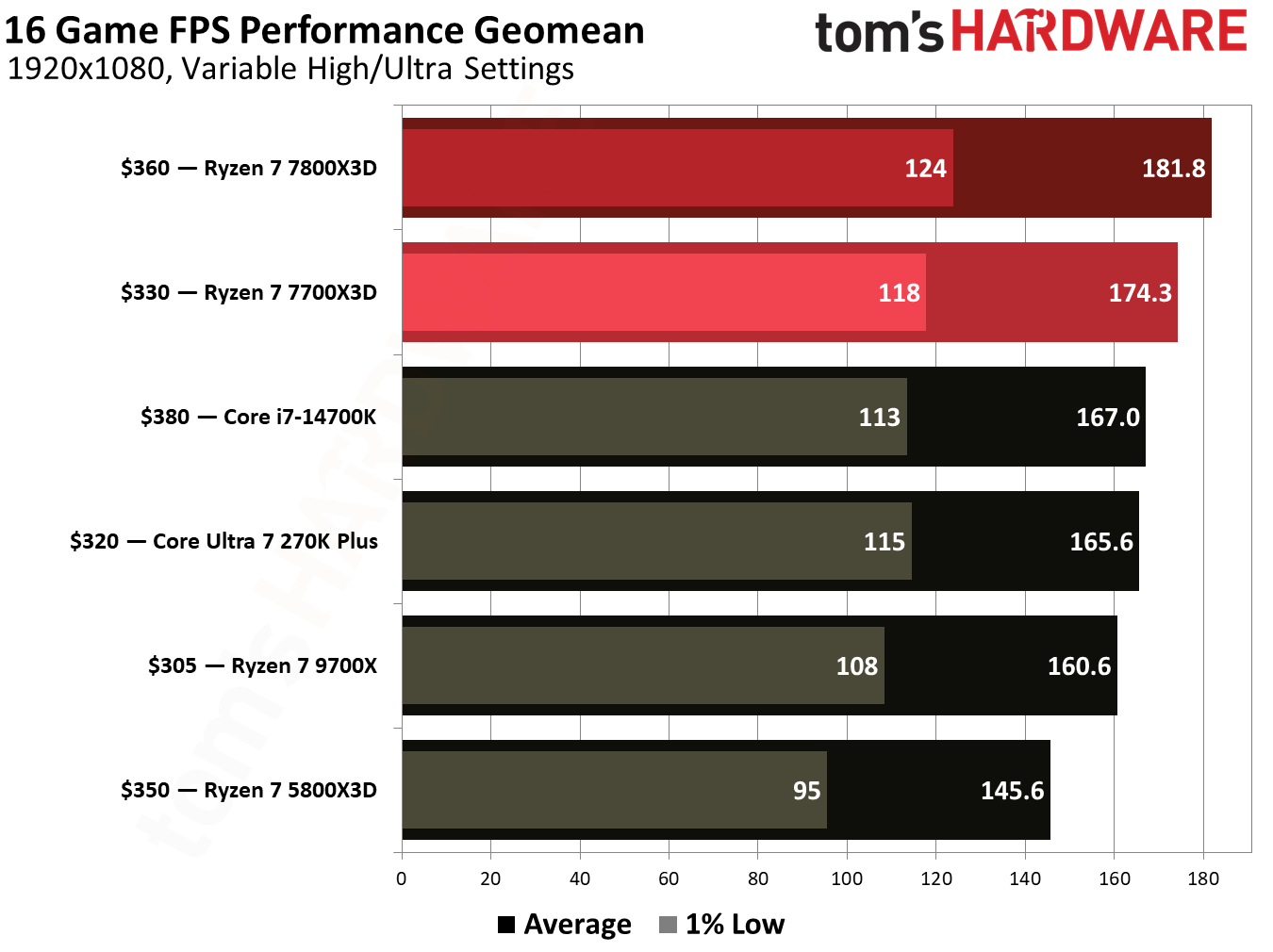
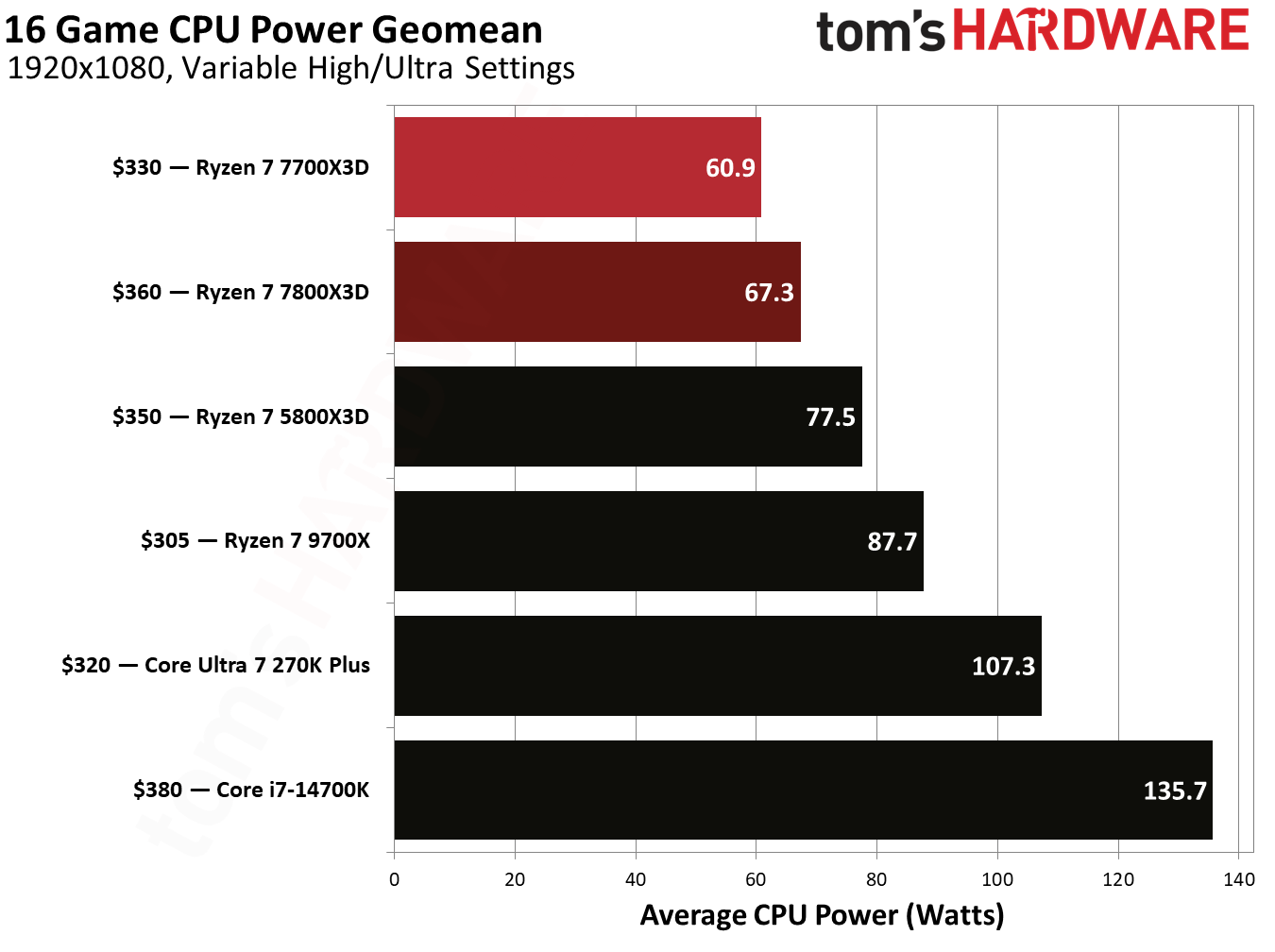
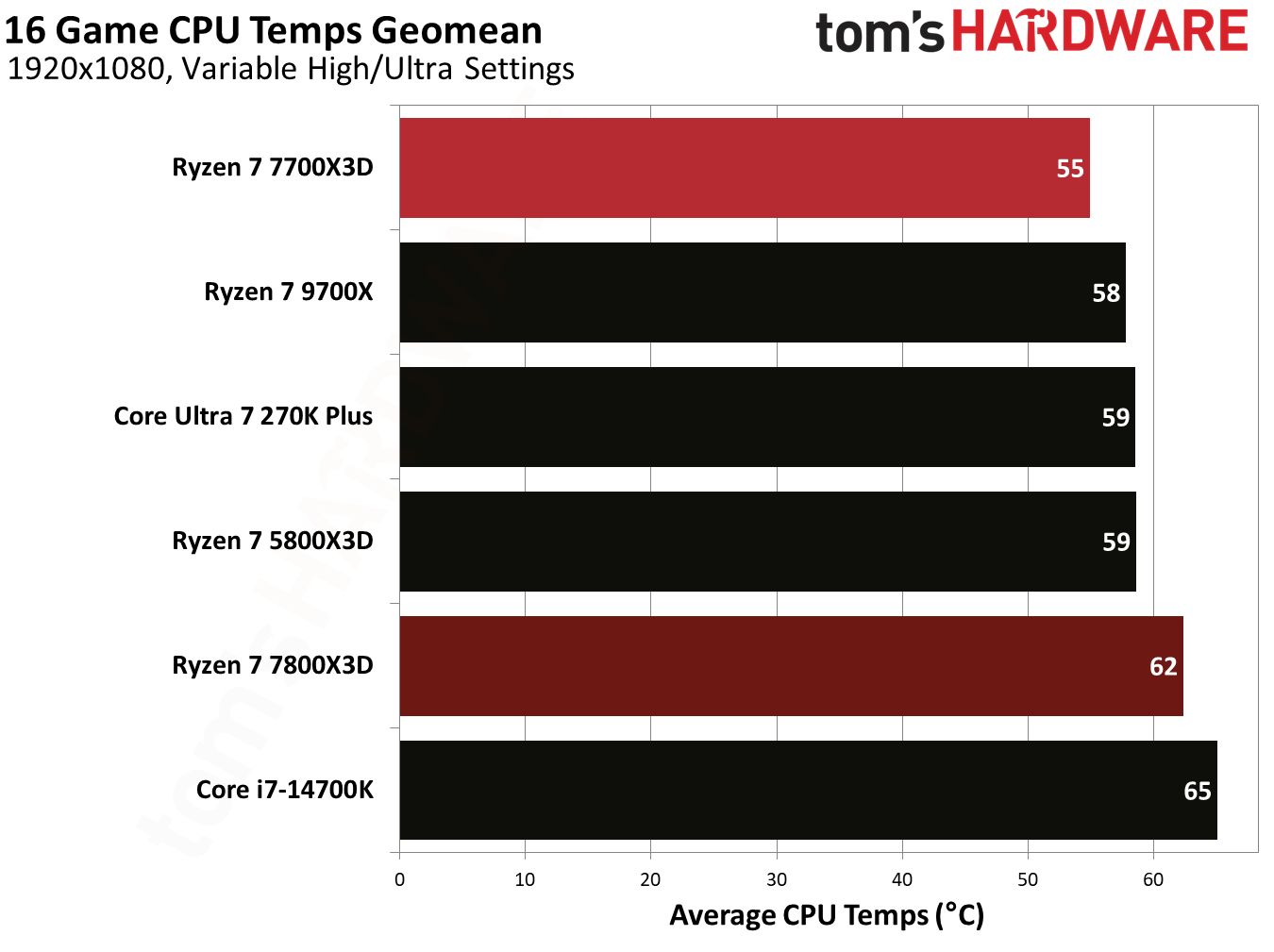
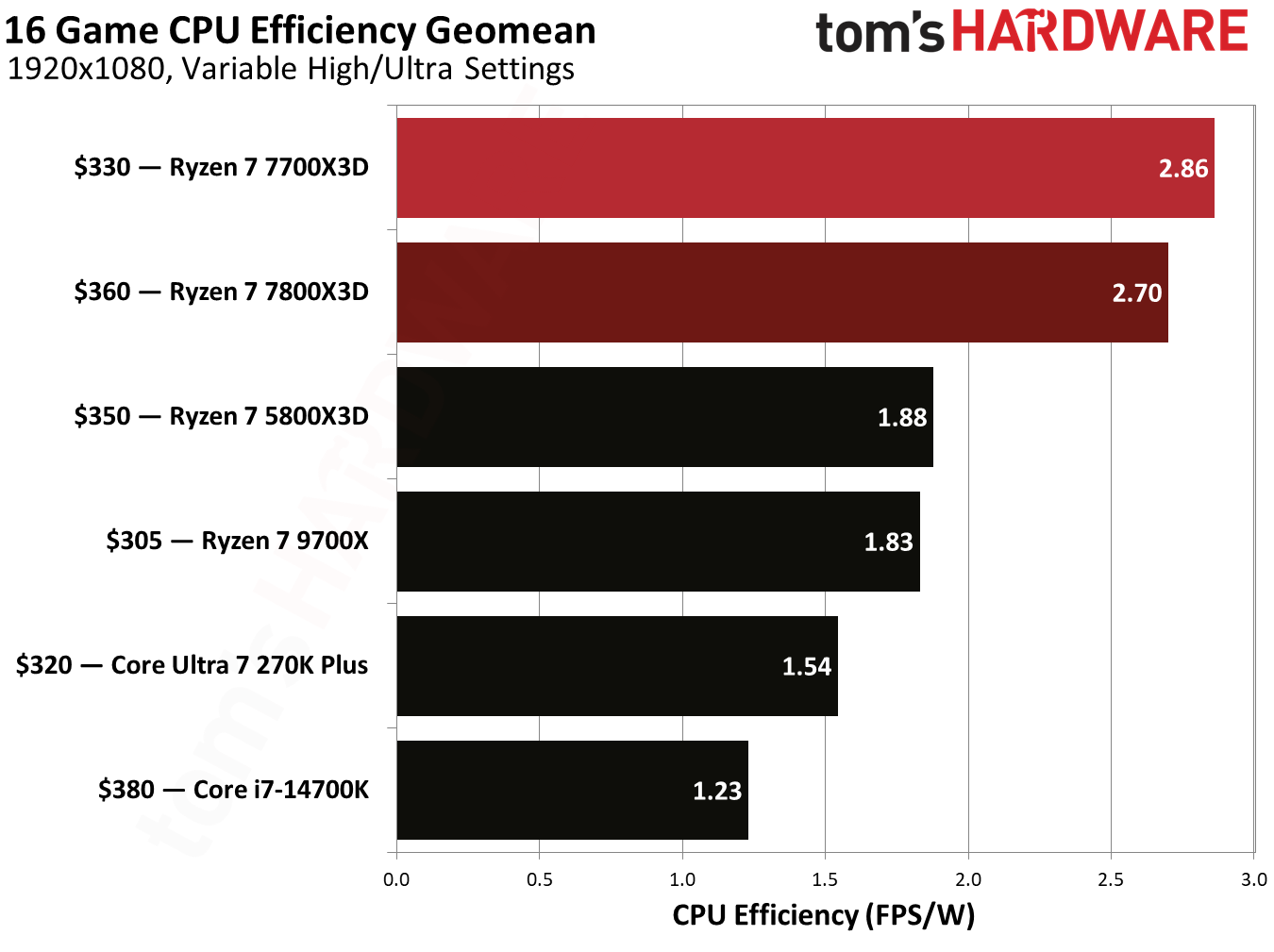
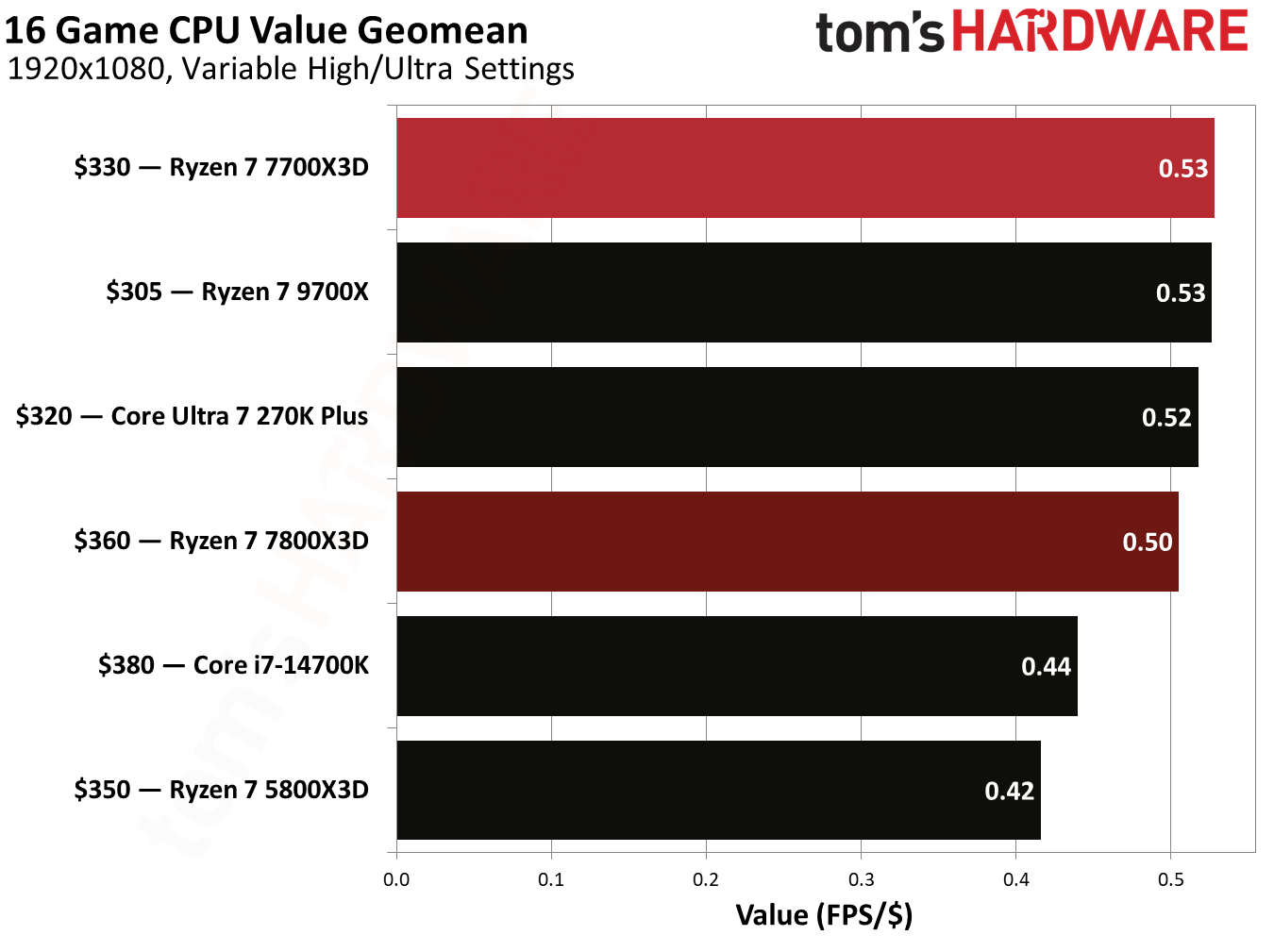
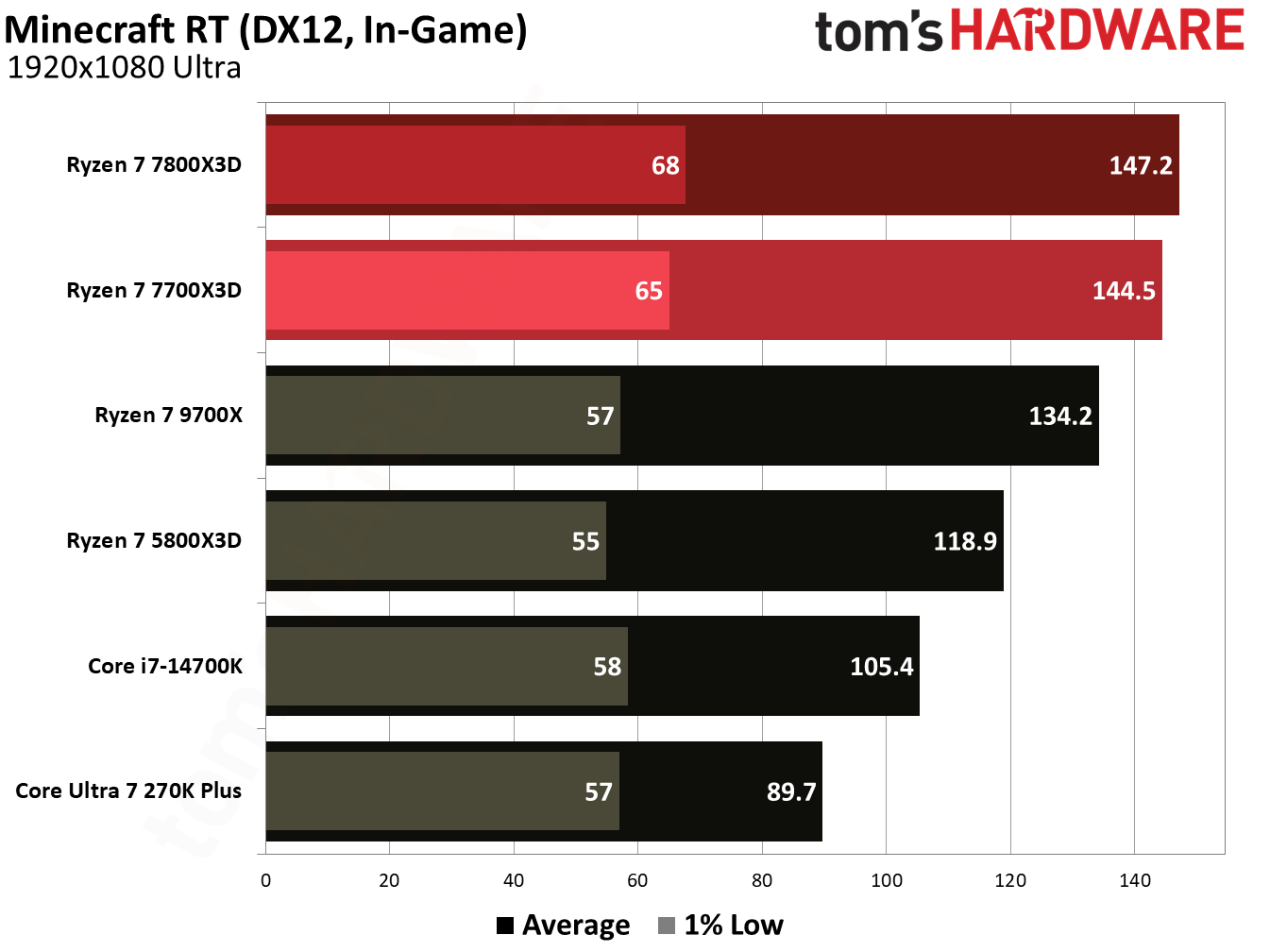
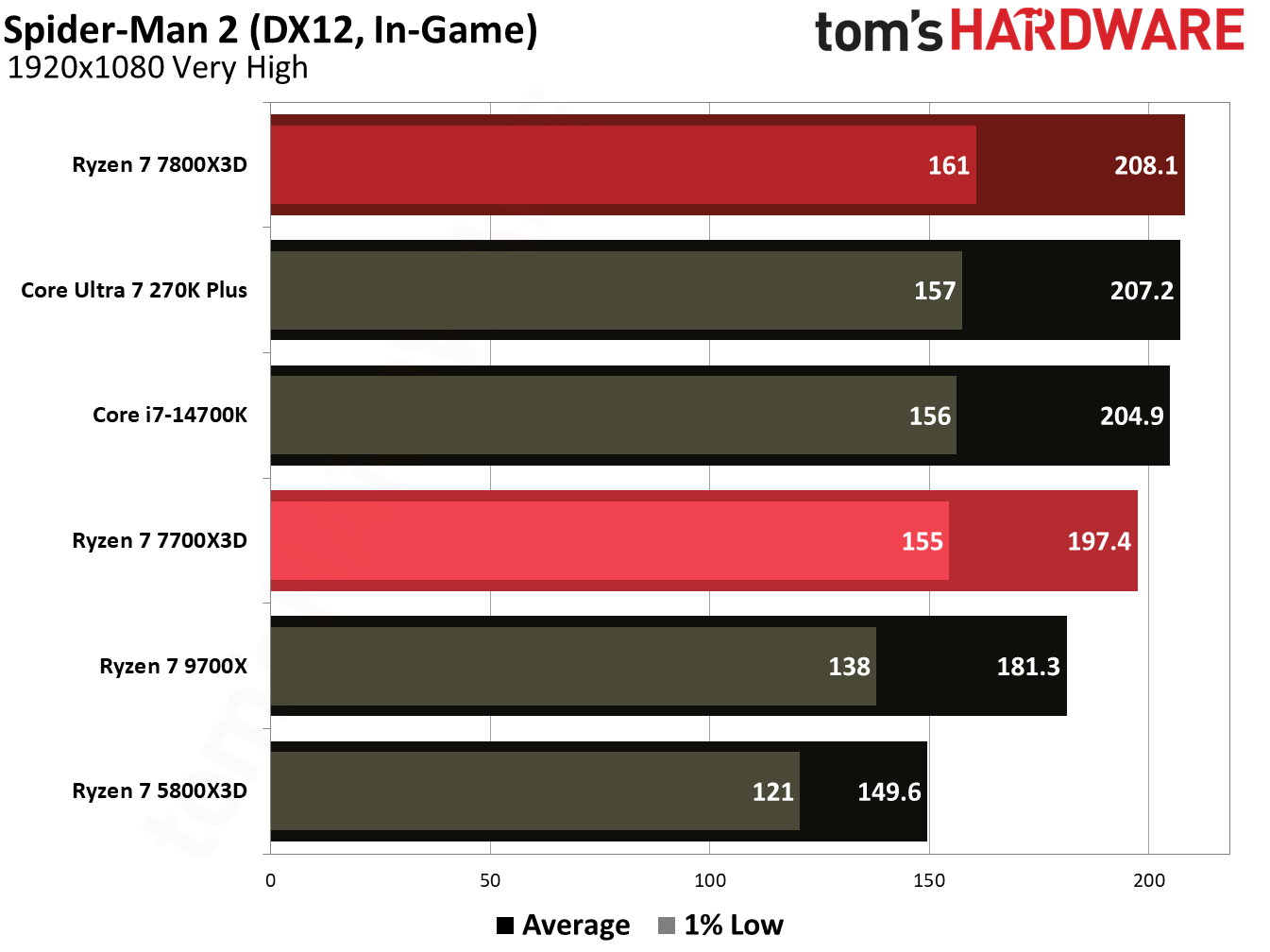
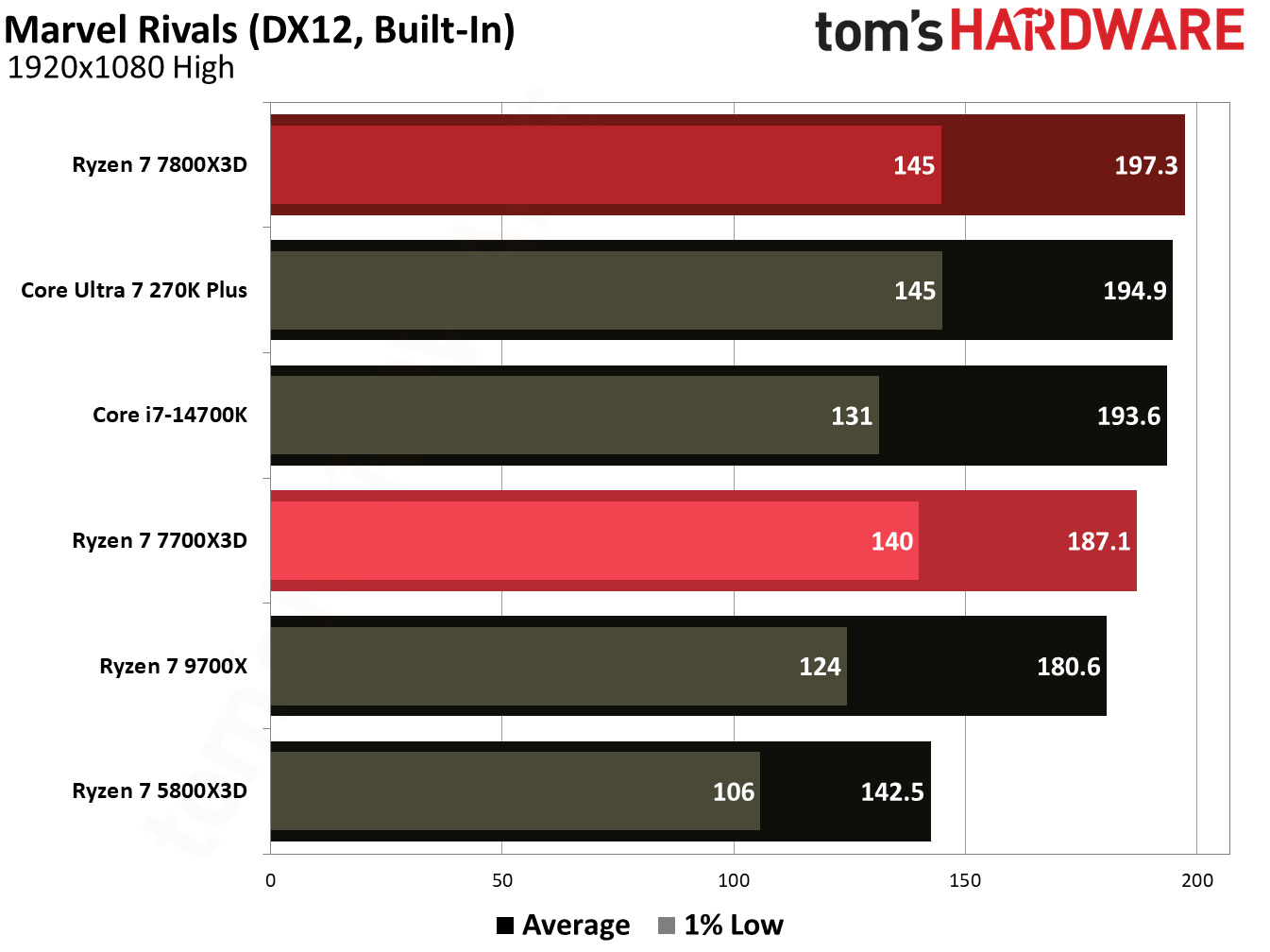
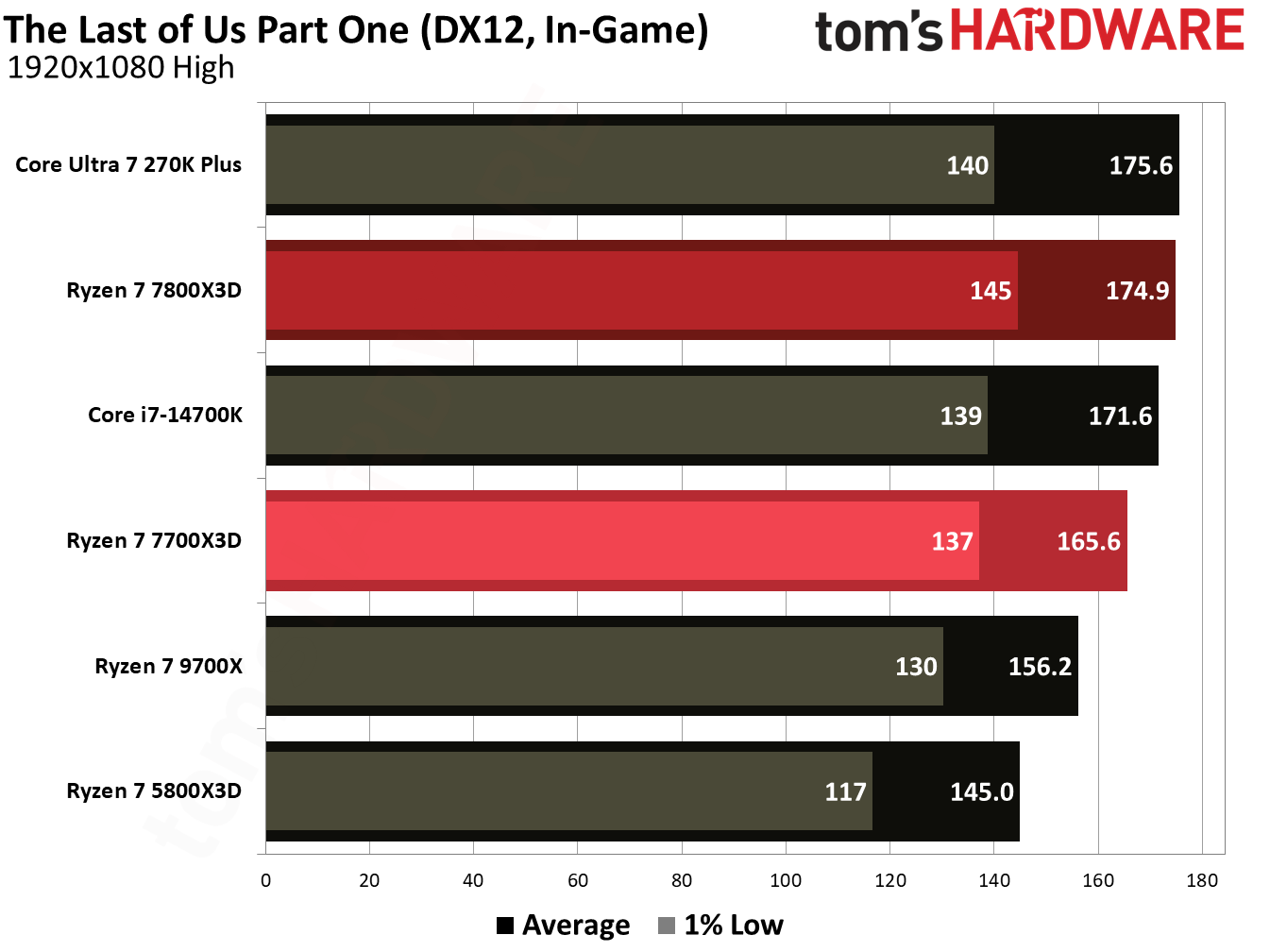
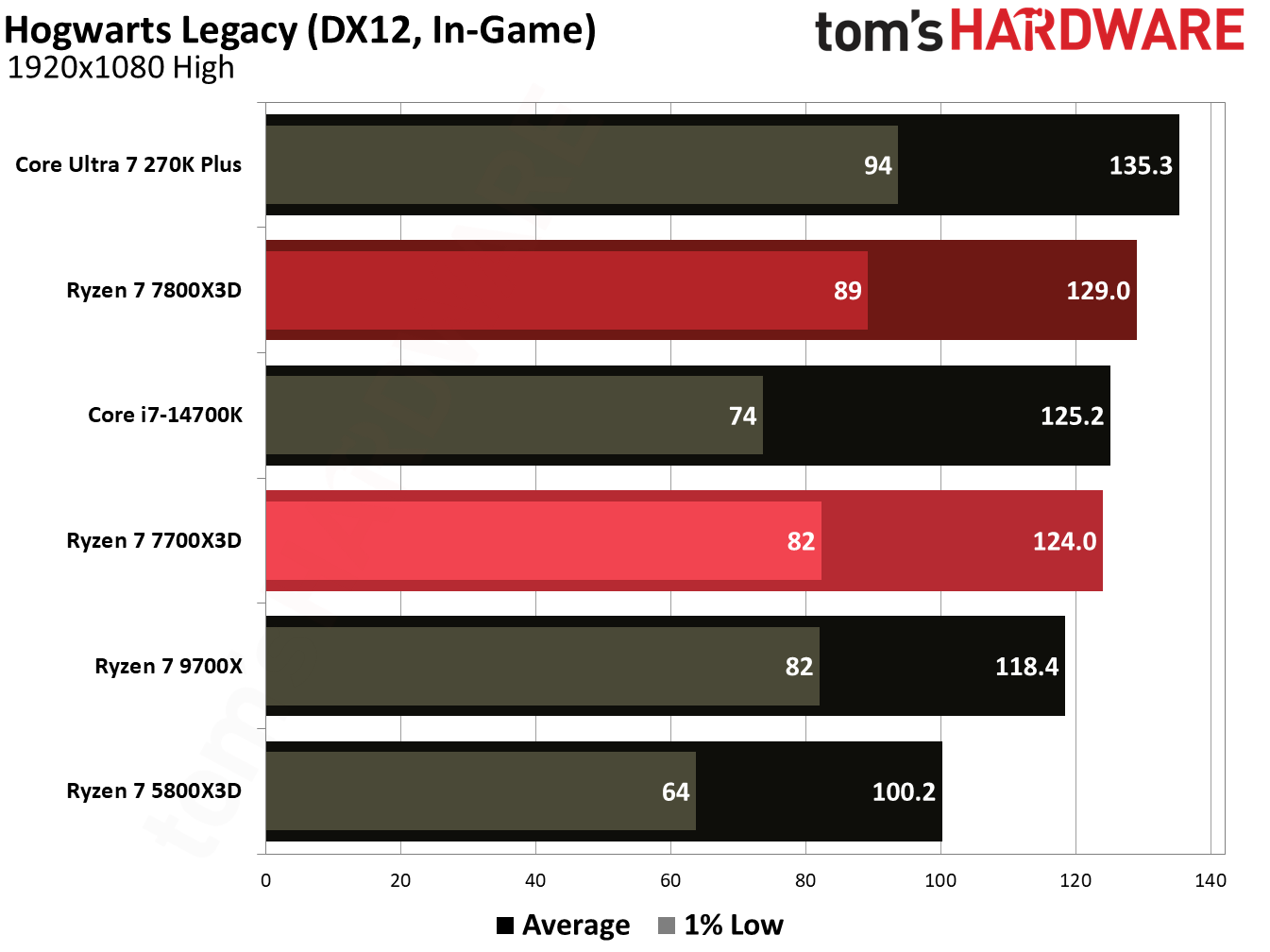
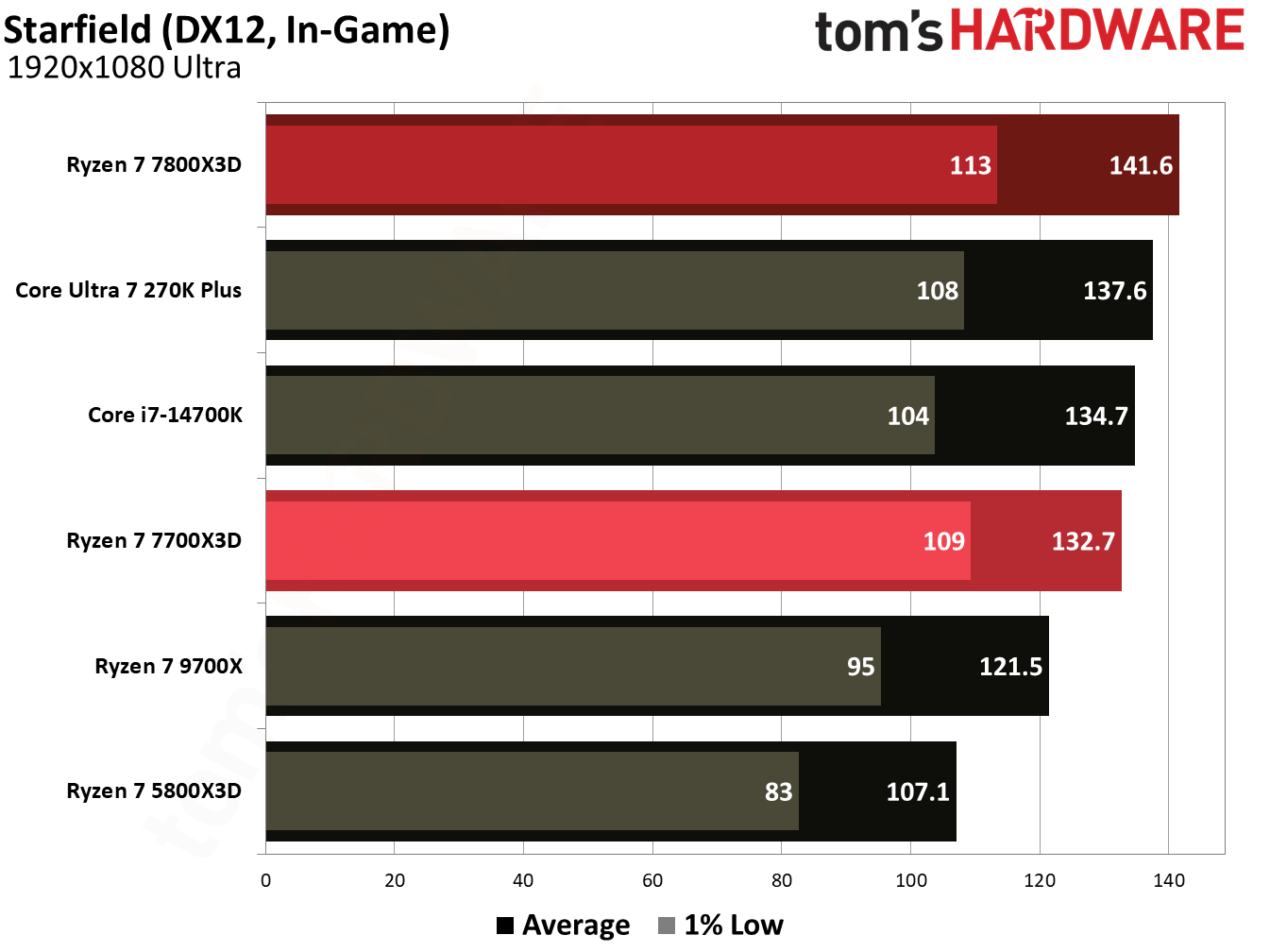
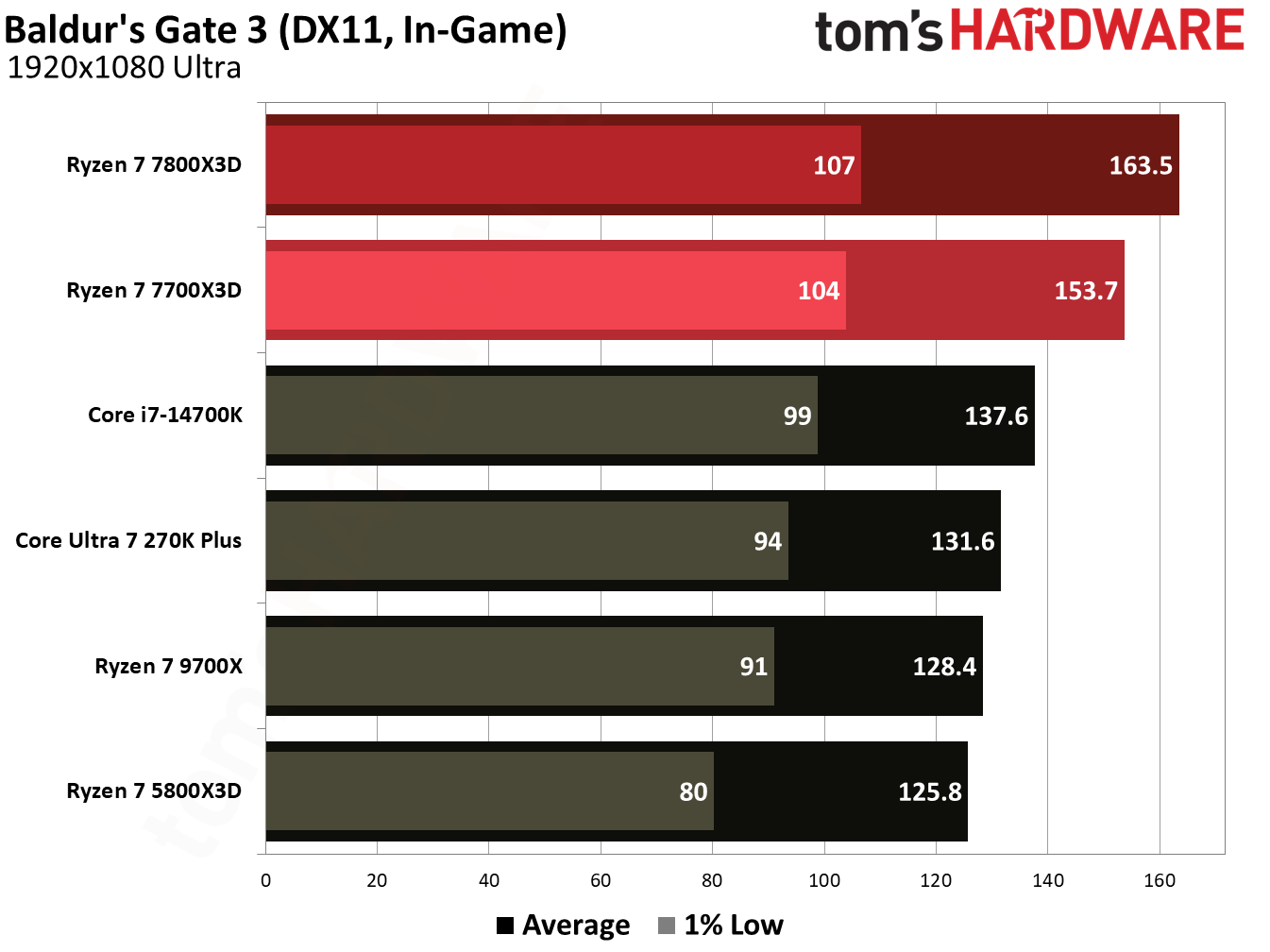
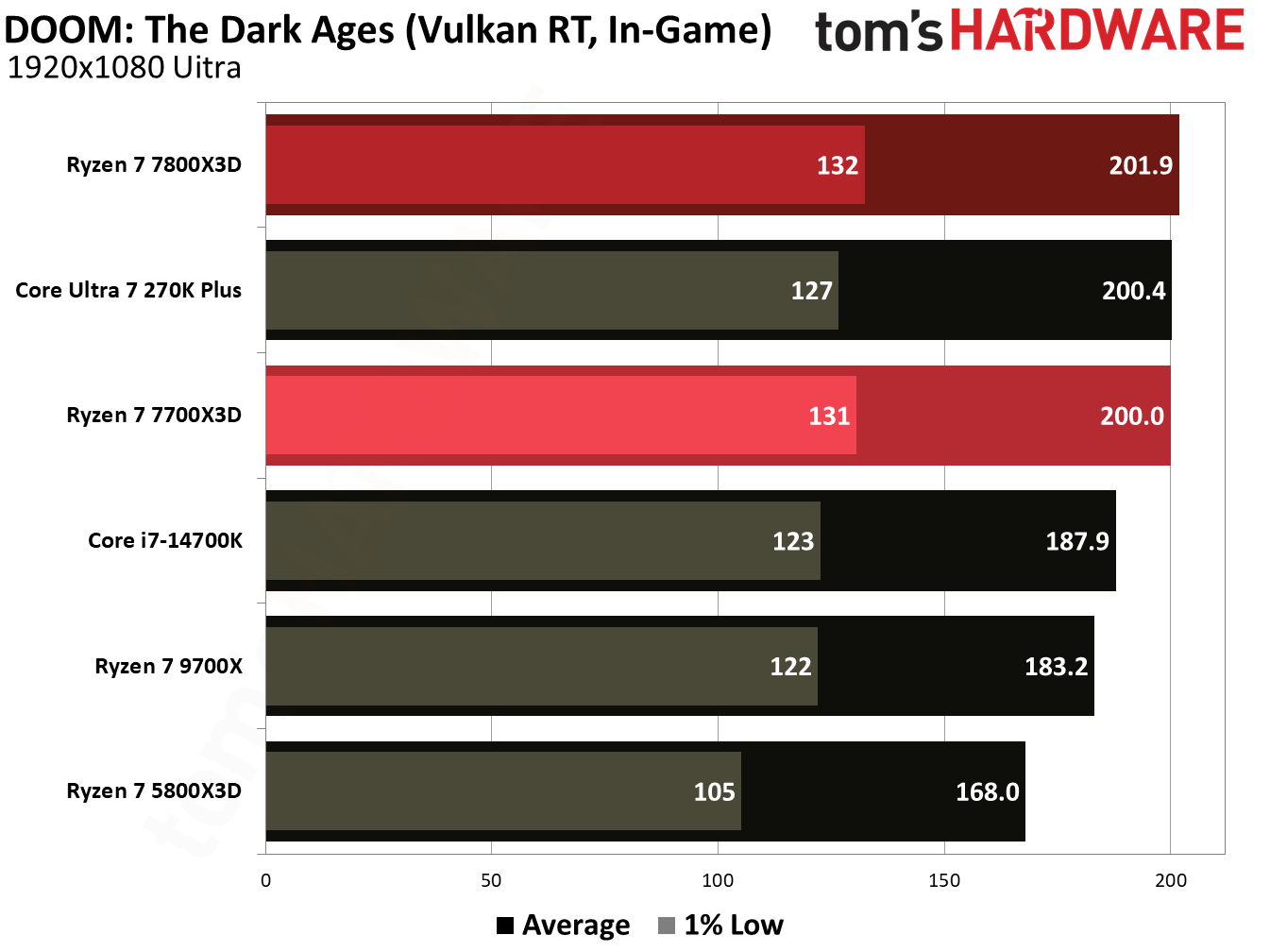
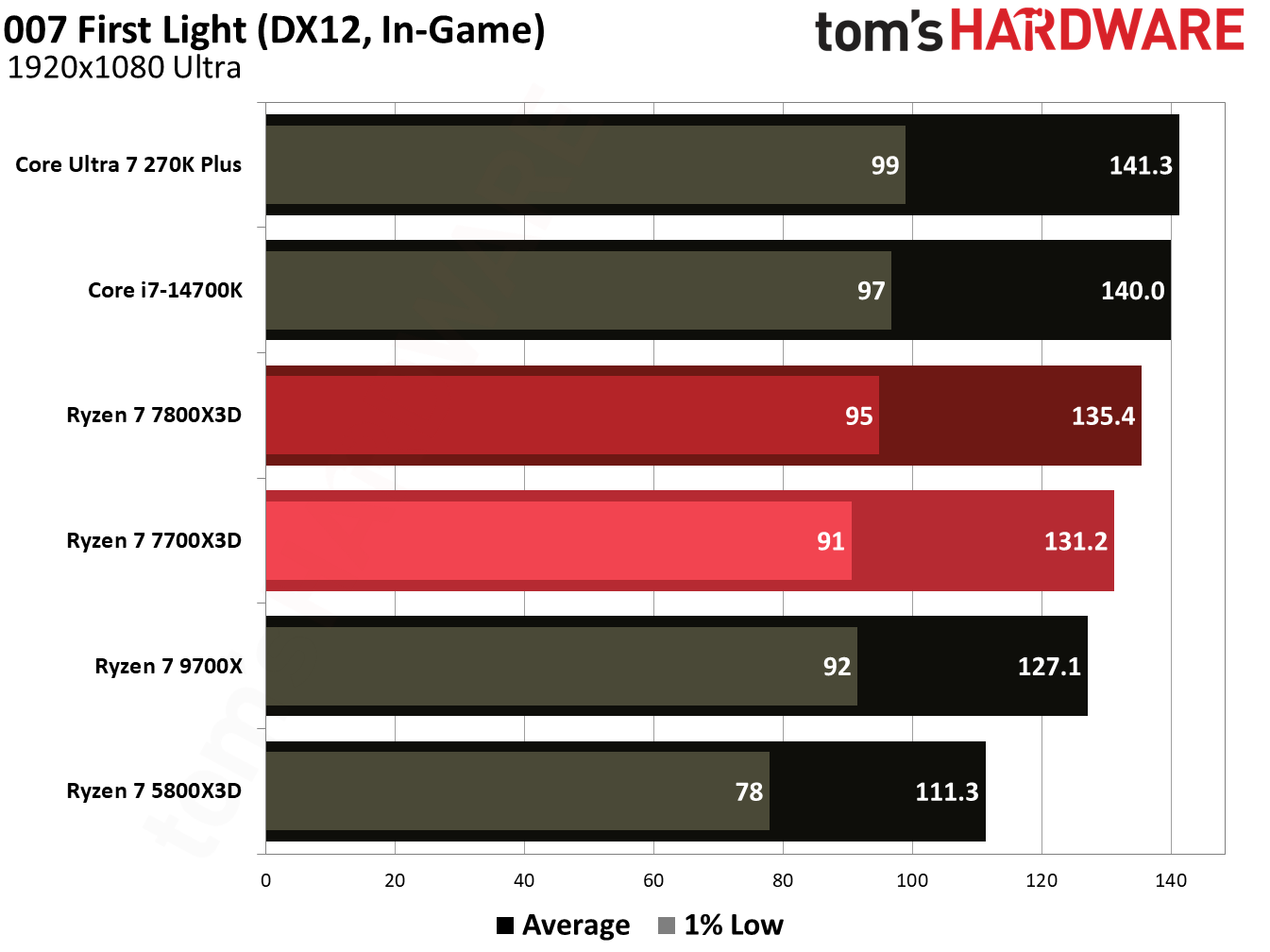
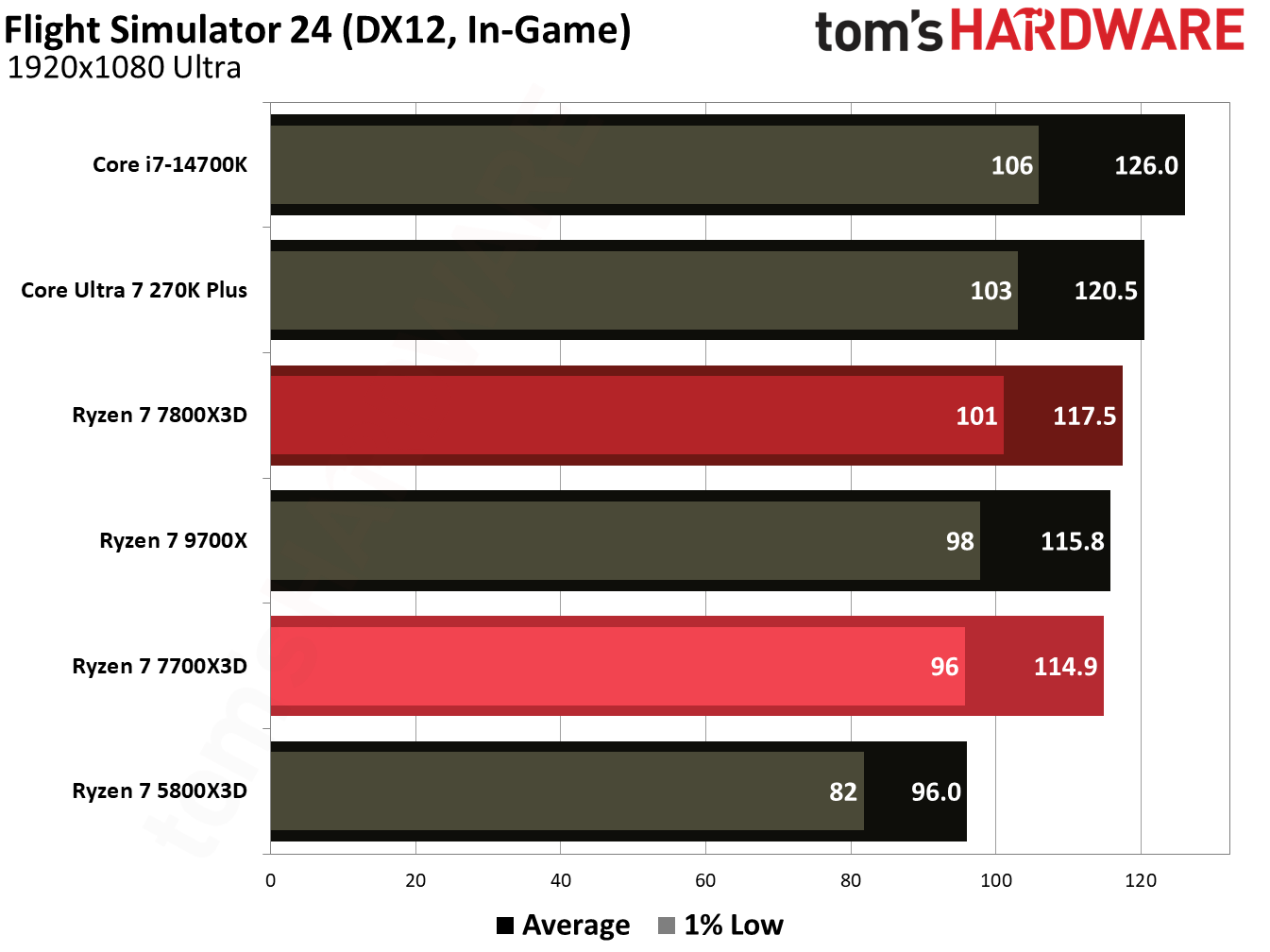
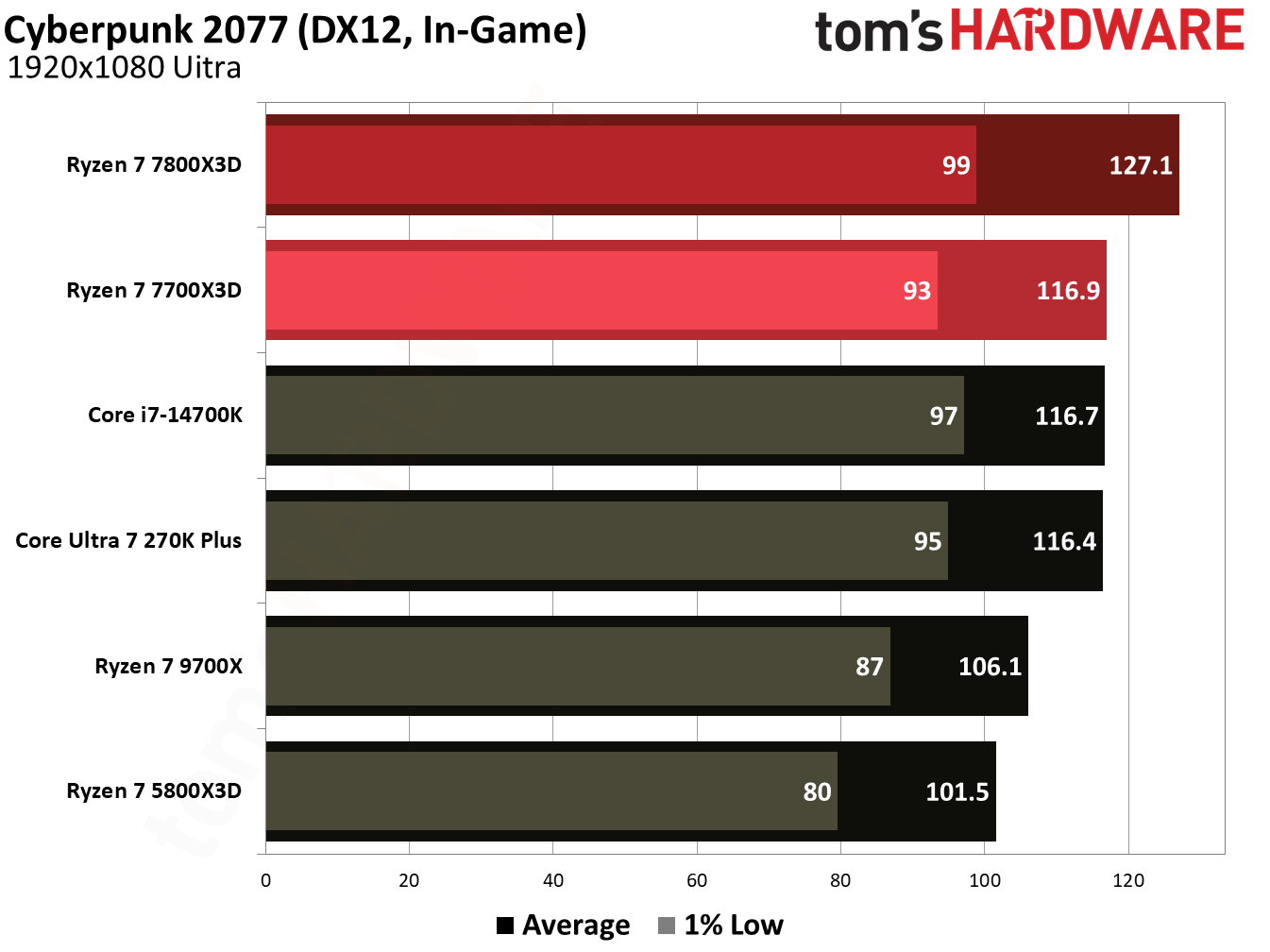
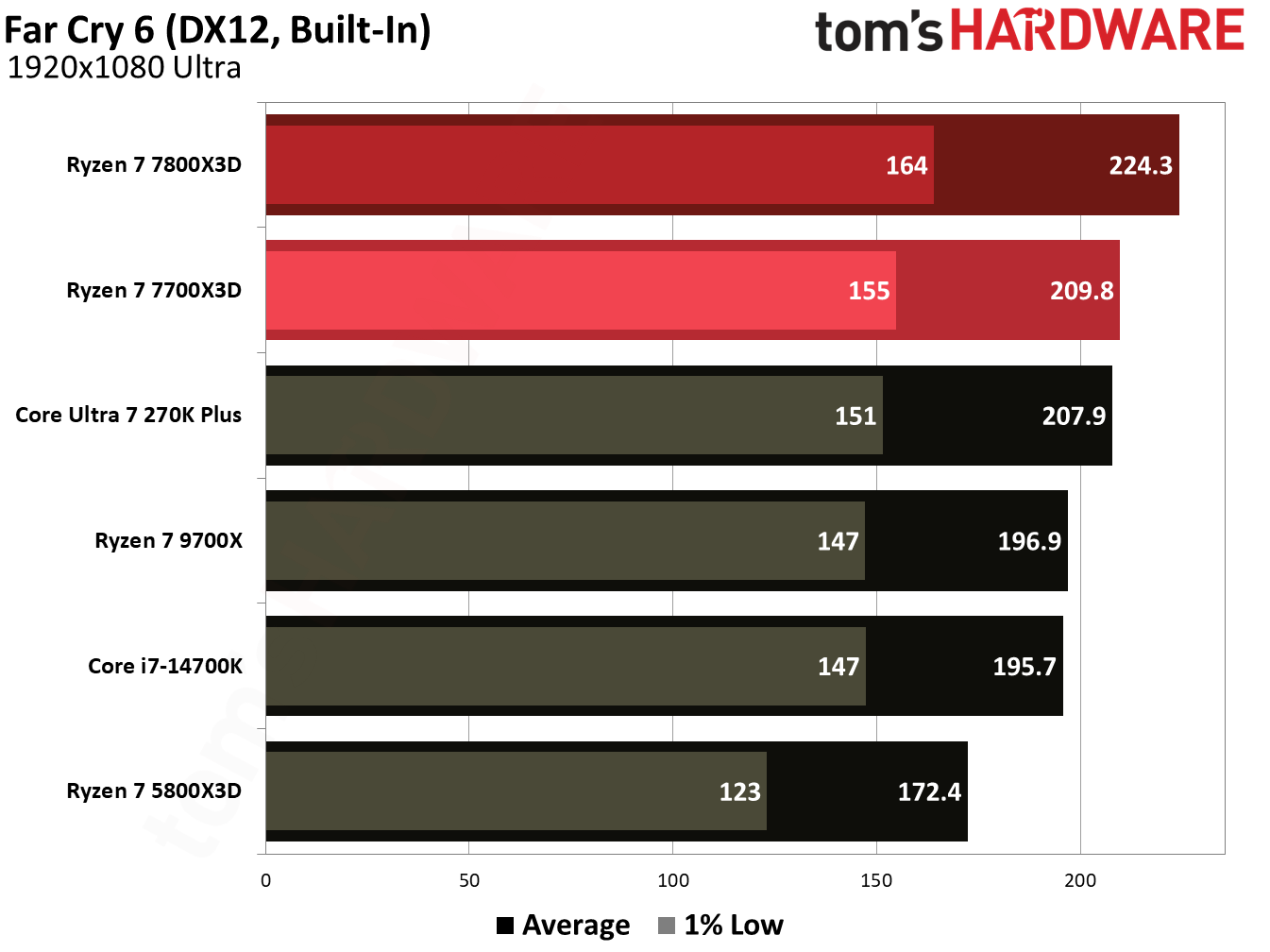
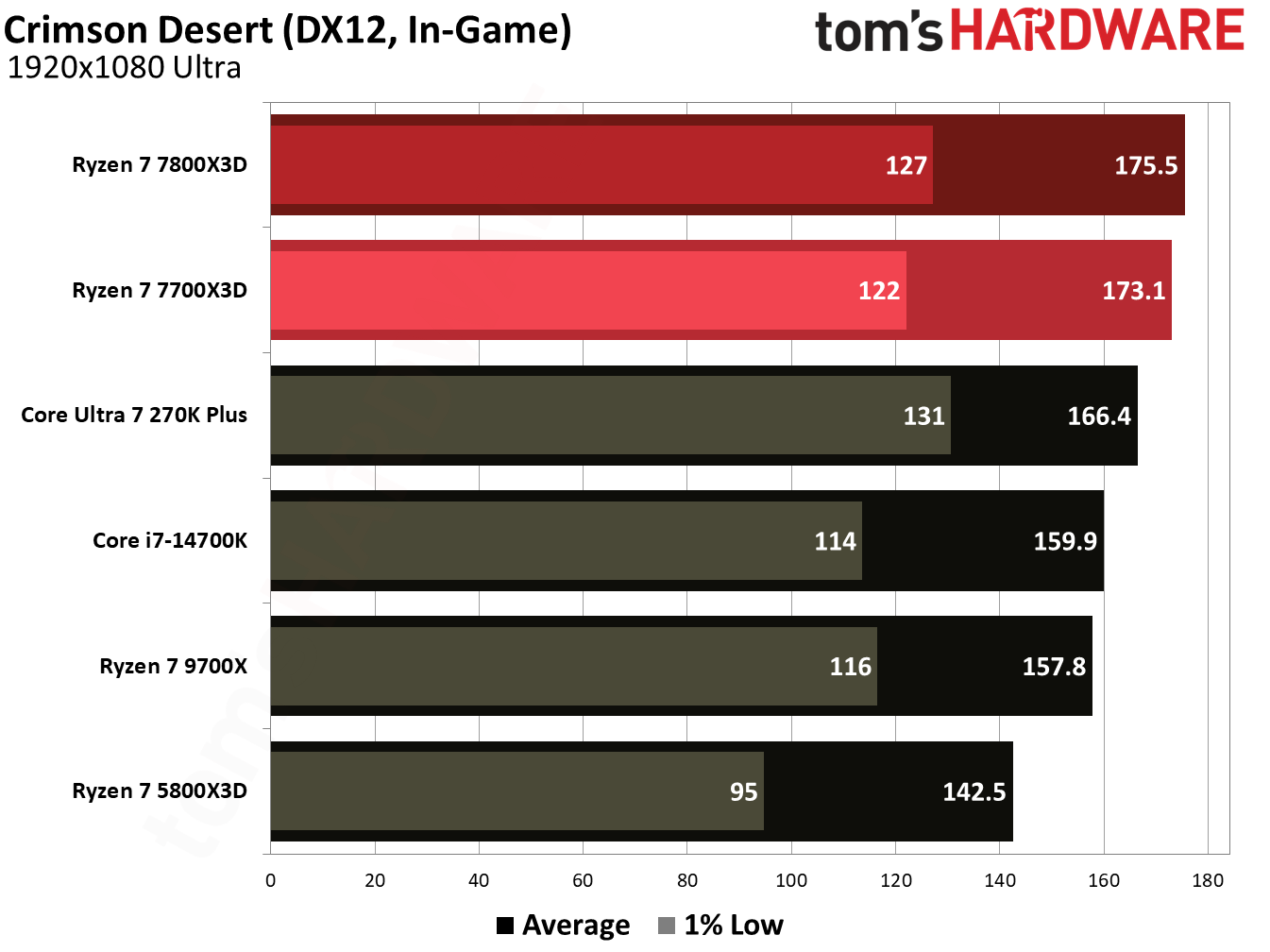
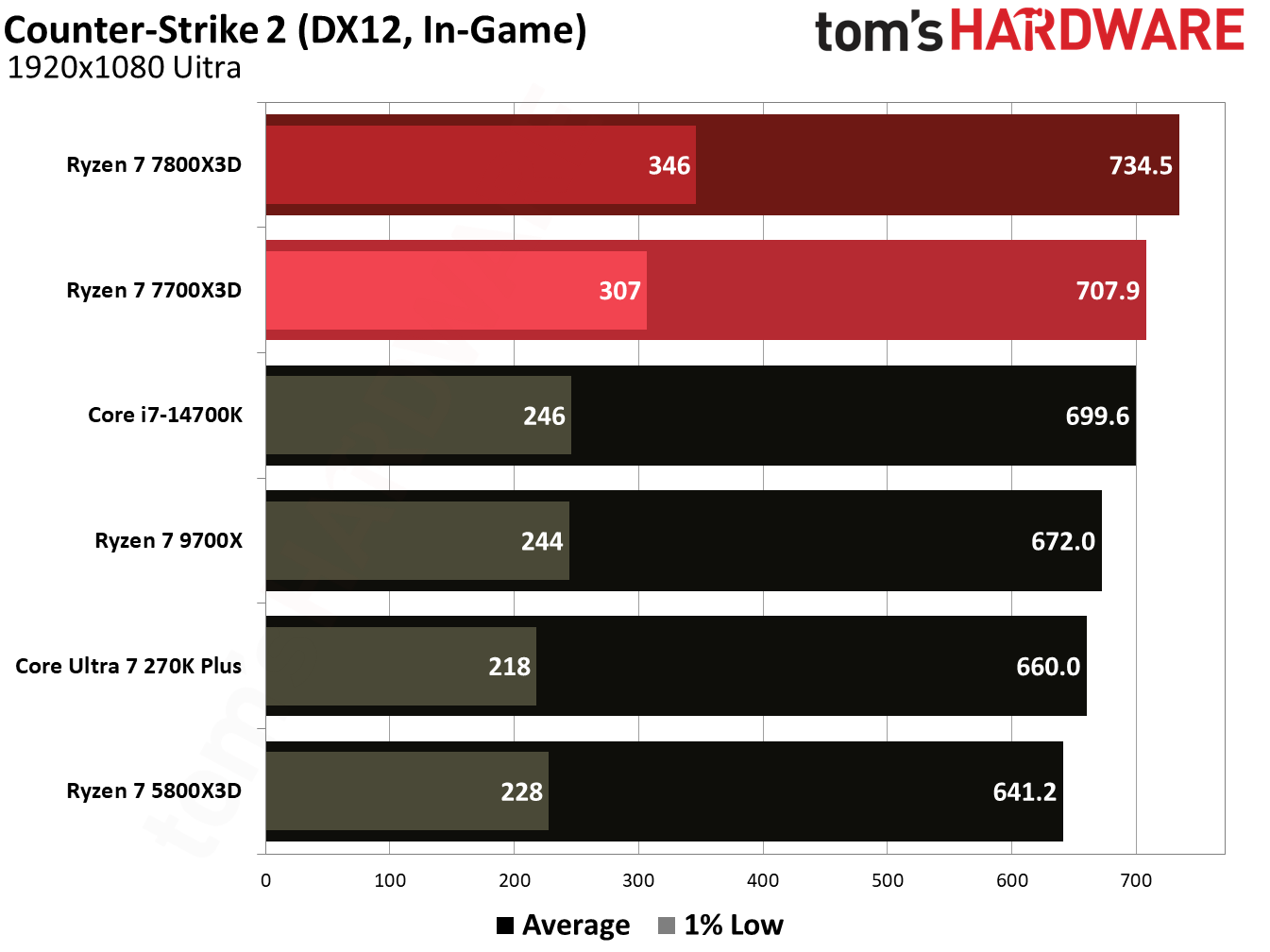
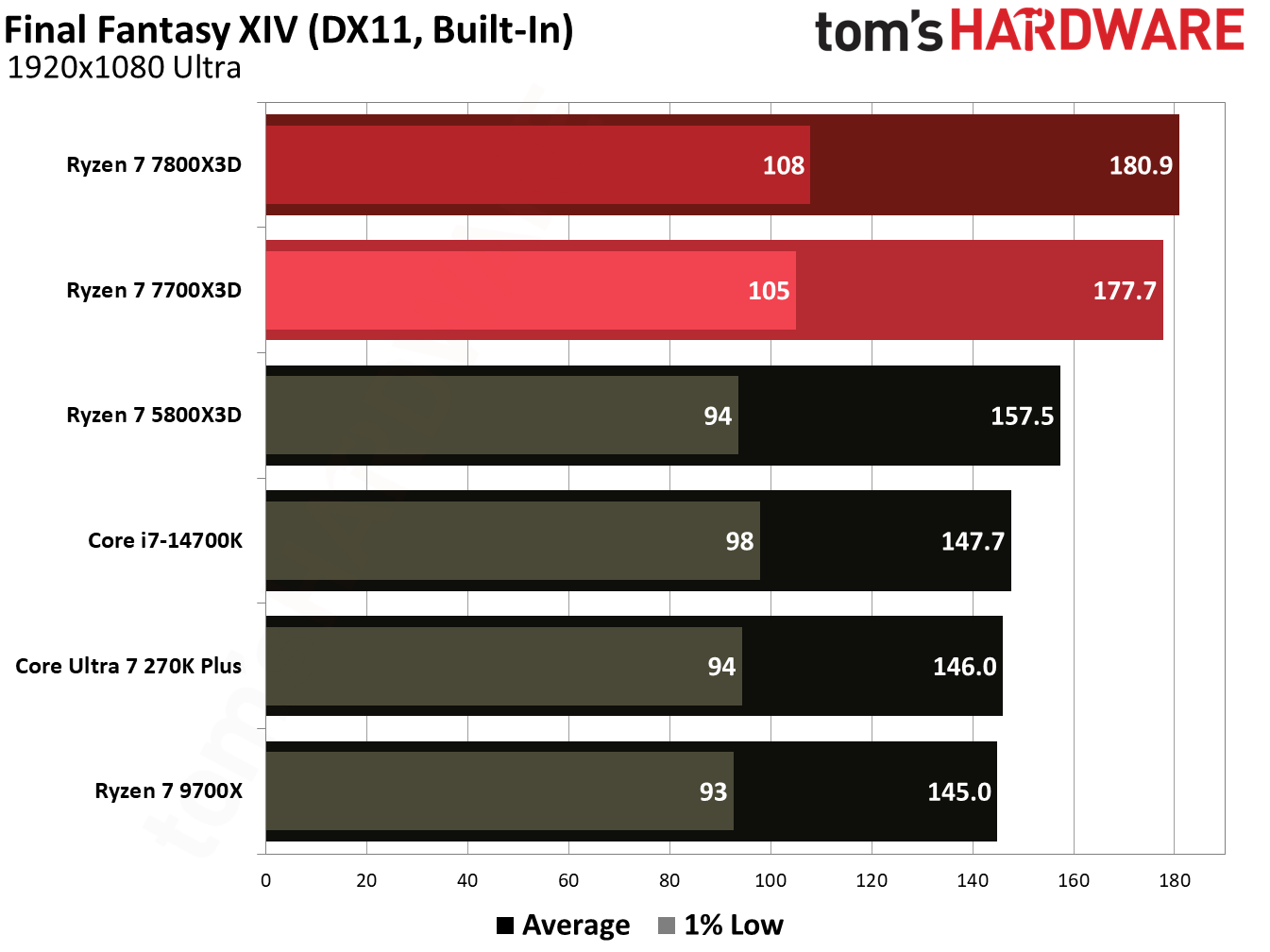
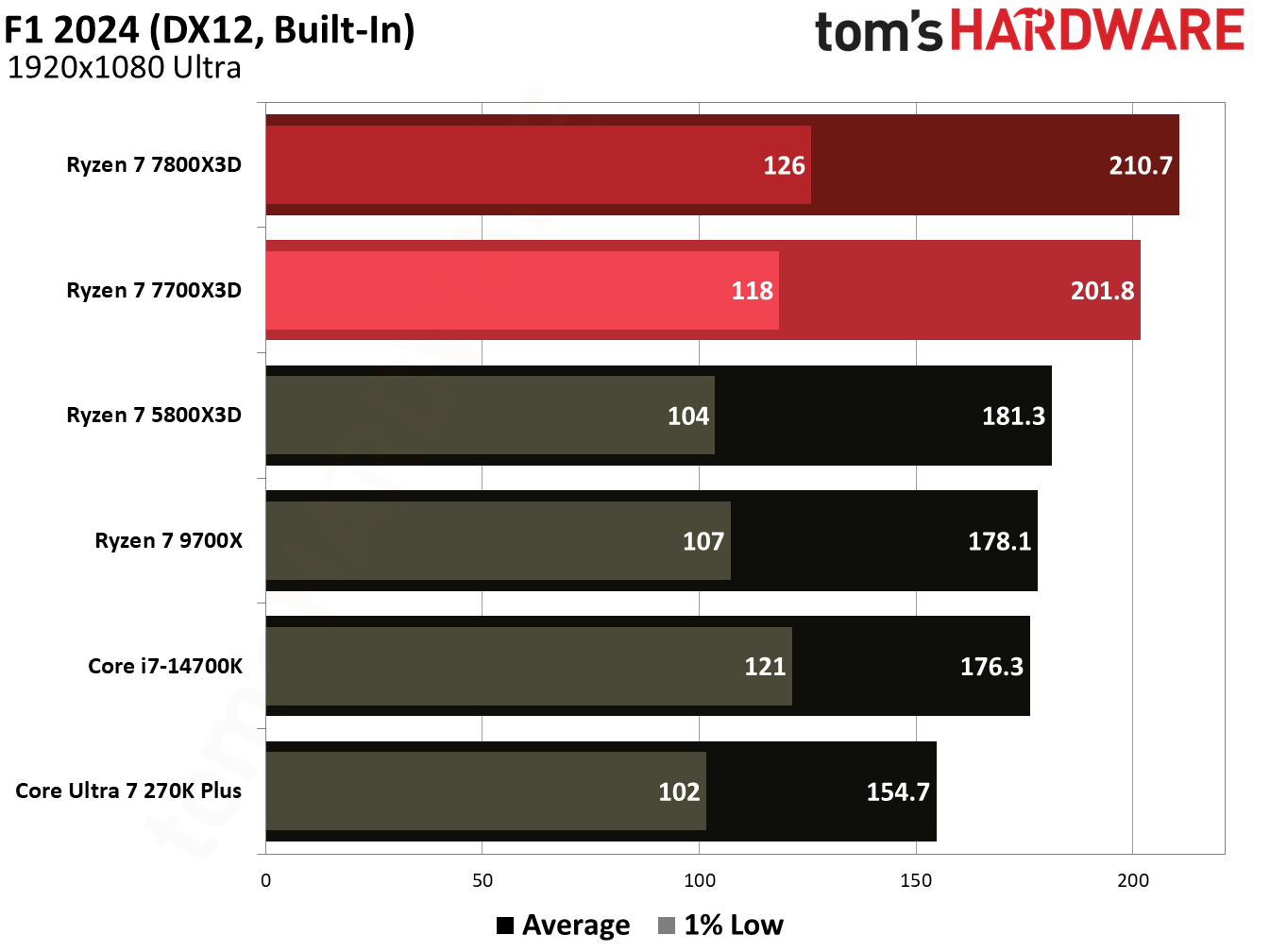
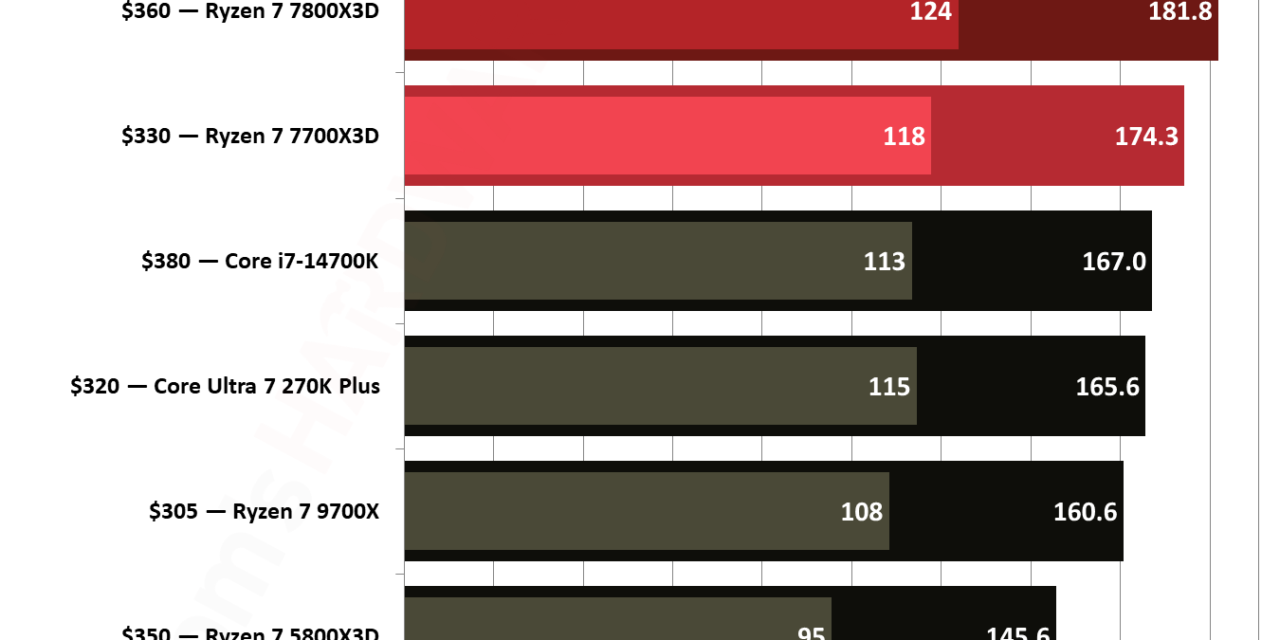
Starting off with our 16-game FPS geomean, the Ryzen 7 7800X3D leads the Ryzen 7 7700X3D with an average of 181.8 FPS, compared to 174.3 FPS for the newer chip. That works out to a 4.3% advantage for the 7800X3D. The gap widens slightly in 1% lows, where the 7800X3D puts out 124 FPS against 118 FPS for the 7700X3D, a difference of about 5%.
It’s a modest lead across the board, but a lead nonetheless. Both CPUs comfortably outpace the rest of the field here, including the pricier Core i7-14700K and Core Ultra 7 270K Plus, so this really comes down to a battle within AMD’s own X3D lineup.
Looking at individual titles, the story stays fairly consistent. In Baldur’s Gate 3, the 7800X3D leads the 7700X3D by 6.4%, and the gap is similar in The Last of Us Part One at 5.6% and Marvel Rivals at 5.5%. Hogwarts Legacy sees the 7800X3D ahead by 4%, and 007: First Light comes in at a 3.2% lead.
However, the margin shrinks considerably in a few titles. Flight Simulator 24 and Minecraft RT both land in the 2% range, and Crimson Desert is even closer at just 1.4%. Interestingly, DOOM: The Dark Ages is essentially a dead heat, with the 7800X3D ahead by less than 1%, at 201.9 FPS to the 7700X3D’s 200 FPS.
So yes, the 7800X3D wins every title we tested, but in a good chunk of them, you’d be hard-pressed to notice the difference without a frame counter on screen. However, that is what you would expect from a CPU that is essentially the same, with a cut-down boost clock.
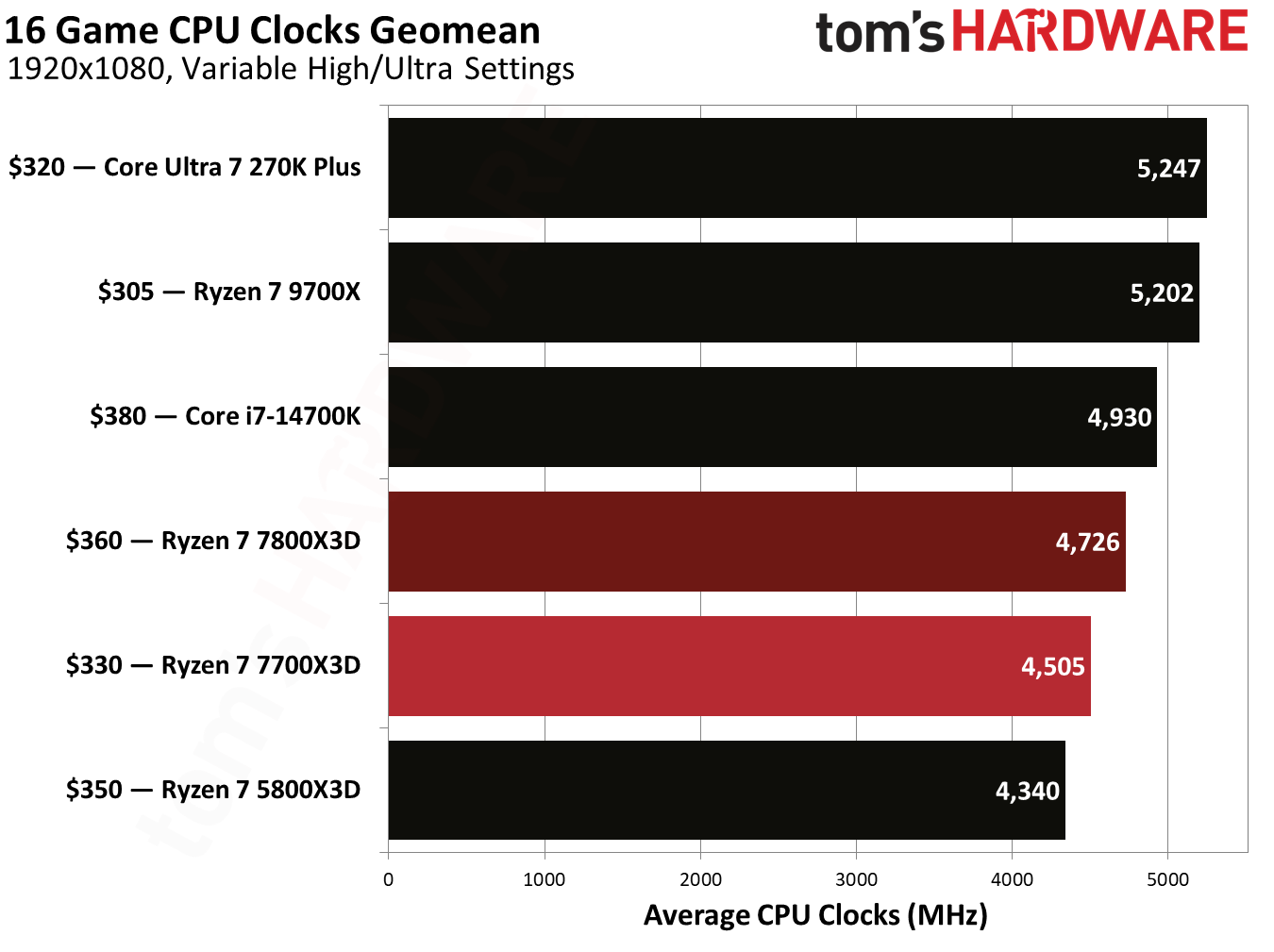
Speaking of the clocks, the 7800X3D averaged 4,726 MHz across our test suite, compared to 4,505 MHz on the 7700X3D. That’s a 4.9% higher average clock speed for the 7800X3D, and it lines up almost exactly with its FPS advantage, so the extra frequency headroom appears to be the deciding factor here.
Where the 7700X3D claws back some ground is in power, temperatures, and value. The newer chip drew just 60.9 watts on average during our gaming tests, compared to 67.3 watts for the 7800X3D, a 9.5% reduction in power draw. That also translates to lower temperatures, with the 7700X3D running at an average of 55°C versus 62°C for the 7800X3D, a full 7°C cooler than its sibling.
Safe to say, the 7700X3D is also the more efficient chip of the two. It managed 2.86 FPS-per-watt in our testing, compared to 2.70 for the 7800X3D, making it about 6% more efficient. The value picture tells a similar story, with the 7700X3D delivering 0.53 FPS-per-dollar against 0.50 for the 7800X3D — though that assumes a $360 price for the 7800X3D, and we’ve seen it sell for the same price as the 7700X3D multiple times previously. Obviously with both CPUs at $330, the 7800X3D comes out ahead on value.
⭐ Winner: AMD Ryzen 7 7800X3D
The 7800X3D wins every game we tested, and while several of those wins are razor thin, a win is still a win. The 7700X3D answers back with better efficiency, cooler temperatures, and a stronger price-to-performance ratio, at least at MSRP, but this round is about raw gaming performance, and the 7800X3D still has the edge there.
Productivity Performance: AMD Ryzen 7 7700X3D vs Ryzen 7 7800X3D
AMD’s X3D chips aren’t top productivity performers, unless you spring for something like the Ryzen 9950X3D. Still, application performance is important even if you primarily use your PC for gaming. We have a range of tests in rendering, encoding, web performance, and more that compromise or multithreaded and single-threaded geomeans, which you can see in the gallery below.
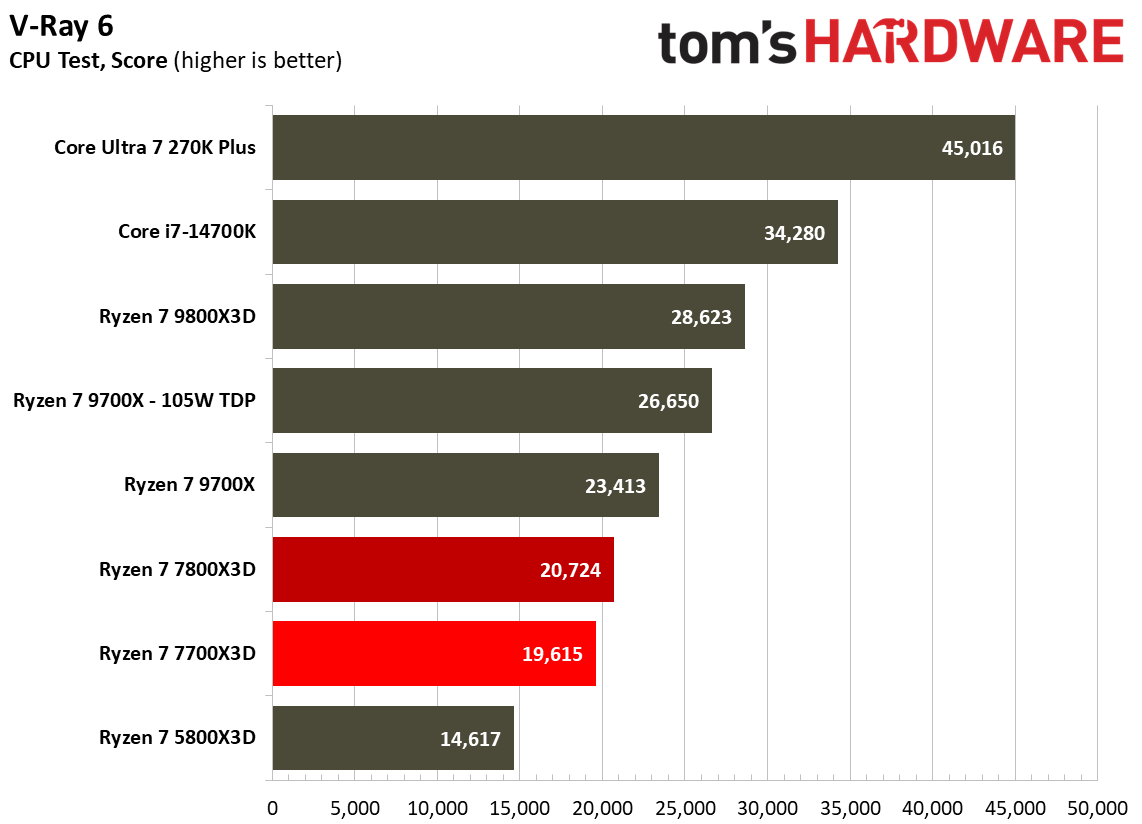
In these workloads that are concerned with raw CPU performance, clock speed alone can make a significant difference. That tracks with our results, with the Ryzen 7 7800X3D consistently providing a larger advantage over the 7700X3D in application performance than it does in games.
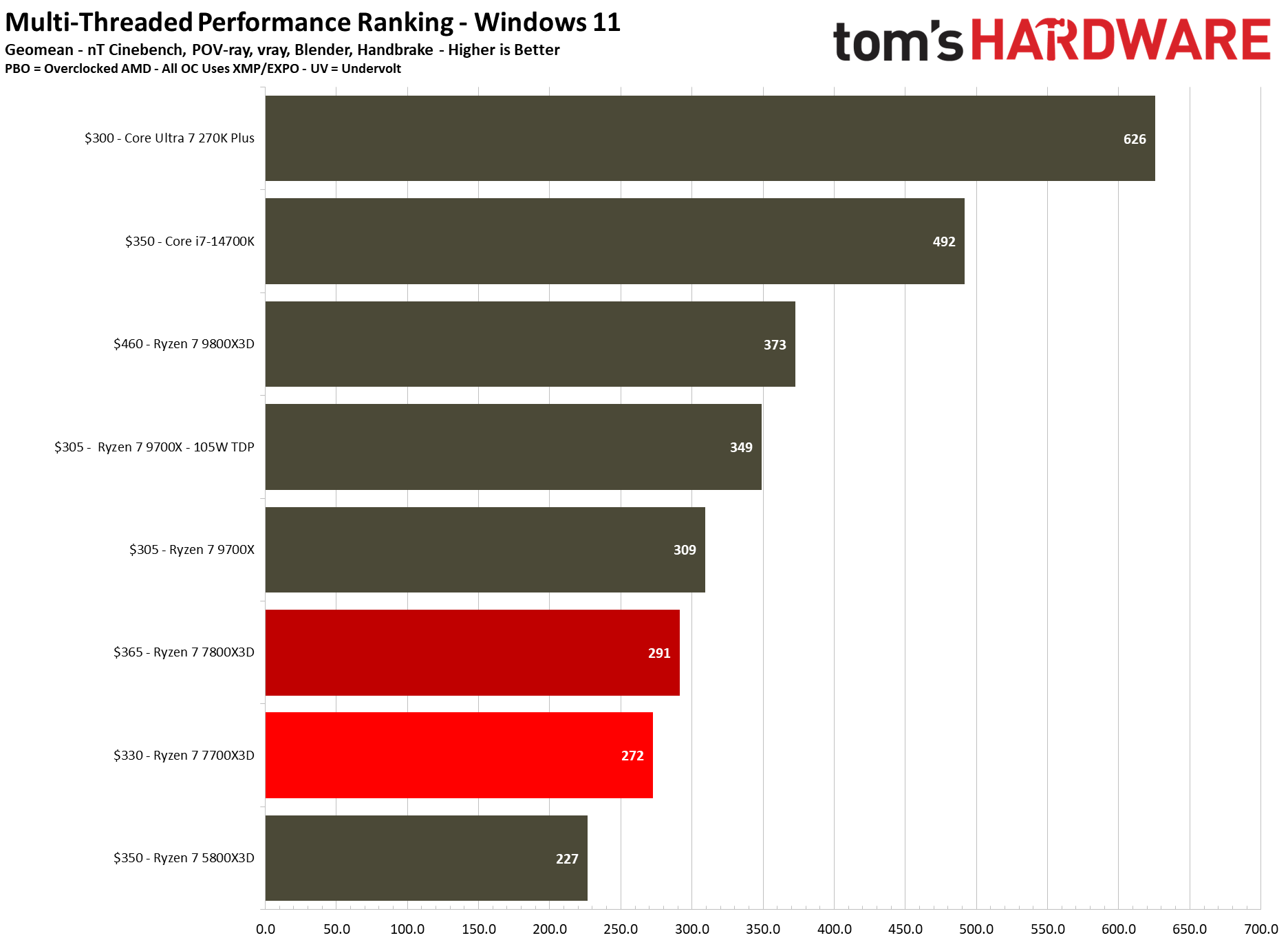
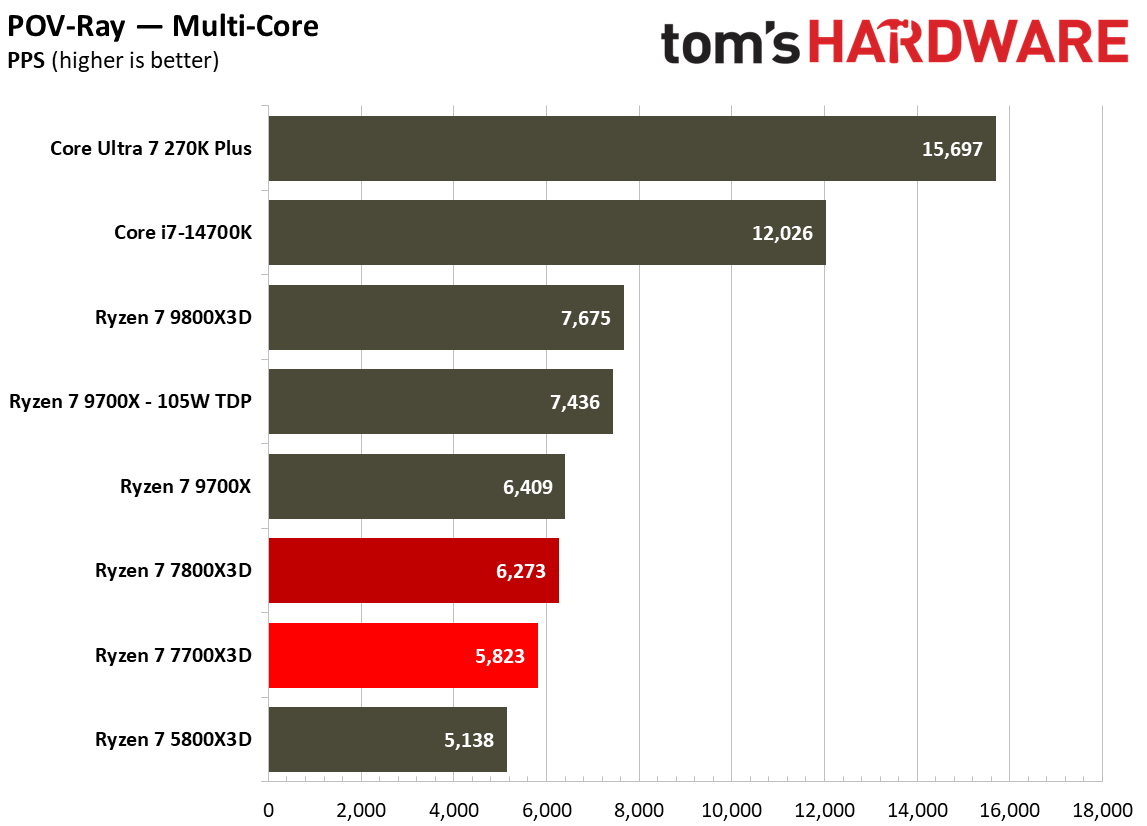
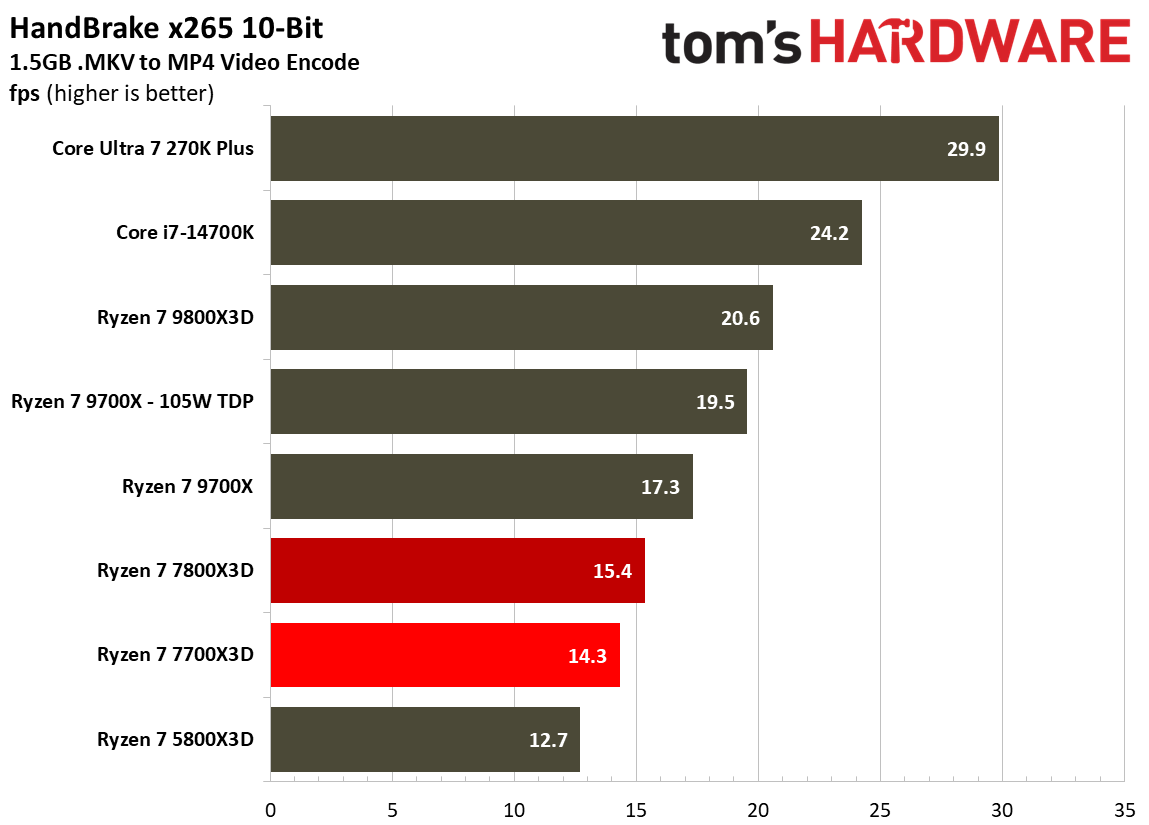
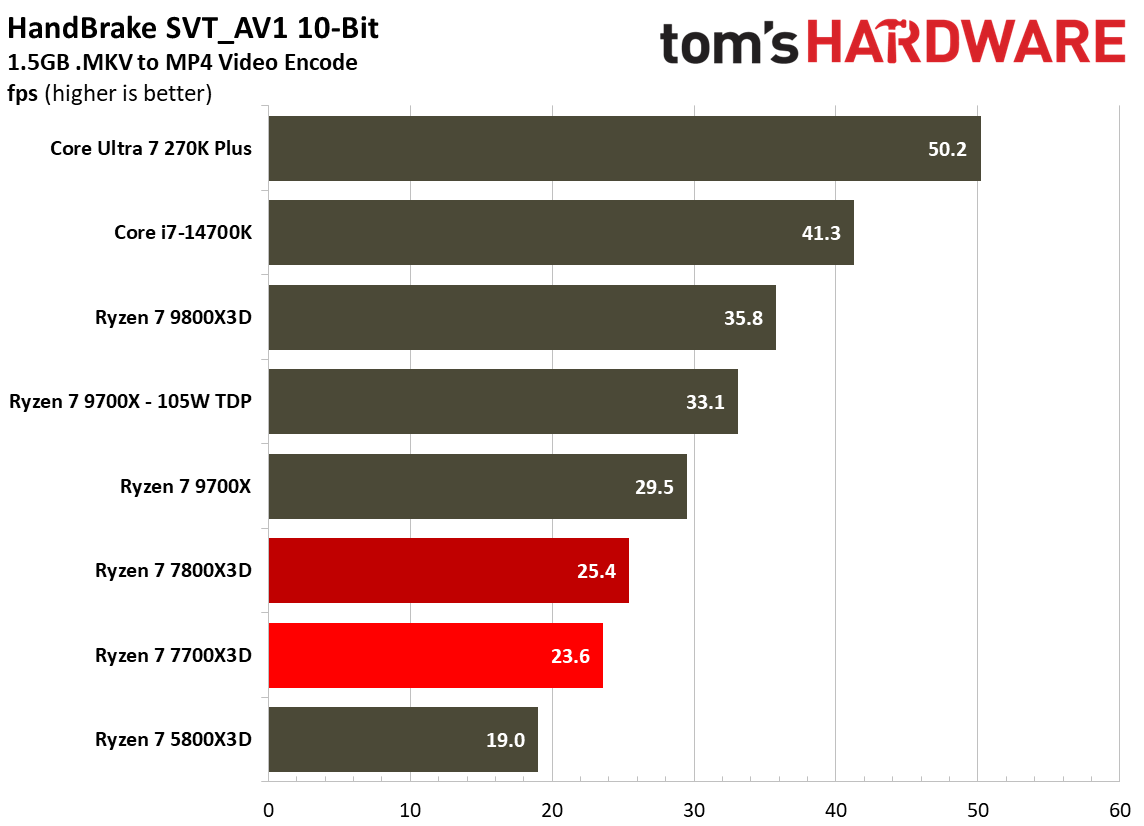
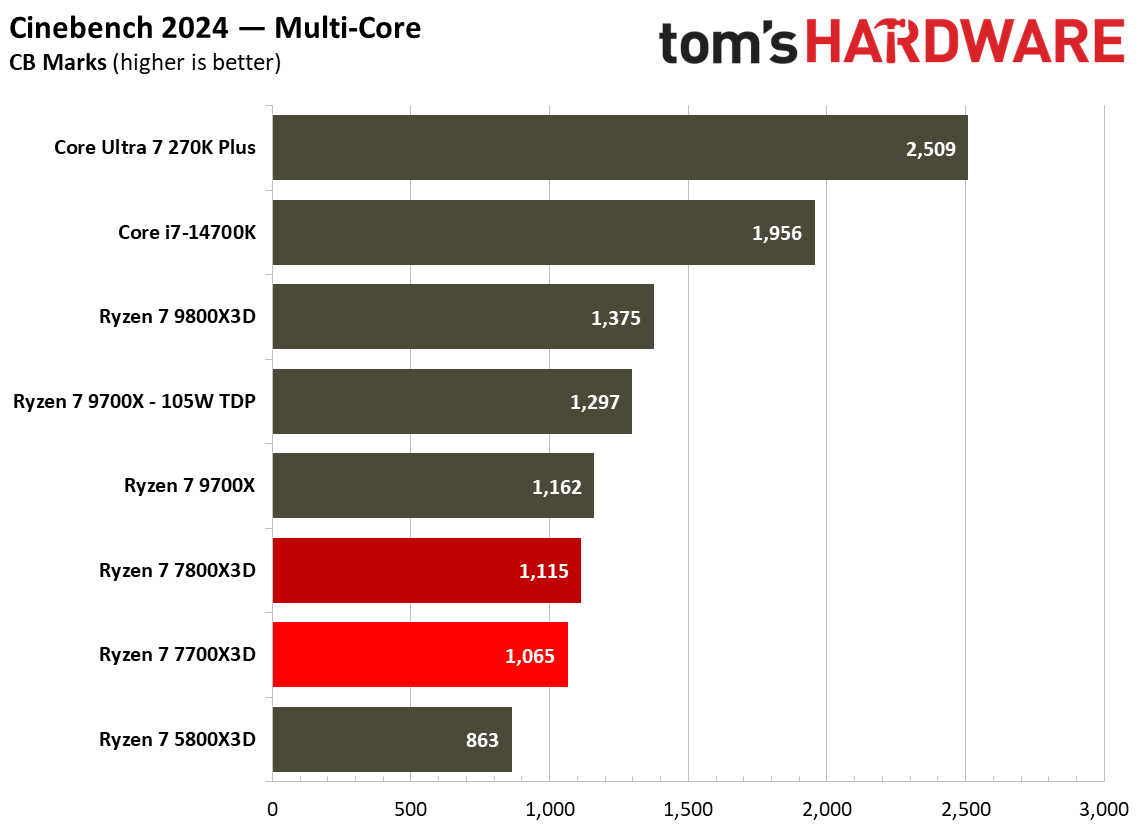
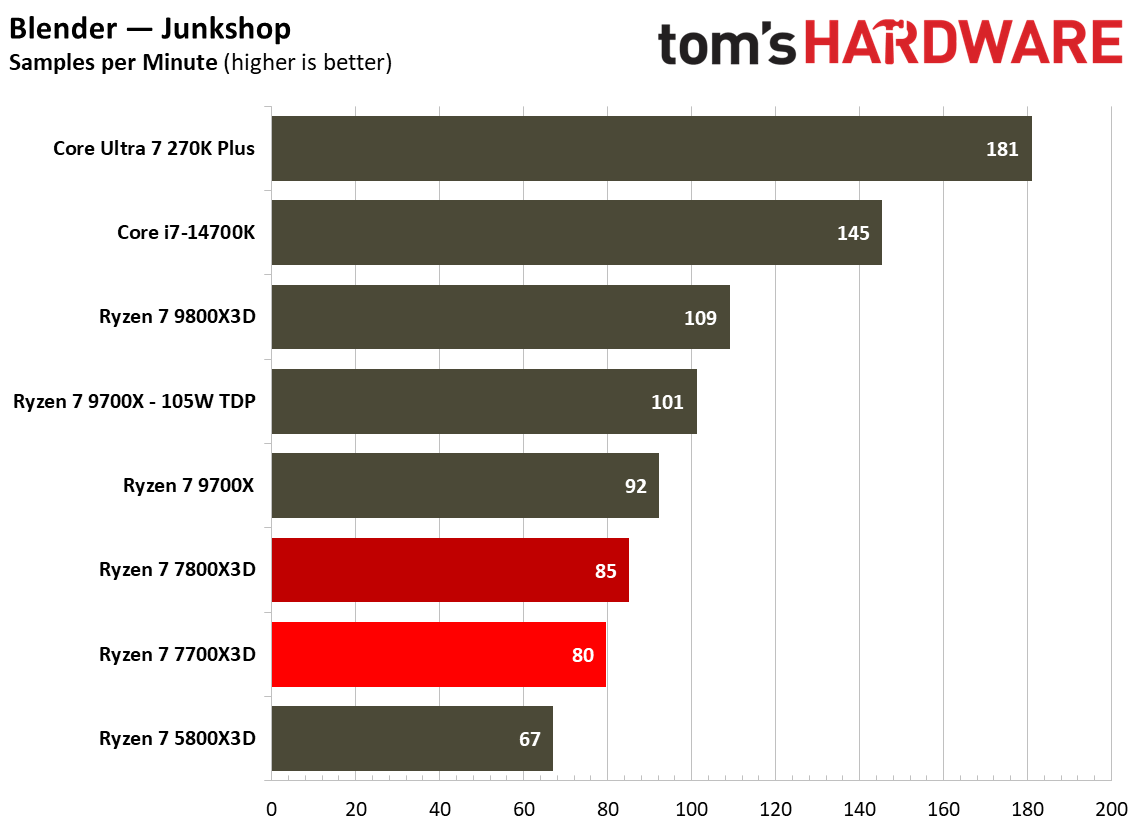
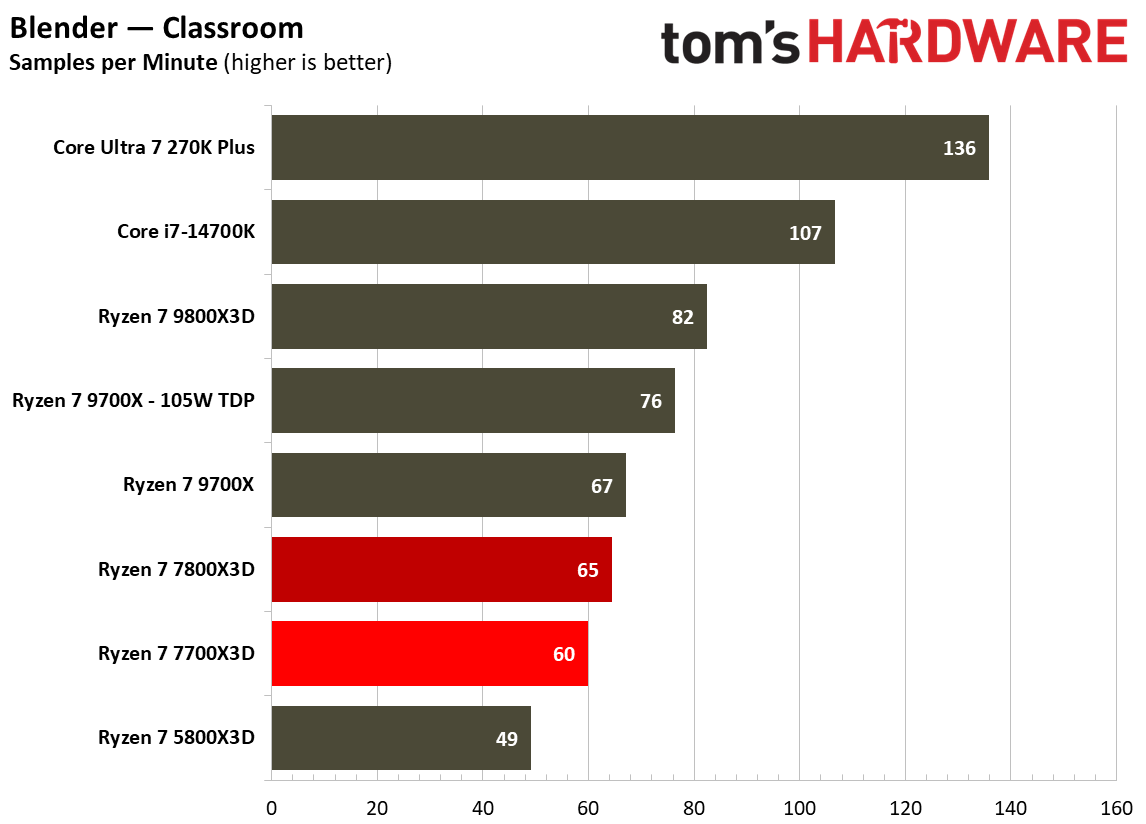
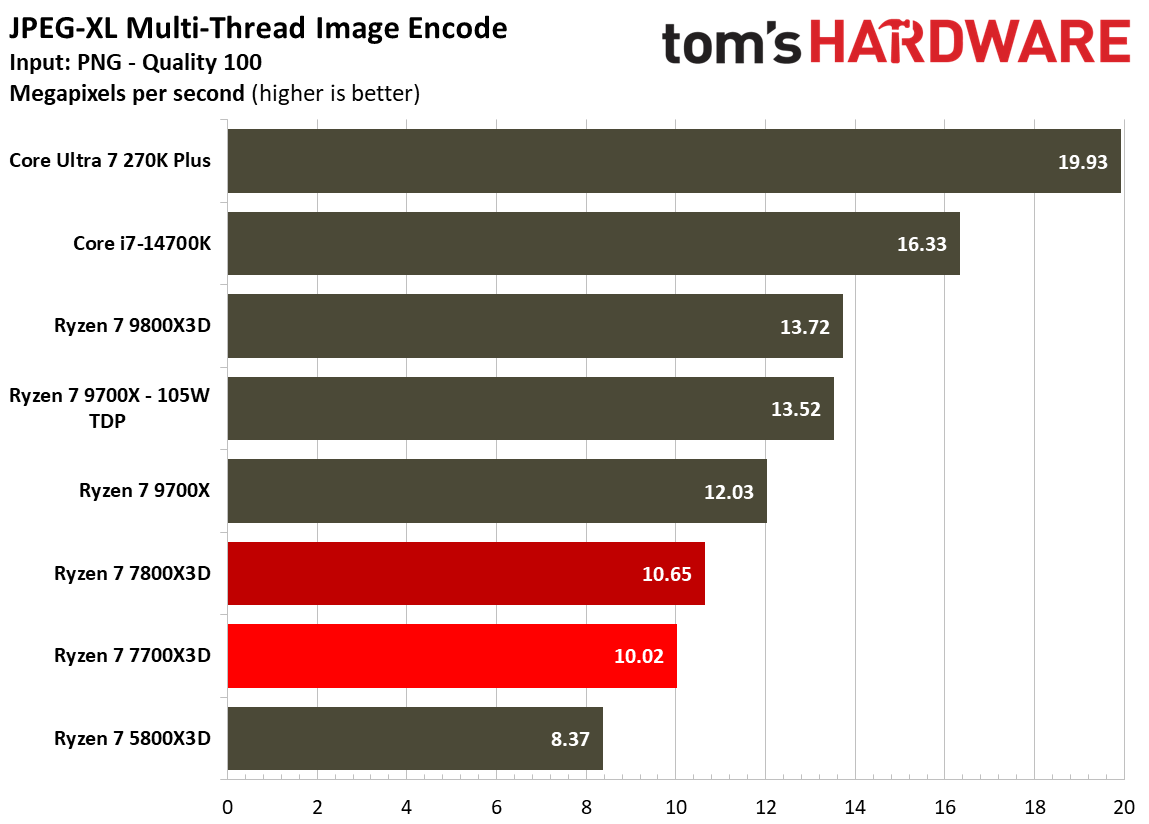
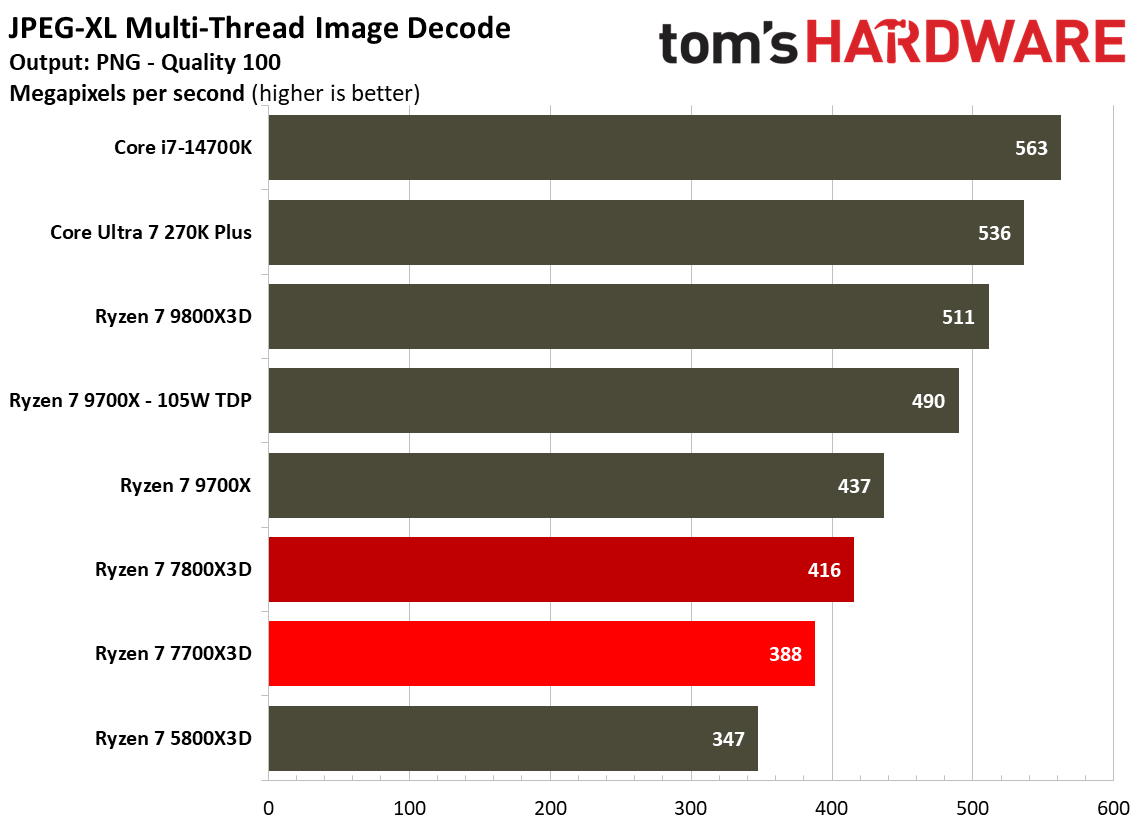
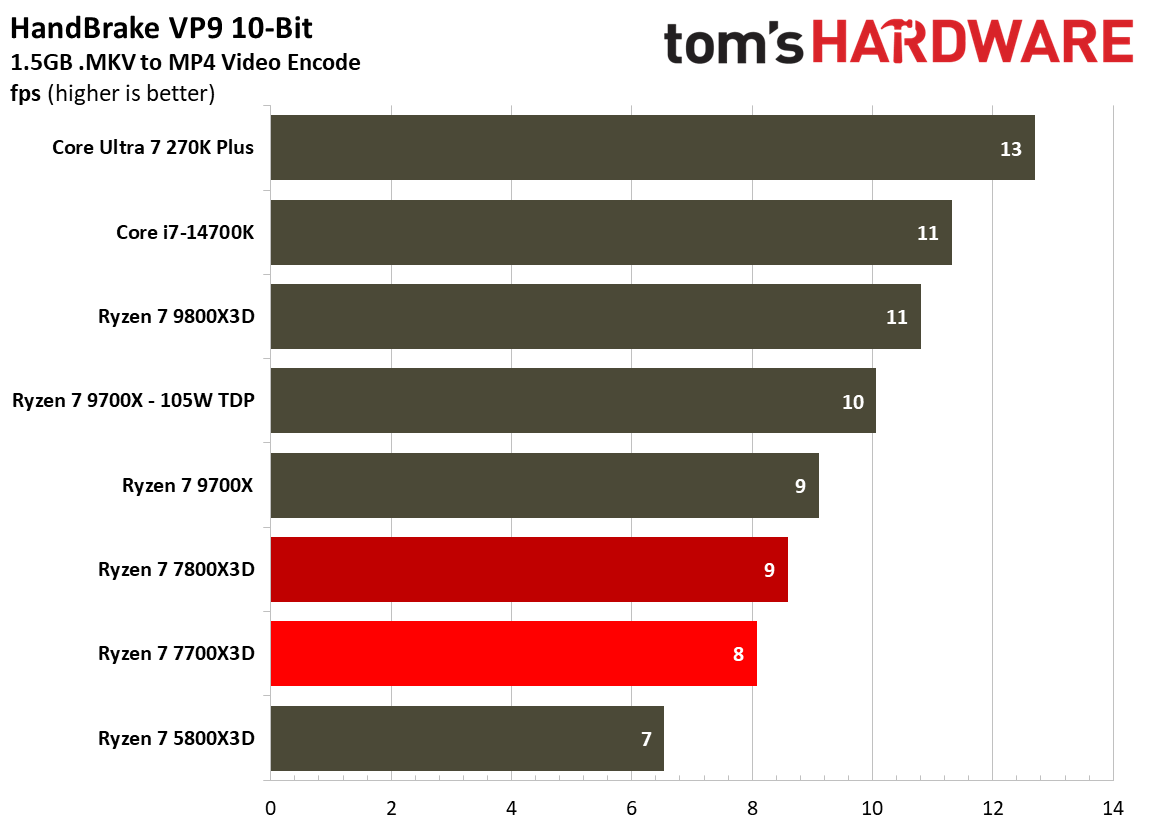
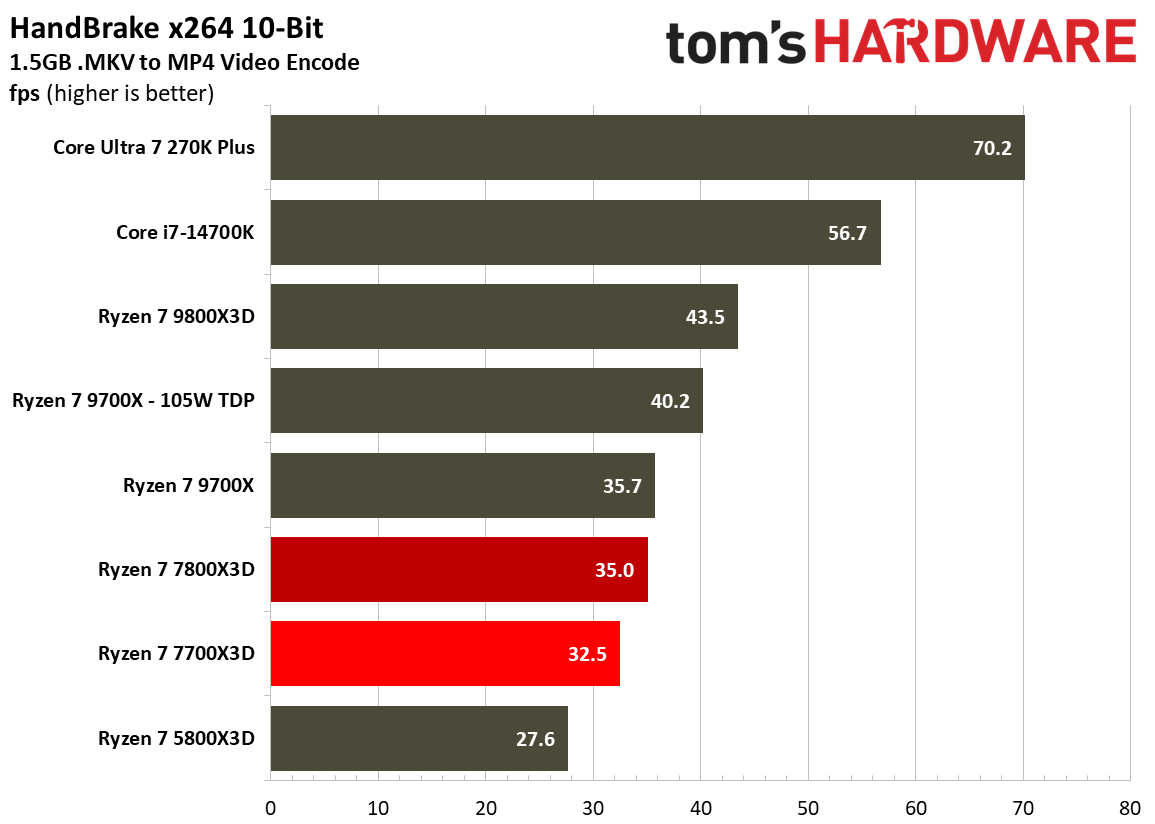
Starting with our multi-threaded performance ranking geomean, the Ryzen 7 7800X3D scores 291 points, compared to 272 points for the Ryzen 7 7700X3D. That puts the 7800X3D ahead by 7% on average. It is not a massive gap, but it is a consistent one, as it shows up across every multi-core test we ran.
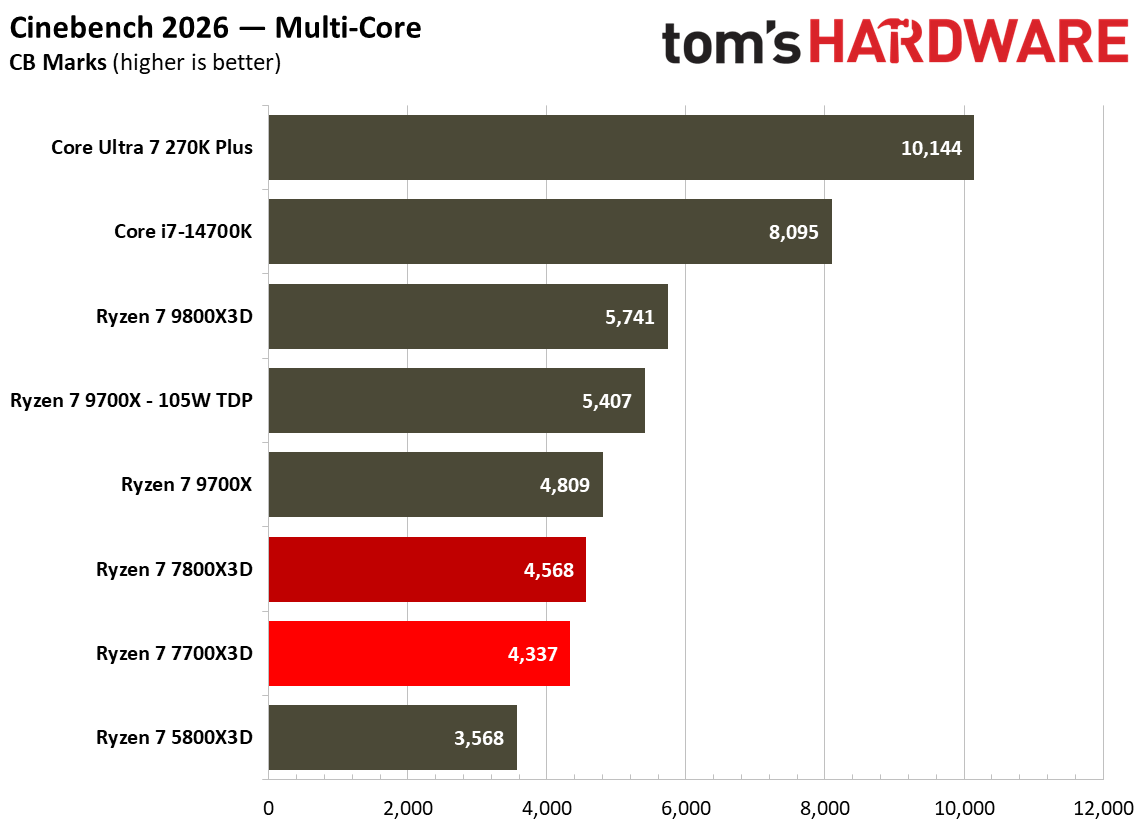
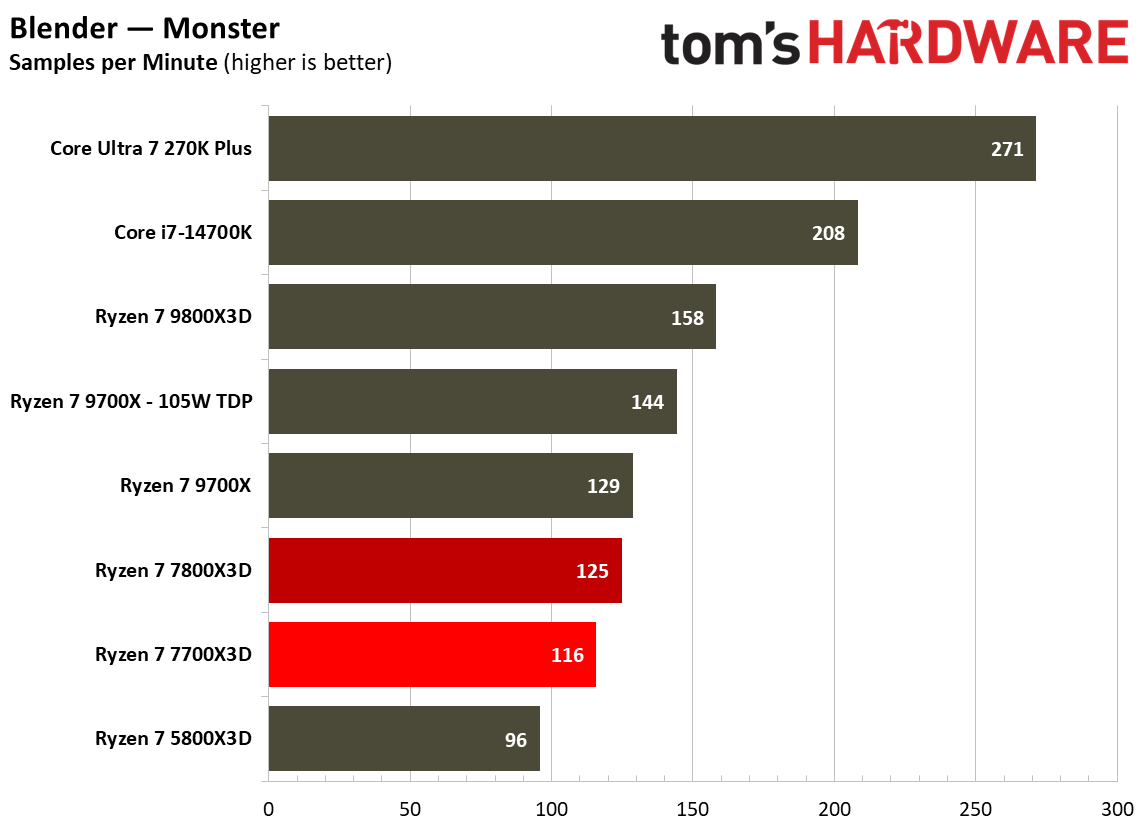
In Cinebench 2024’s multi-core test, the 7800X3D leads the 7700X3D by 4.7%, with the same pattern showing up in Cinebench 2026 at a 5.3% lead. POV-Ray tells a similar story, with the 7800X3D ahead by 7.7%, and Blender’s Junkshop scene puts the 7800X3D 6.25% faster than the newer chip.
The encoding tests follow the same trend. In HandBrake’s x265 10-bit encode, the 7800X3D is 7.7% faster than the 7700X3D, and that lead holds nearly identical at 7.6% in SVT_AV1 encoding. JPEG-XL multi-threaded decode shows the 7800X3D ahead by 7.2%.
Interestingly, the gap in every single multi-threaded benchmark sits somewhere between 4% and 8%, so there is no real outlier here in either direction. Since core and thread counts are identical, this is really just a straightforward reflection of the 7800X3D’s higher boost clocks doing their job across sustained, all-core loads.
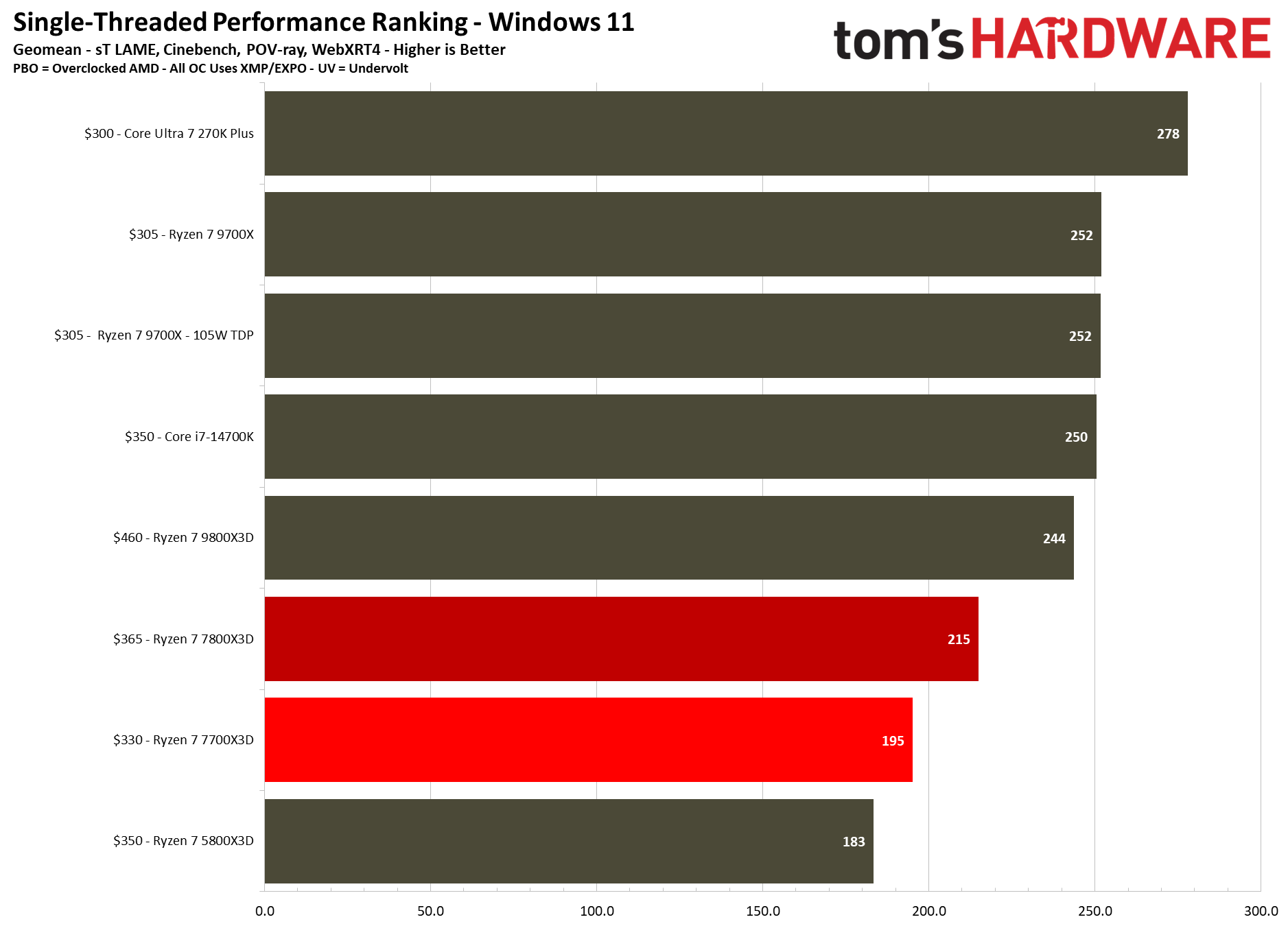
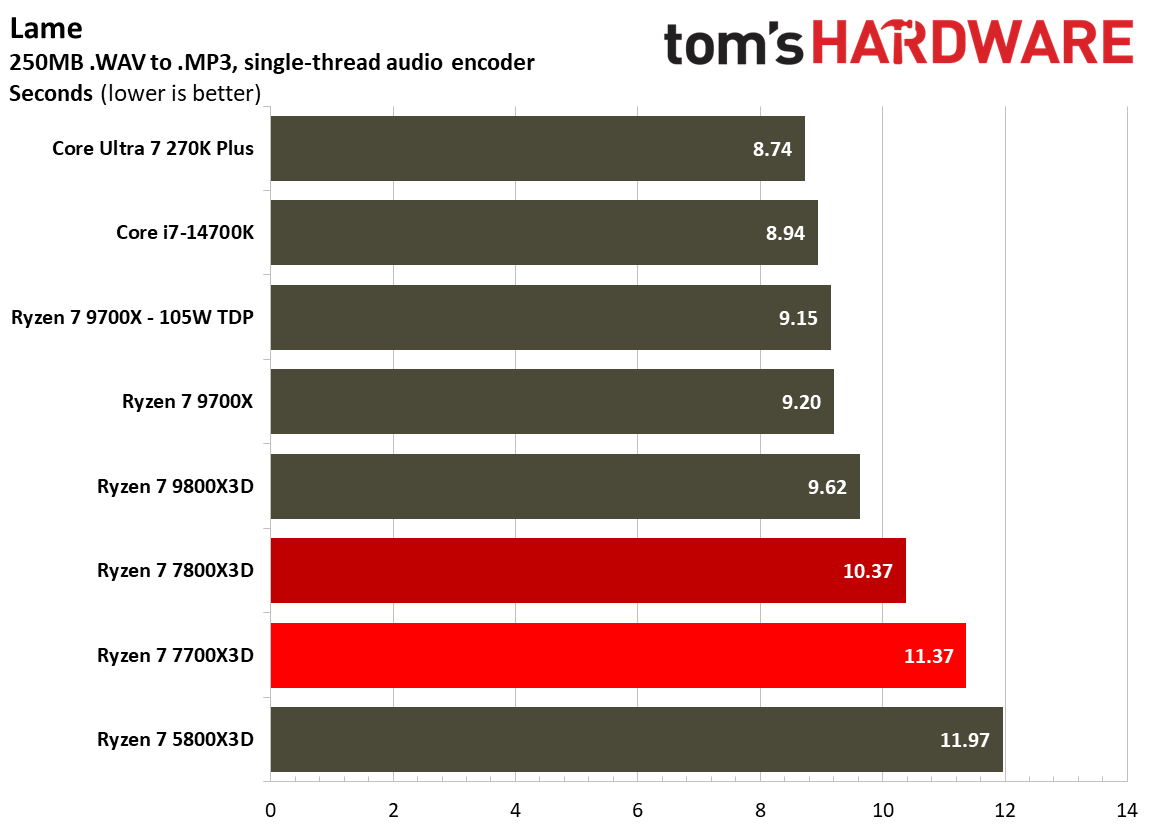
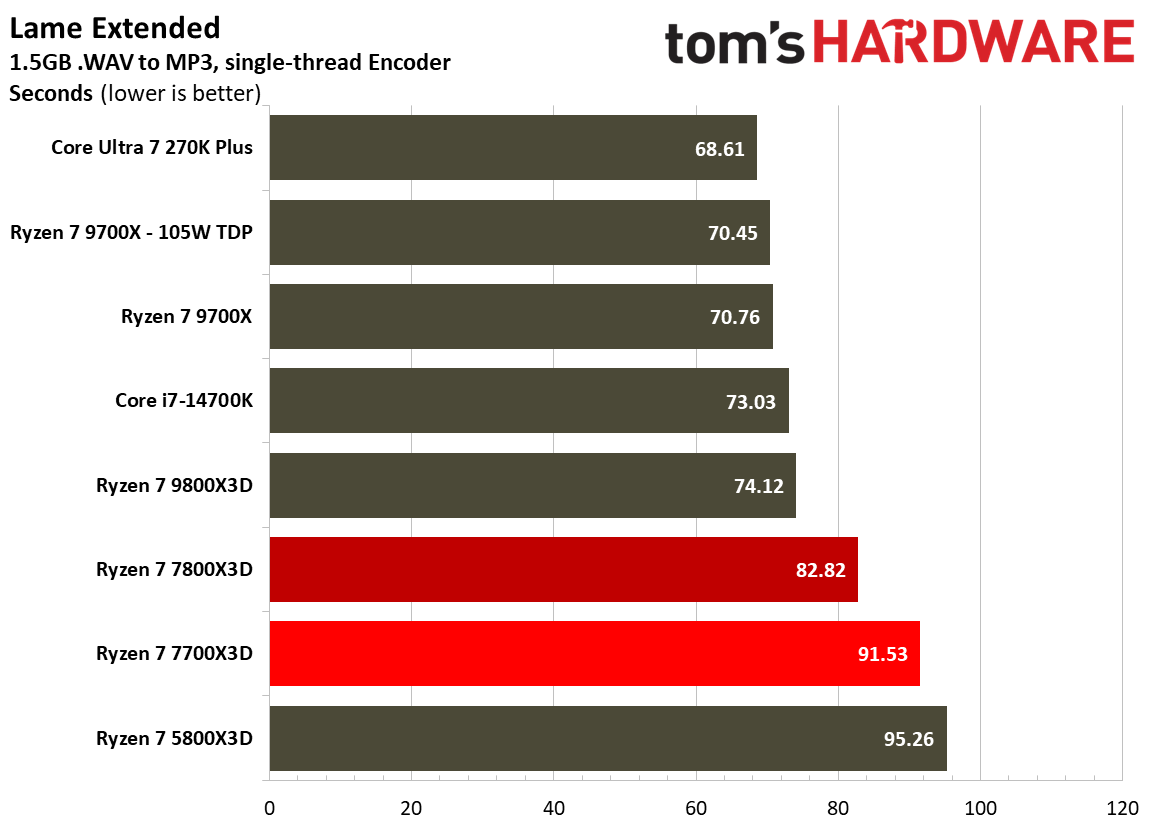
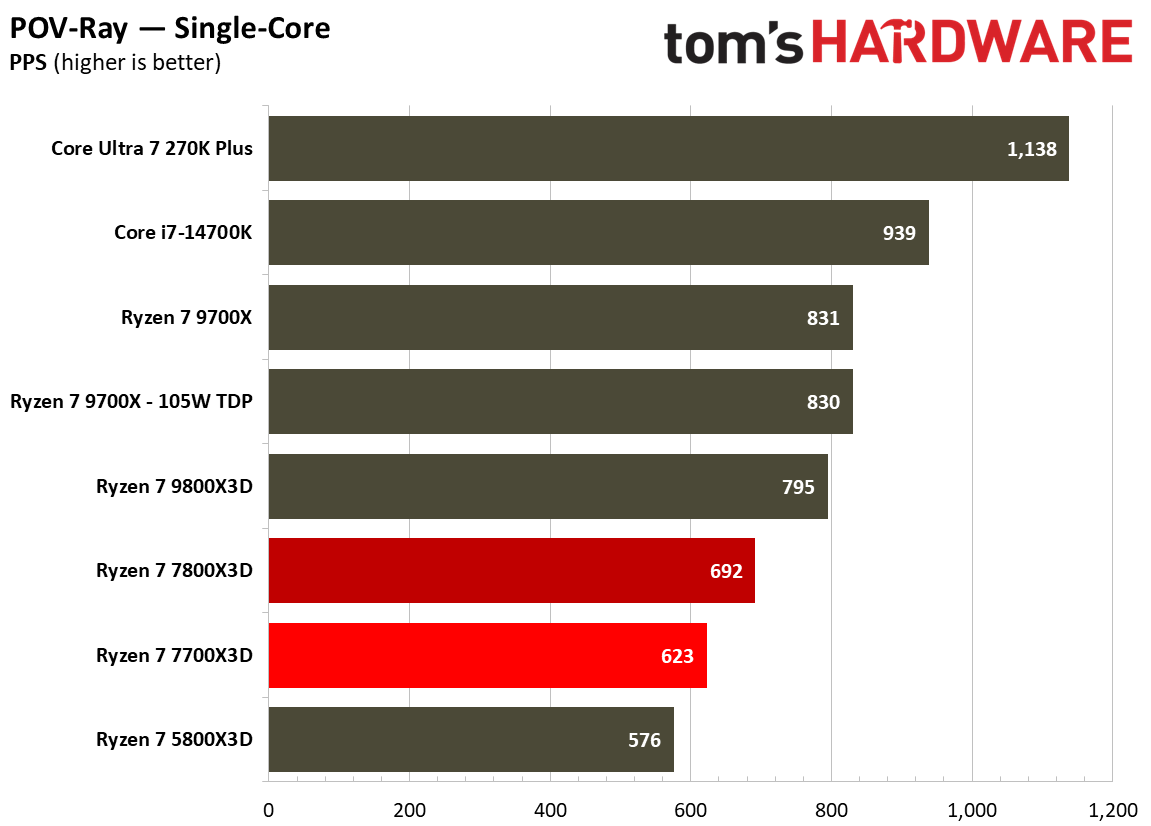
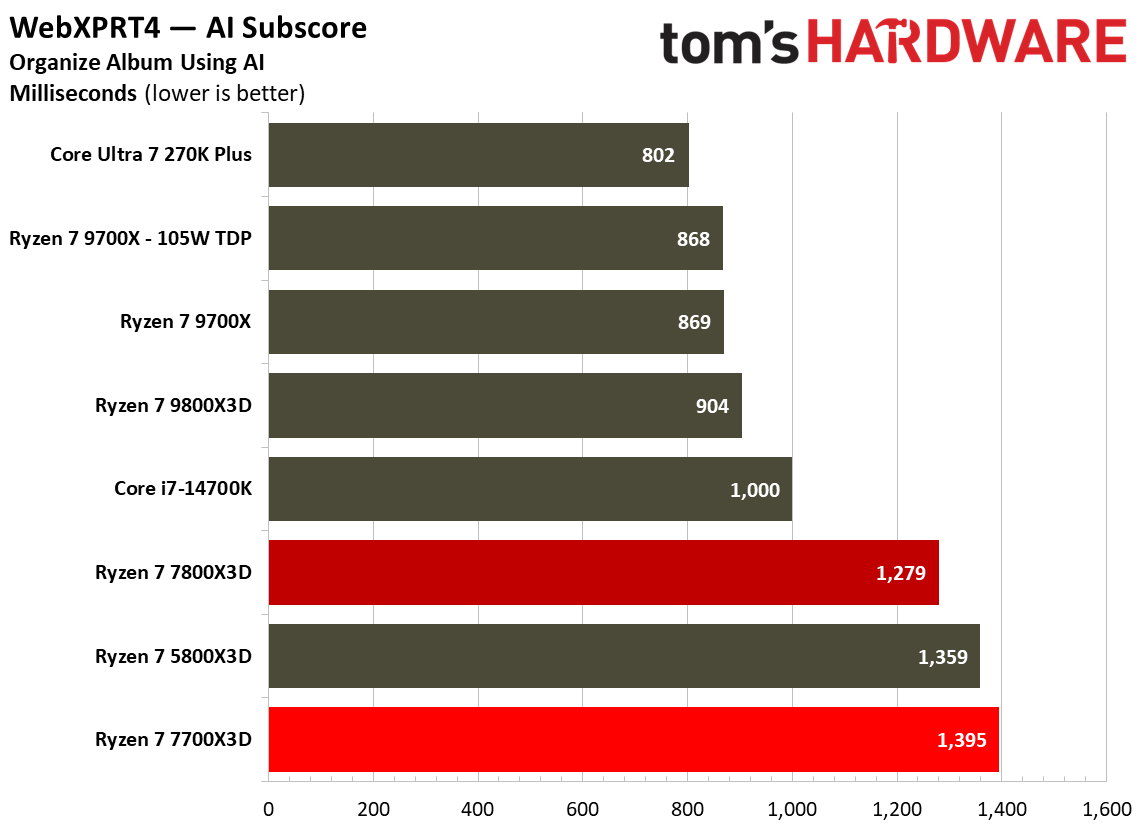
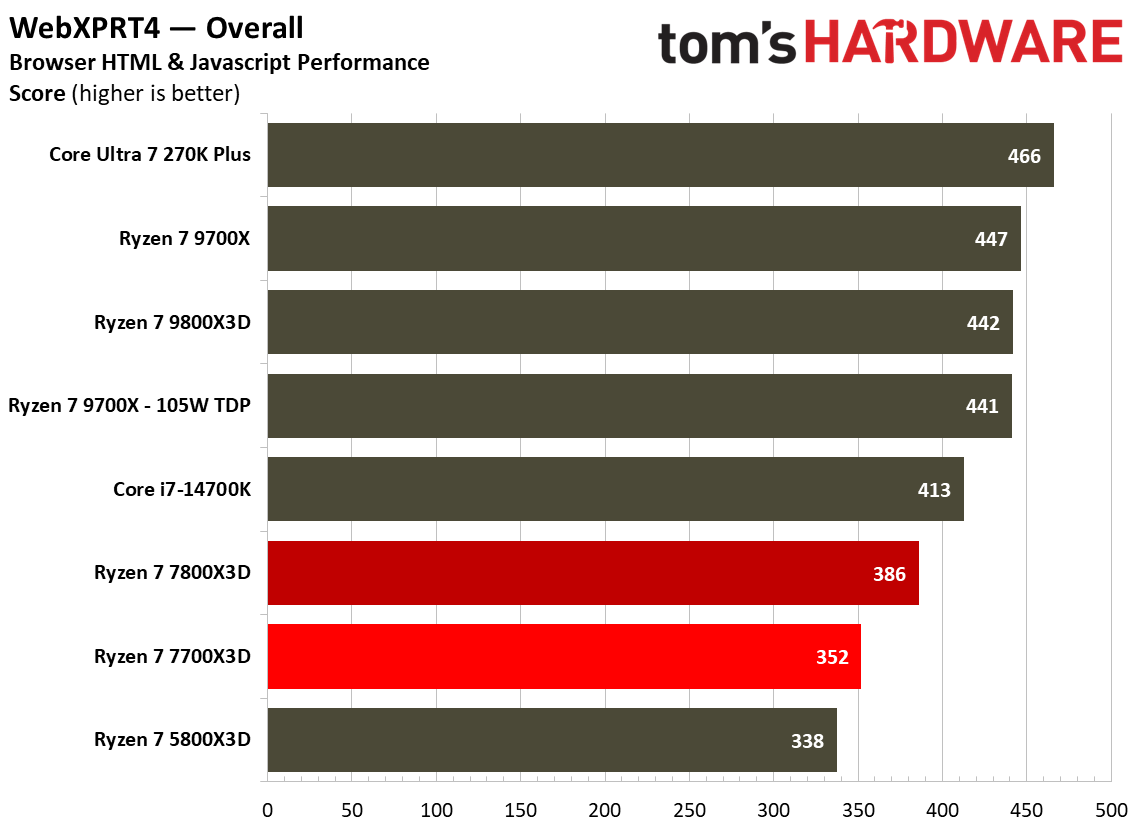
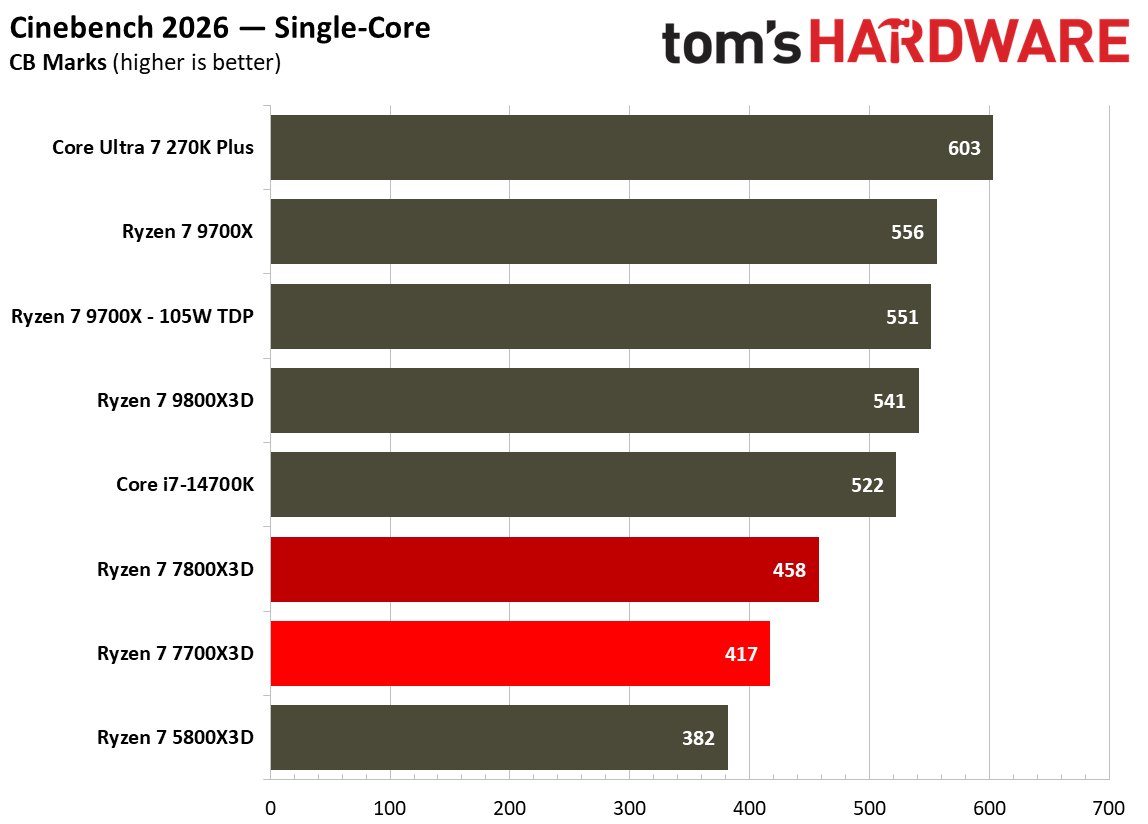
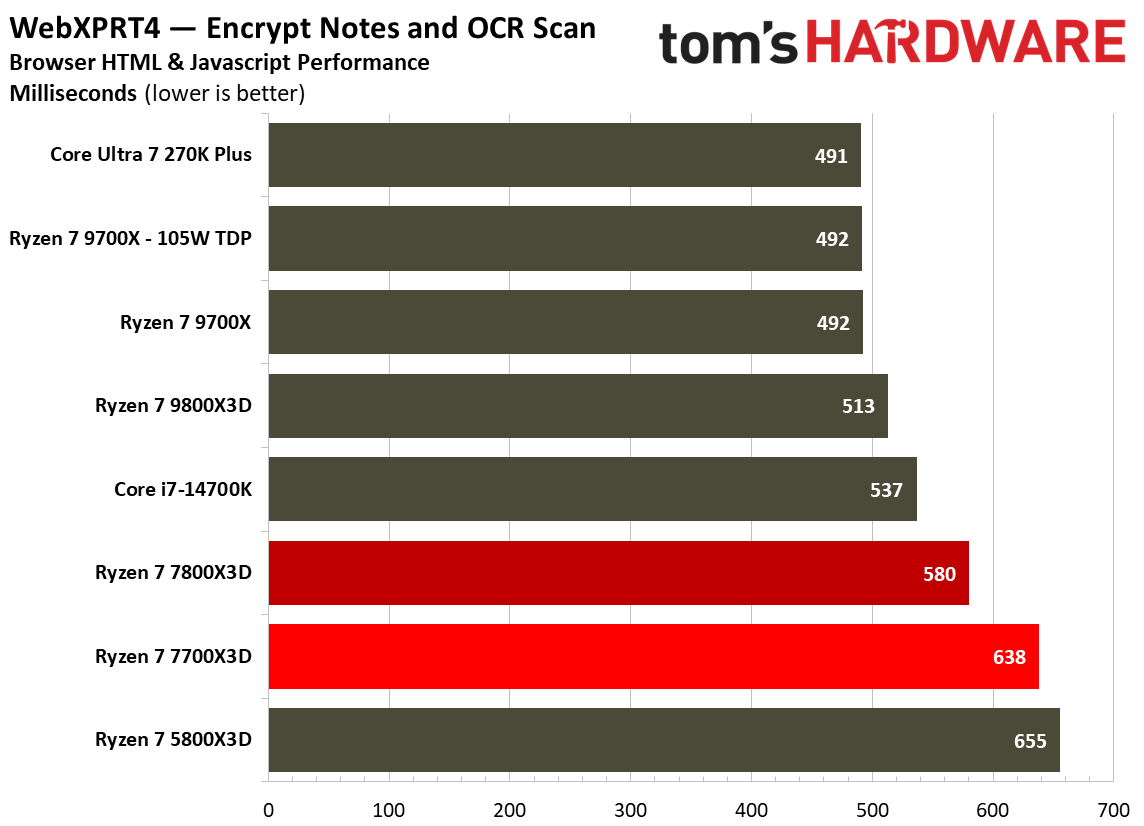
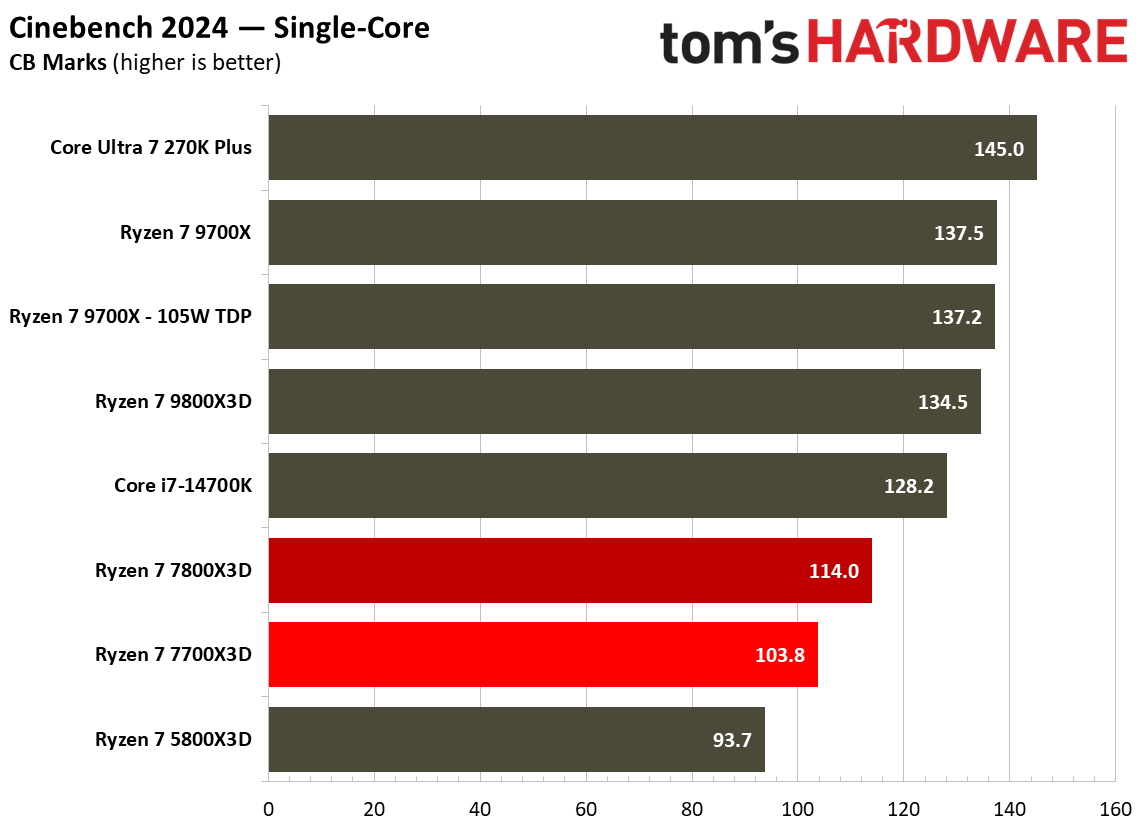
Moving on to single-threaded performance, the gap actually widens a bit. Our single-threaded performance ranking geomean has the 7800X3D at 215 points against 195 points for the 7700X3D, which is a 10.3% lead for the pricier chip.
This makes sense when you consider how single-core workloads work. With fewer cores active, the CPU can push individual cores harder within its power budget, so the chip with the higher clock ceiling pulls further ahead than it does in multi-core tests where thermal and power limits are shared across all cores at once.
The same pattern shows up across the individual single-threaded tests. Cinebench 2024’s single-core result favors the 7800X3D by 9.8%, and Cinebench 2026 comes in nearly identical at 9.8% as well. POV-Ray’s single-core test shows the widest gap of the round, with the 7800X3D ahead by a noticeable 11.1%.
In the Lame audio encoding tests, the 7800X3D finishes 8.8% faster in the standard test and 9.5% faster in the extended version. WebXPRT4, which measures browser and JavaScript performance, has the 7800X3D ahead by 9.7%.
It is worth remembering that neither of these CPUs was really built with productivity as the main focus. The extra 3D V-Cache that makes them so good at gaming doesn’t help much in these tests, and if anything, the lower clock speeds that come with fitting that cache onto the die work against them in these tests.
⭐Winner: AMD Ryzen 7 7800X3D
The 7800X3D wins every single productivity test we ran, with leads ranging from roughly 5% in multi-threaded work up to 11% in single-threaded tasks. It is a clean sweep, though the margins stay consistent enough that the 7700X3D never looks completely outmatched.
Overclocking: AMD Ryzen 7 7700X3D vs Ryzen 7 7800X3D
AMD introduced traditional multiplier-based overclocking with Zen 5 X3D CPUs. However, the Ryzen 7 77003D and 7800X3D don’t have access to that. These CPUs stack the cache on top of the compute die, acting as an insulating layer. New Zen 5 X3D CPUs instead keep the cache below the compute die.
That said, AMD loosened things up compared to the first-gen X3D chips. Both the 7700X3D and 7800X3D support Precision Boost Overdrive and Curve Optimizer, which let you push sustained boost clocks a bit further and shave voltage where the silicon allows it, without touching the core multiplier directly. Memory and Infinity Fabric overclocking remain fully open on both chips too, and EXPO makes hitting rated DDR5 speeds simple enough.
Given that the 7800X3D already ships with higher stock clocks and a bit more thermal headroom than the 7700X3D, it also tends to respond slightly better to PBO tuning, since it has more room to stretch before hitting the same limits. The 7700X3D isn’t far behind, and its lower stock power draw means it has some slack of its own to work with when pushed.
Realistically, this round is a wash in terms of actual tools available. Both chips are locked in the same way, and both get the same PBO and Curve Optimizer toolkit. The only real difference comes down to how much headroom each chip has to give up before hitting a wall, which slightly favors the 7800X3D, but it is still a tie overall.
⭐Winner: Tie
Both CPUs are limited to the same PBO and Curve Optimizer tuning since neither got AMD’s reworked cache layout, so this round is essentially a tie between the two.
Power Consumption, Efficiency, and Cooling: AMD Ryzen 7 7700X3D vs Ryzen 7 7800X3D
For power consumption, we measured power draw across idle, active idle, and full load scenarios, then broke things down further into efficiency metrics to see which chip gets more work done per watt.
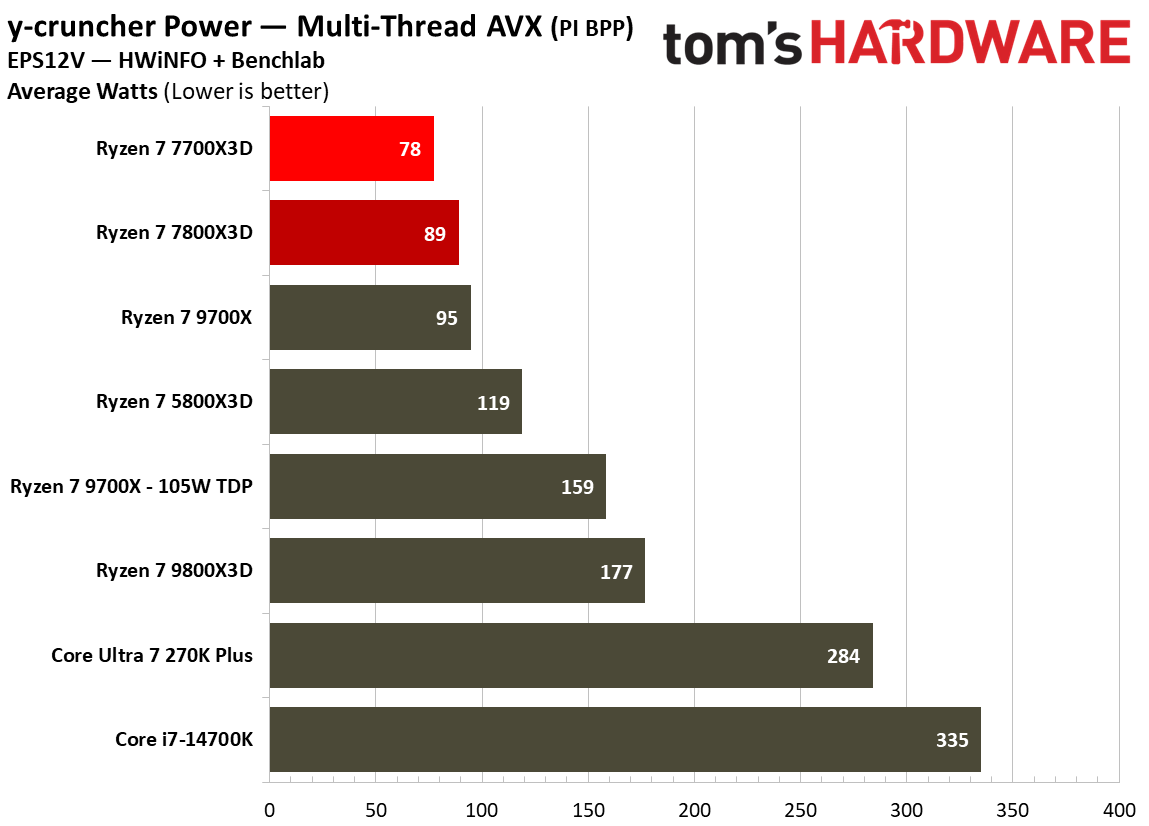
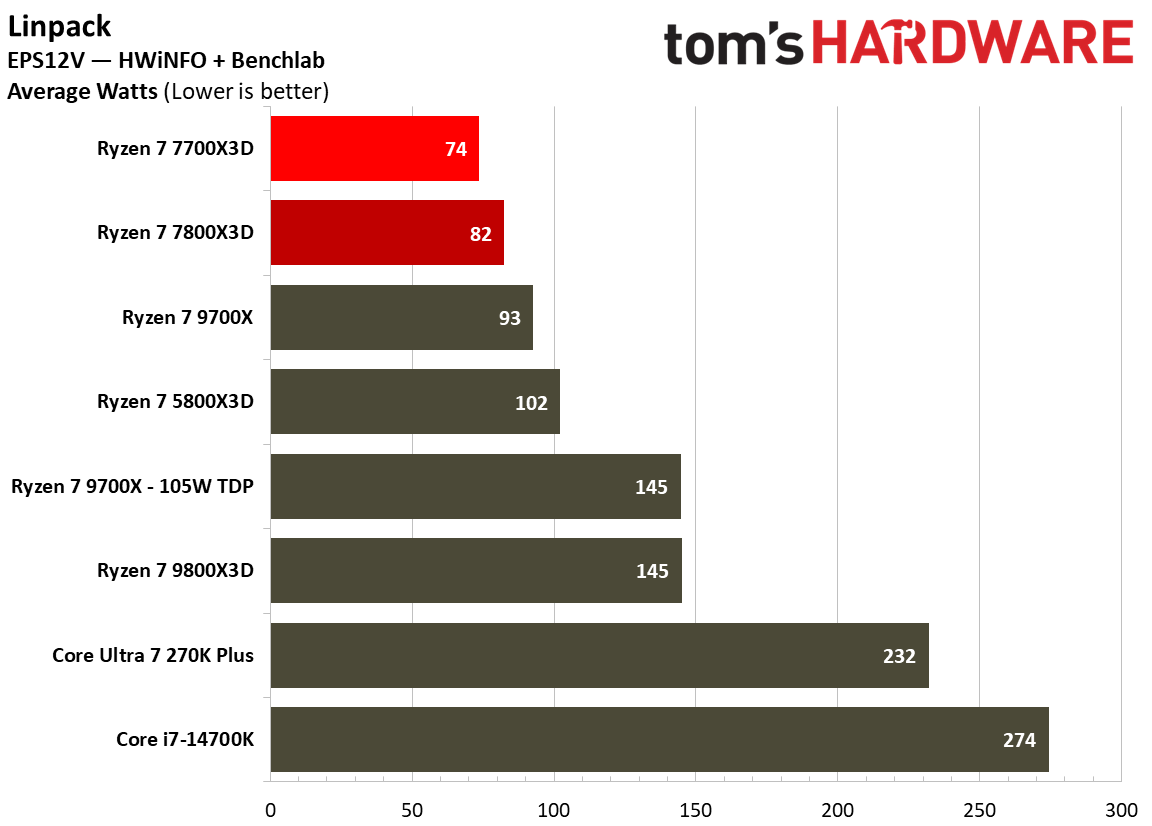
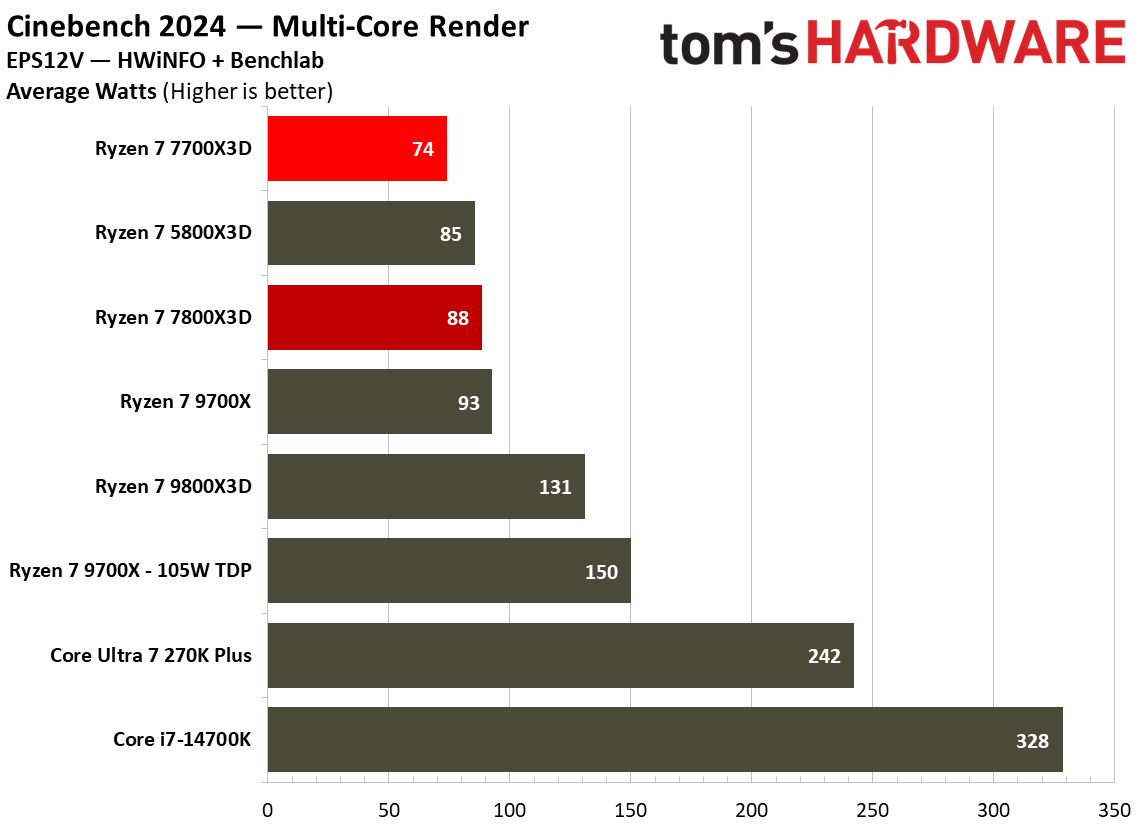
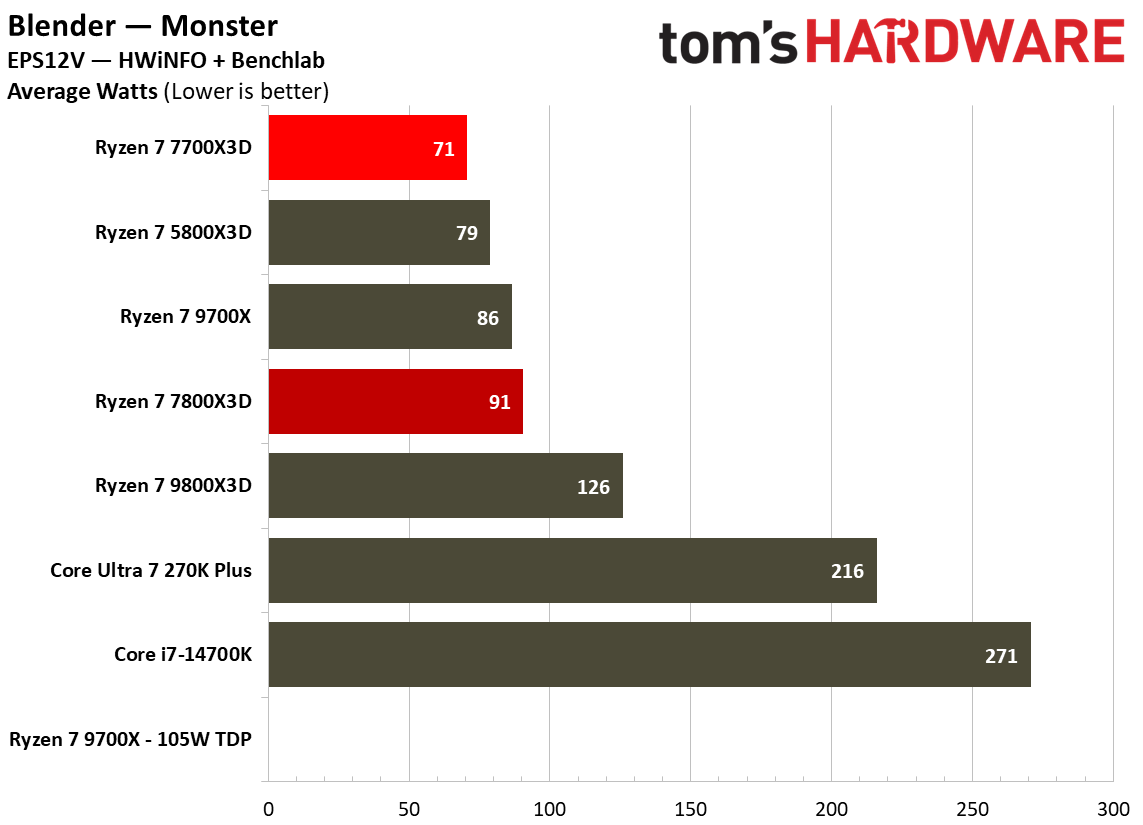
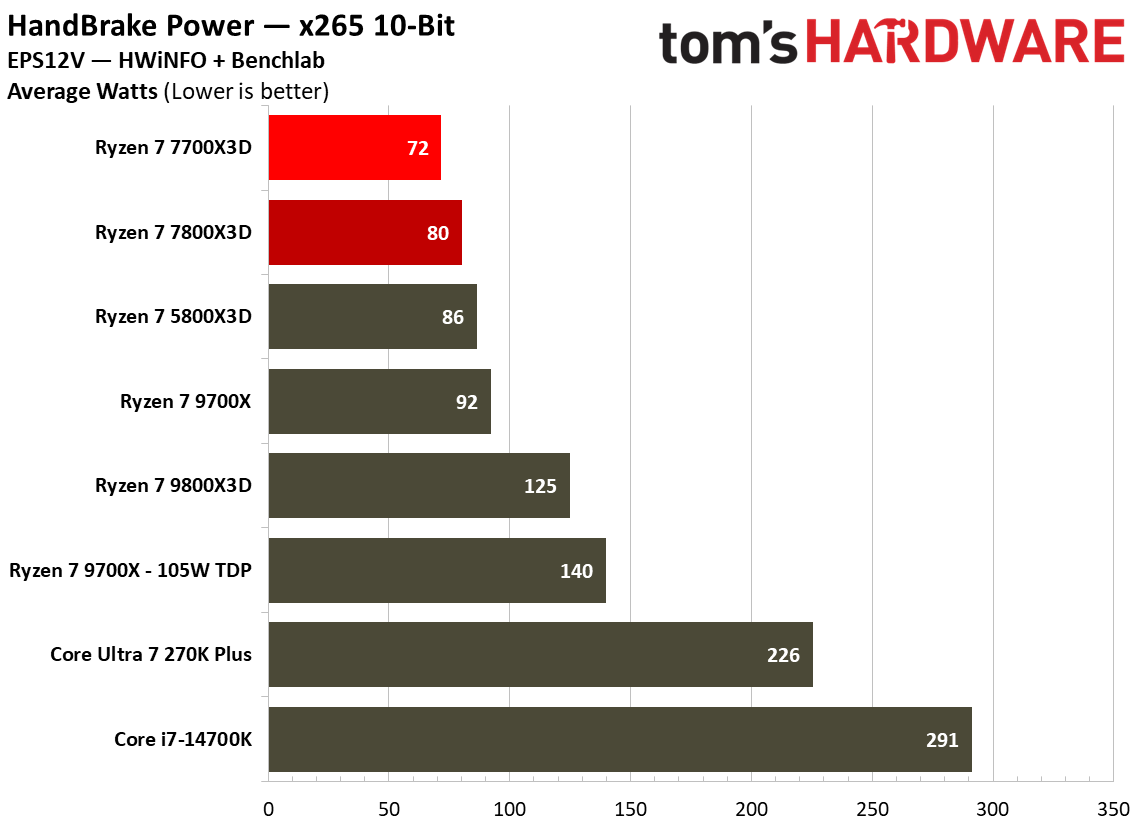
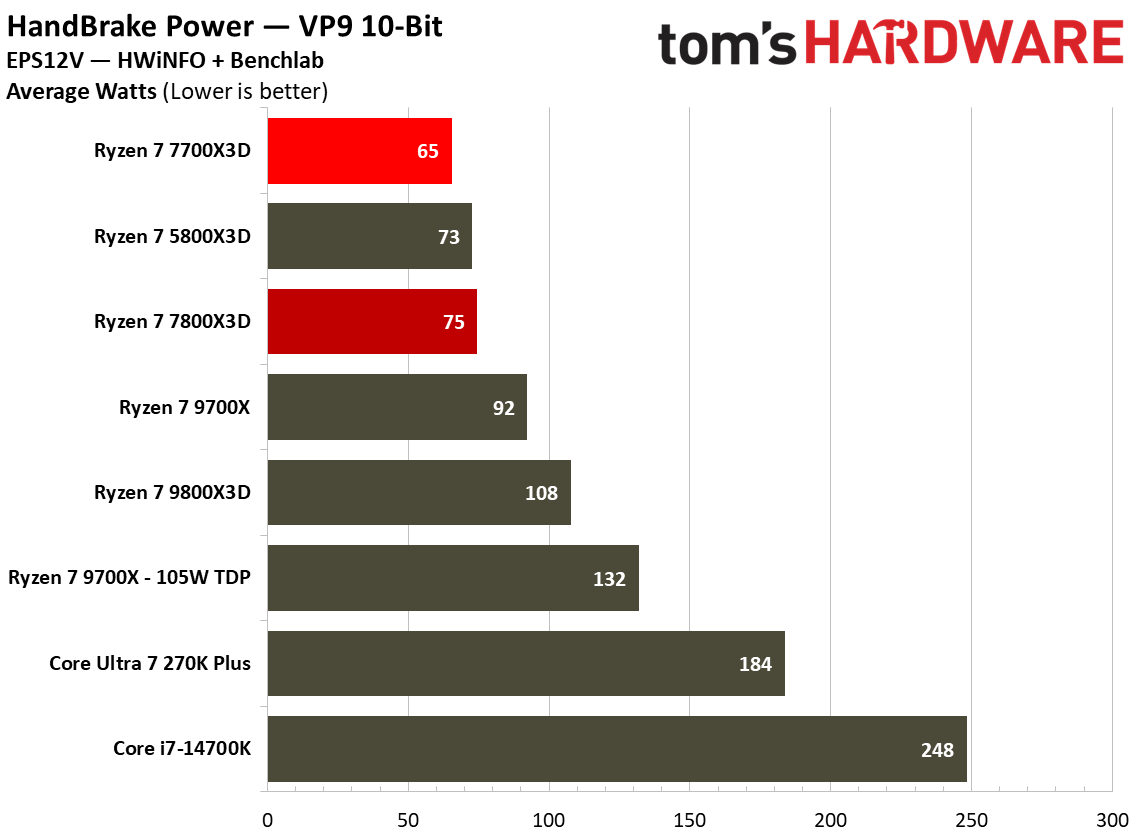
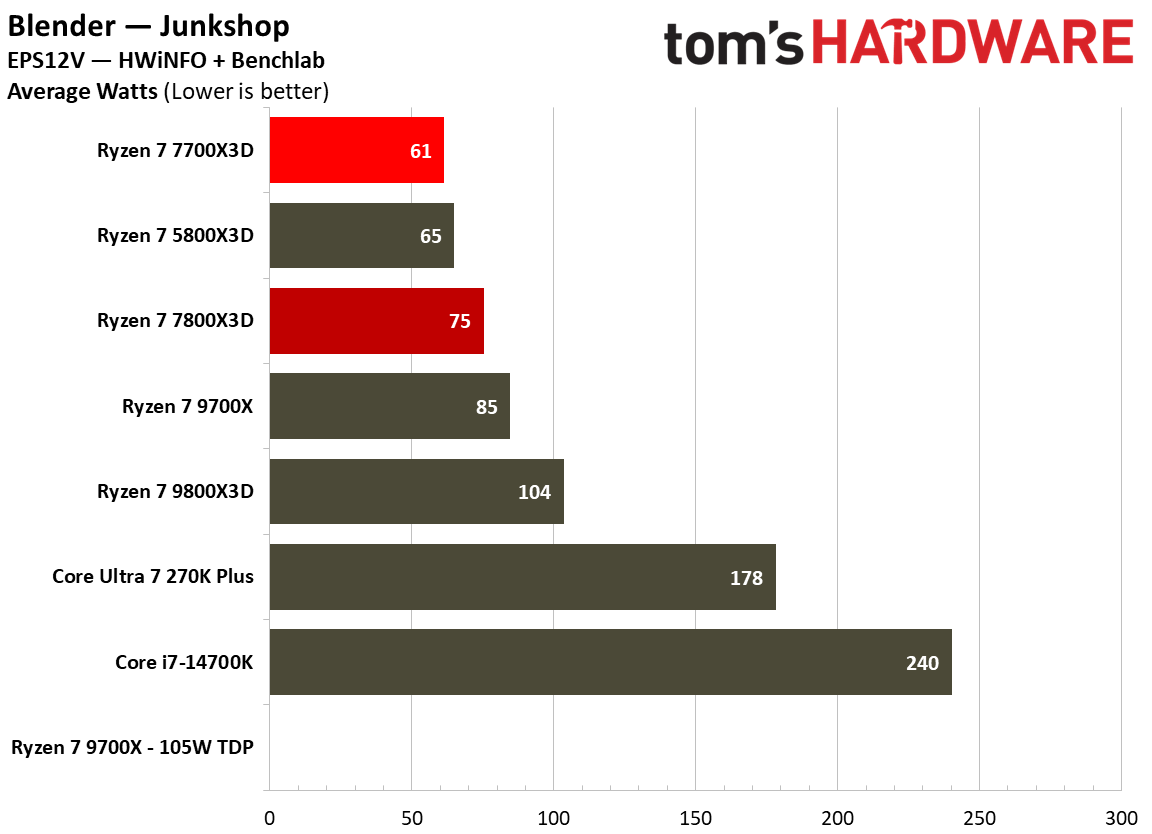
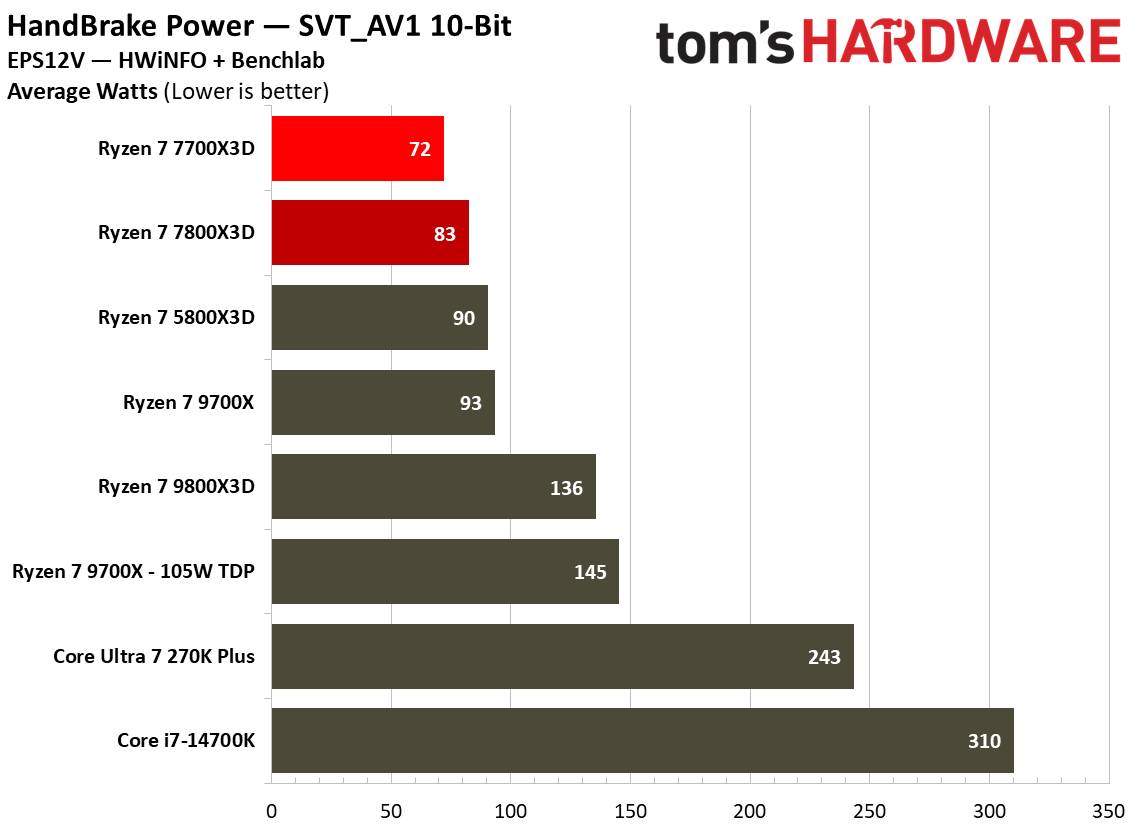
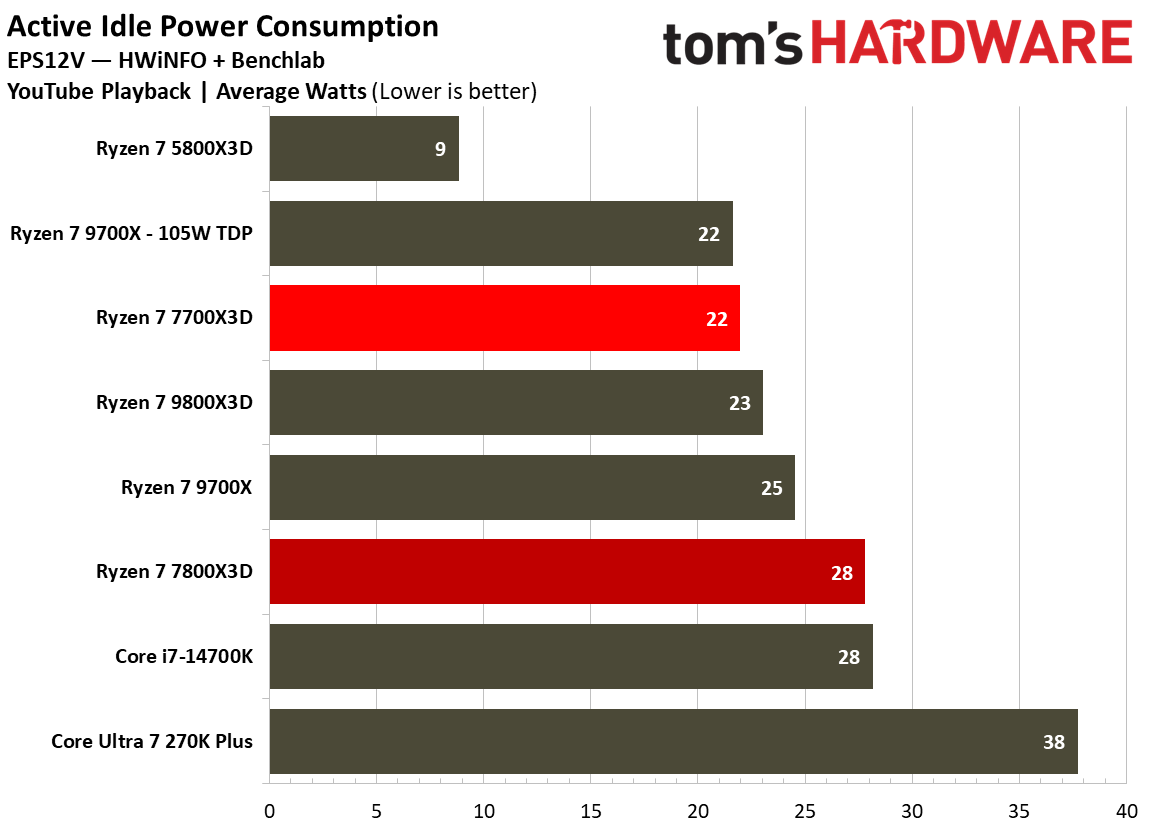
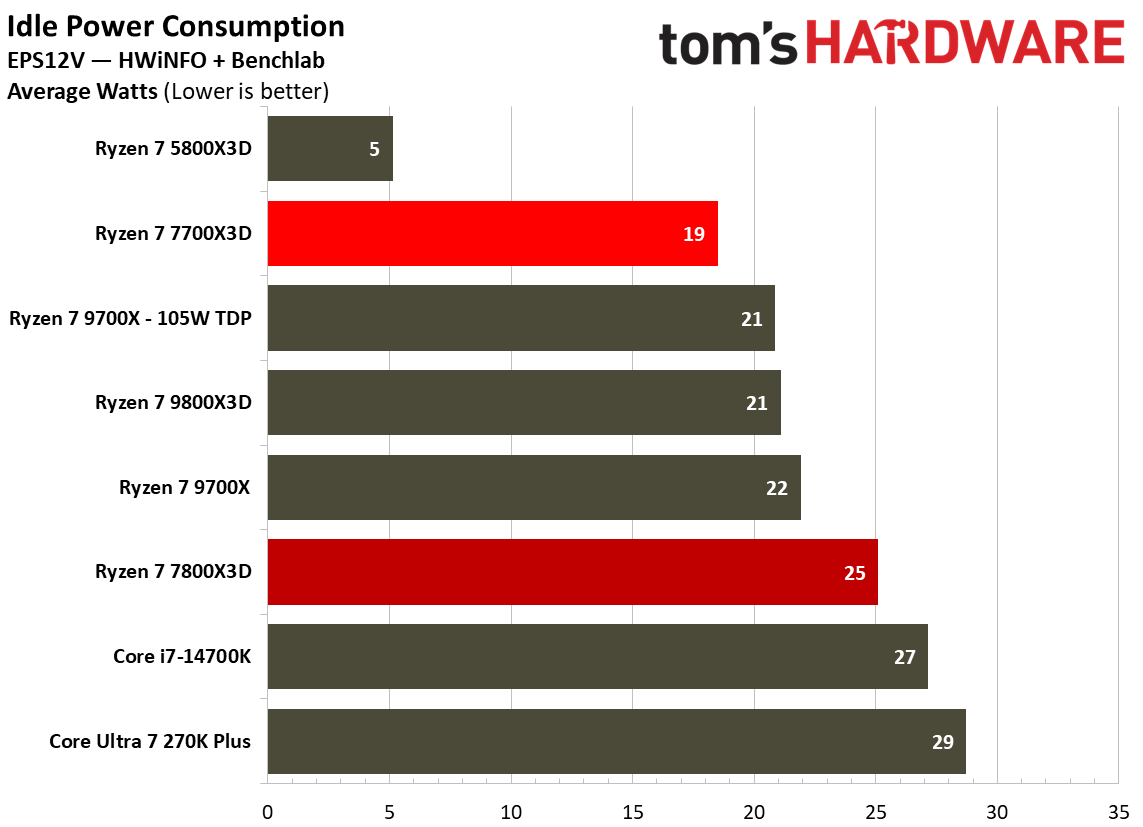
At idle, the Ryzen 7 7700X3D consumed just 19 watts, compared to 25 watts for the Ryzen 7 7800X3D, making the 7700X3D 31.6% more efficient at rest. That gap narrows slightly in an active-idle scenario like YouTube playback, where the 7700X3D drew 22W against 28W for the 7800X3D, a 27.3% difference. Even while doing nothing demanding, the newer chip is sipping noticeably less power.
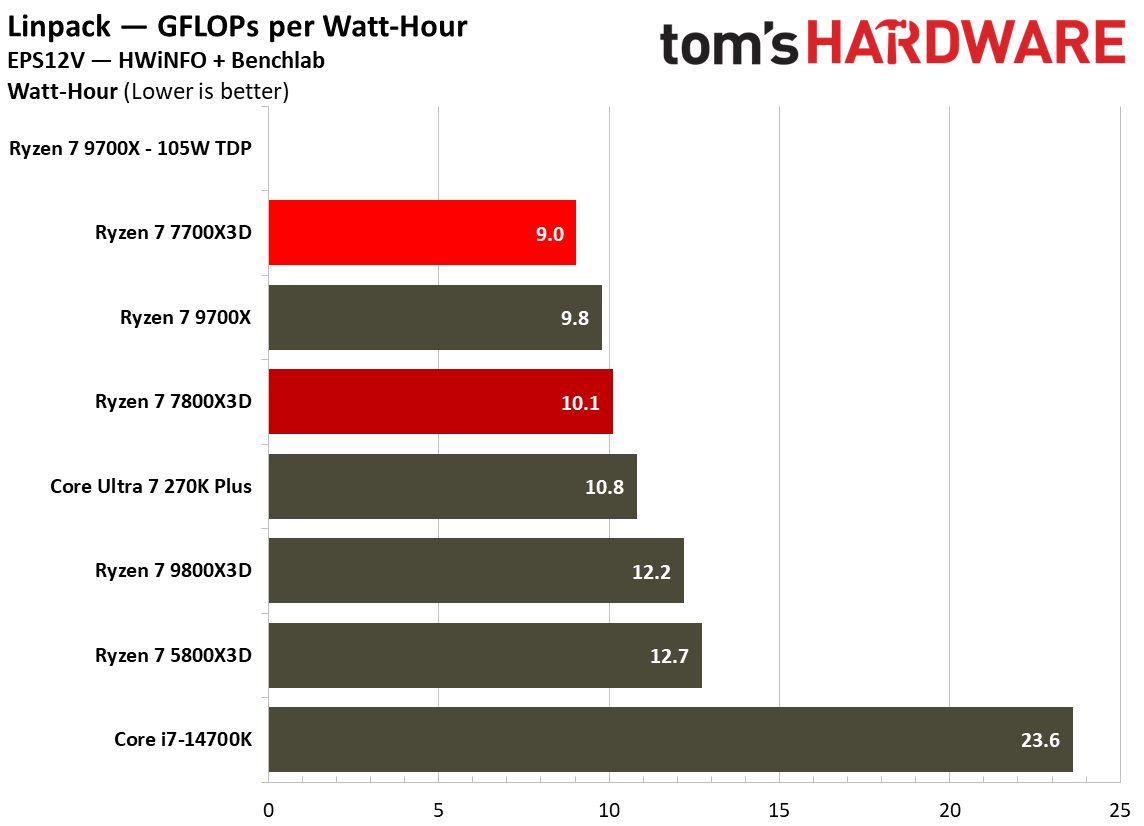
Moving on to all-core workloads, in our y-cruncher multi-threaded AVX power test, the Ryzen 7 7700X3D consumed 78W, while the Ryzen 7 7800X3D drew 89W, which is a 14.1% increase. The same pattern shows up in Linpack, where the 7800X3D consumed 10.8% more power than the 7700X3D.
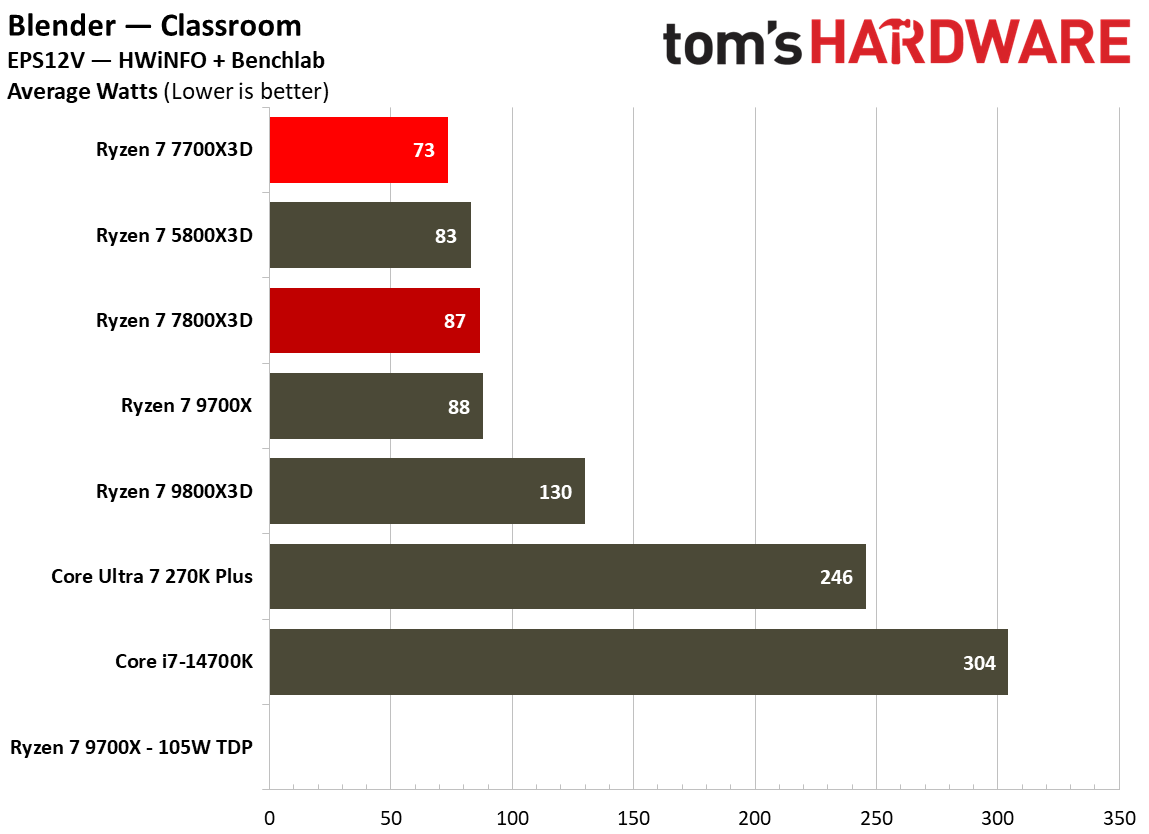
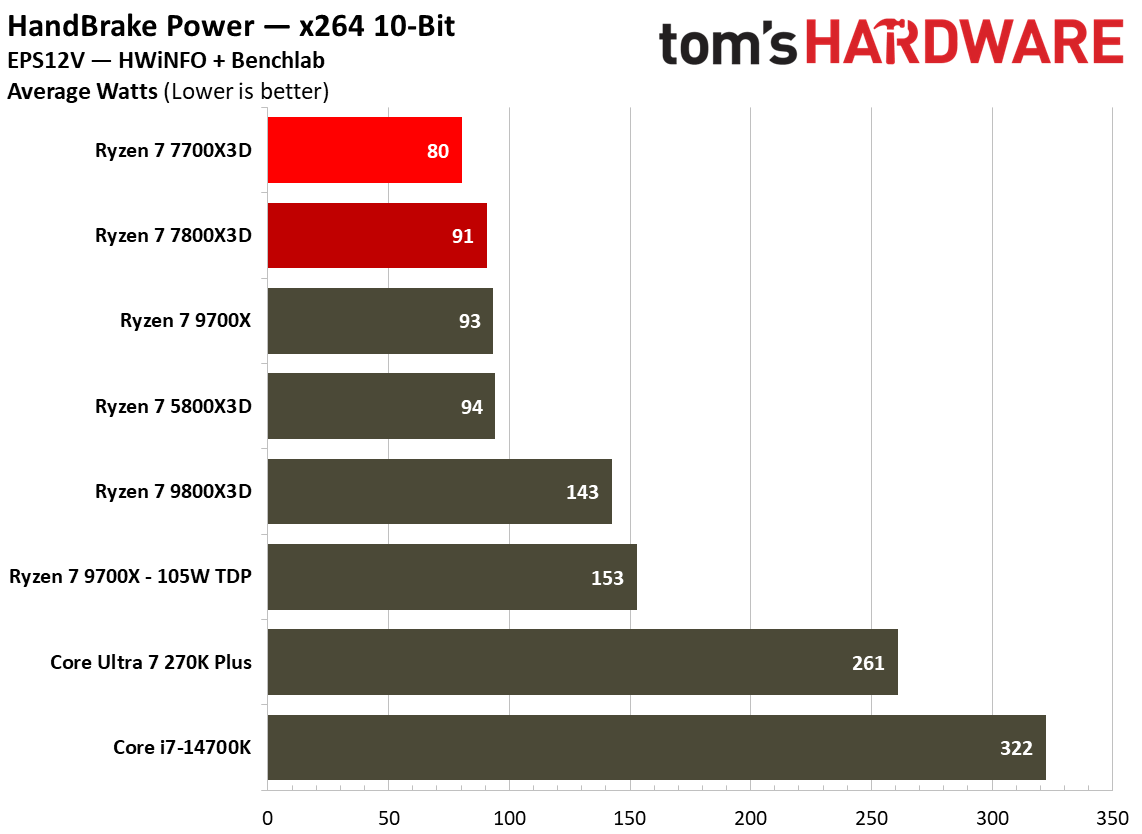
We see the gap growing wider in our rendering tests. Cinebench 2024’s multi-core render has the 7800X3D pulling 88W compared to 74W for the 7700X3D, an 18.9% increase, and Blender’s Junkshop scene shows an even wider 23% gap. The encoding tests land somewhere in between, with the 7800X3D drawing 11.1% more power in HandBrake x265 and 15.3% more in SVT_AV1 encoding.
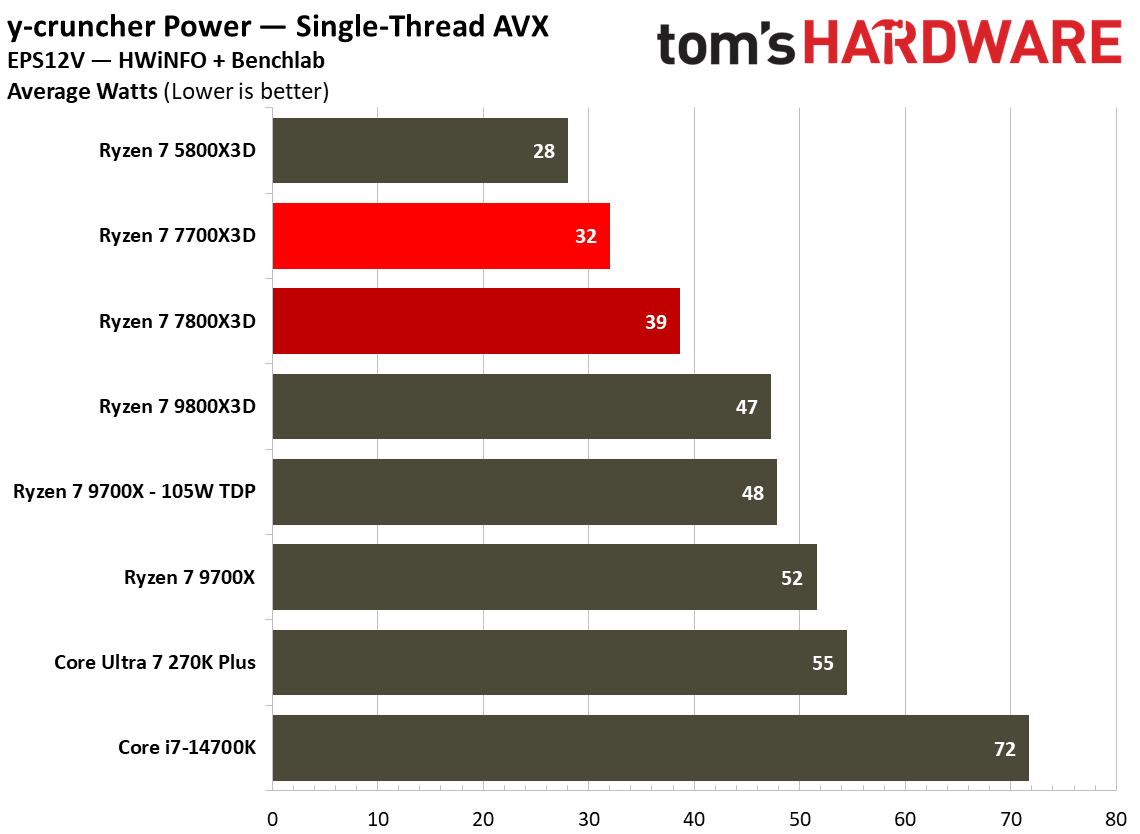
We even looked at single-threaded power draw, and the same pattern can be seen here as well. In y-cruncher’s single-threaded AVX test, the 7700X3D consumed 32W, while the 7800X3D needed 39W, which is a 21.9% increase. This lines up with the more conservative power budget AMD appears to have given the 7700X3D, as it prioritizes efficiency over the extra clock speed the 7800X3D gets to use.
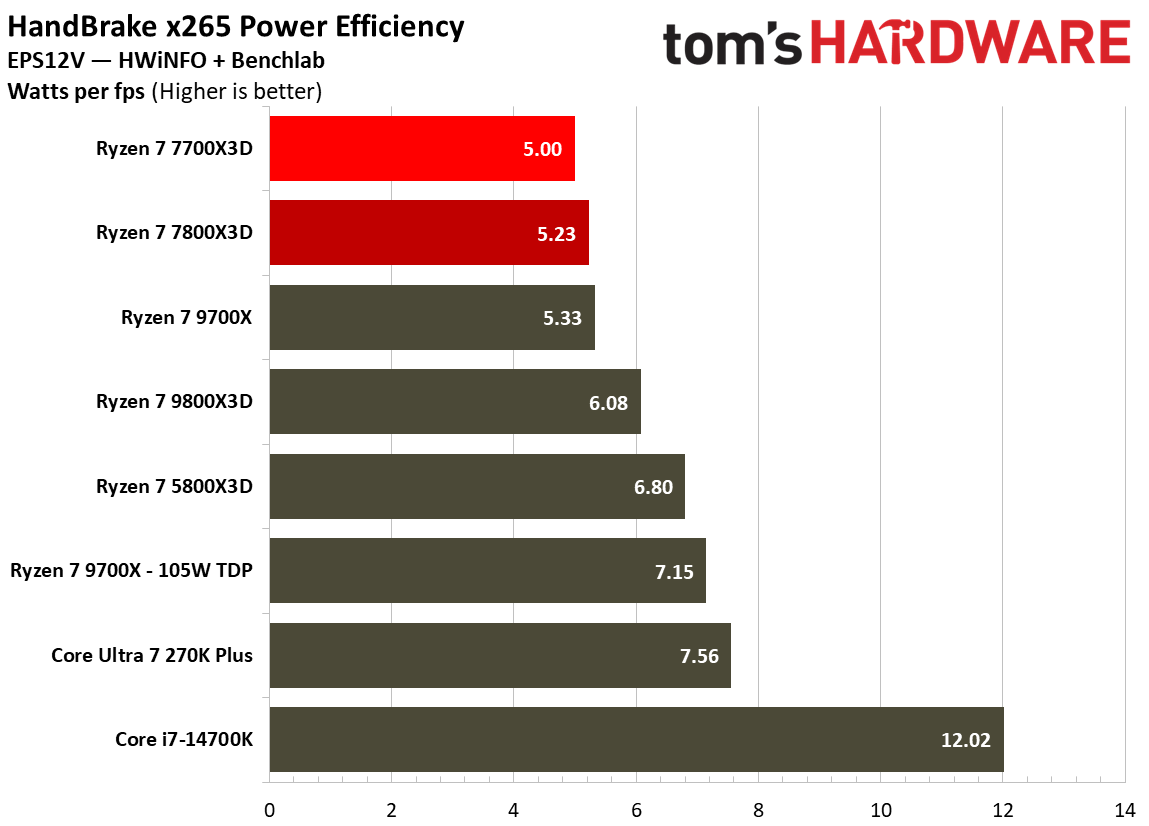
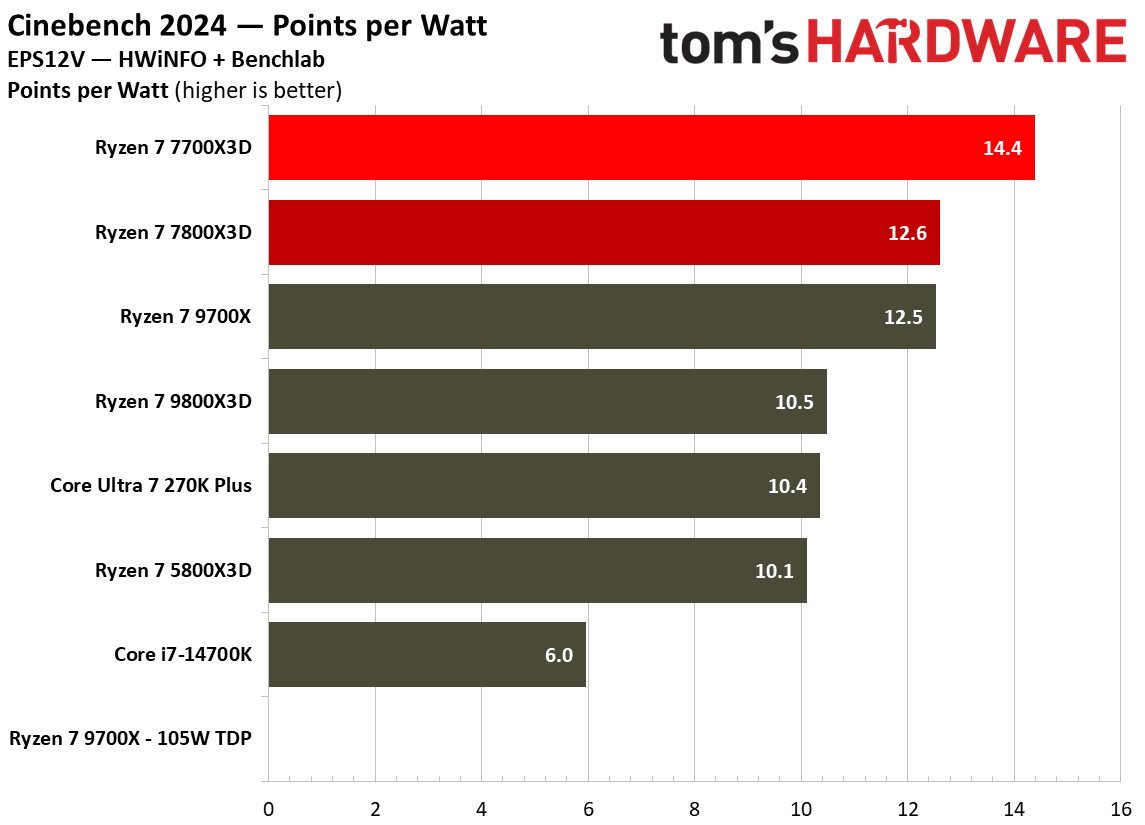
To determine said efficiency, we looked at the performance delivered per watt. In Cinebench 2024, the 7700X3D managed 14.4 points per watt compared to 12.6 for the 7800X3D, making it 14.3% more efficient in this test. Linpack’s GFLOPs-per-watt-hour metric shows a similar story, with the 7700X3D being 12.2% more efficient in this test. In HandBrake x265, the watts-per-FPS numbers are close, but the 7700X3D still edges ahead by 4.6%.
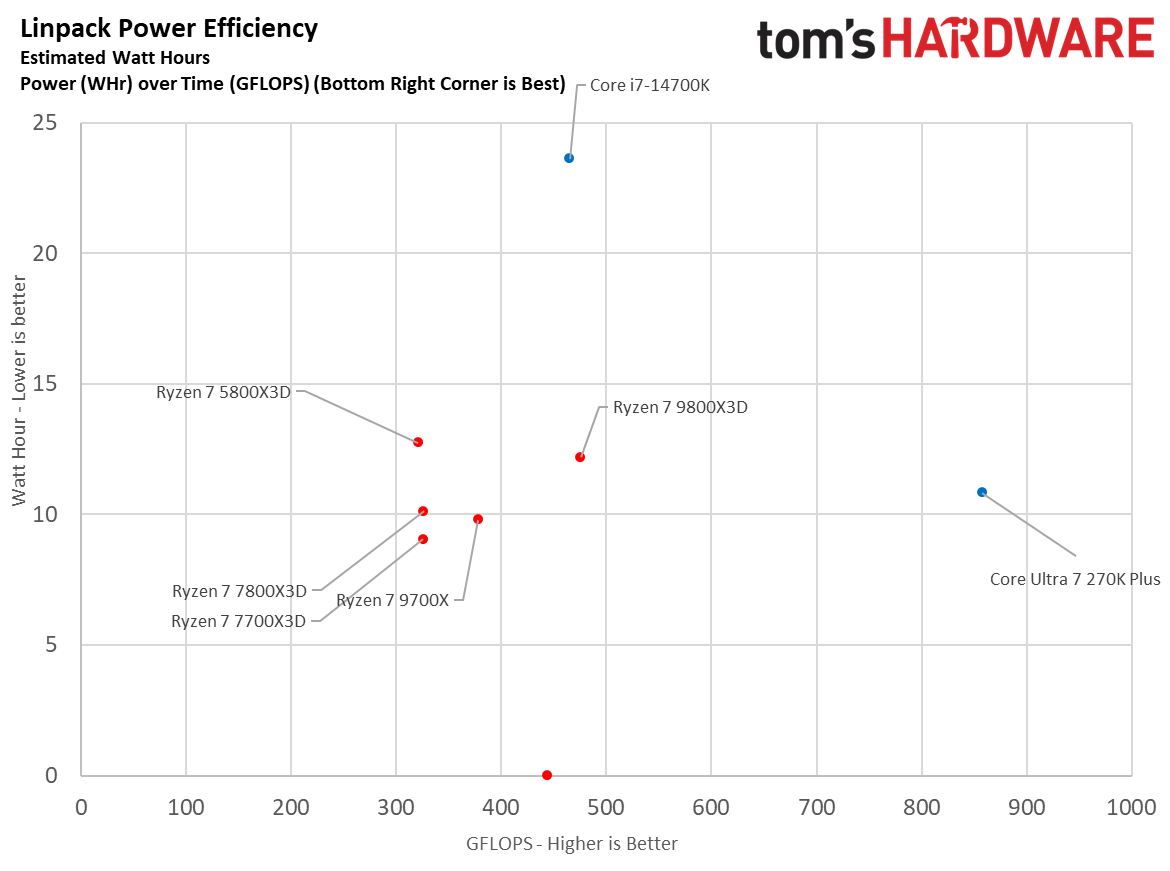
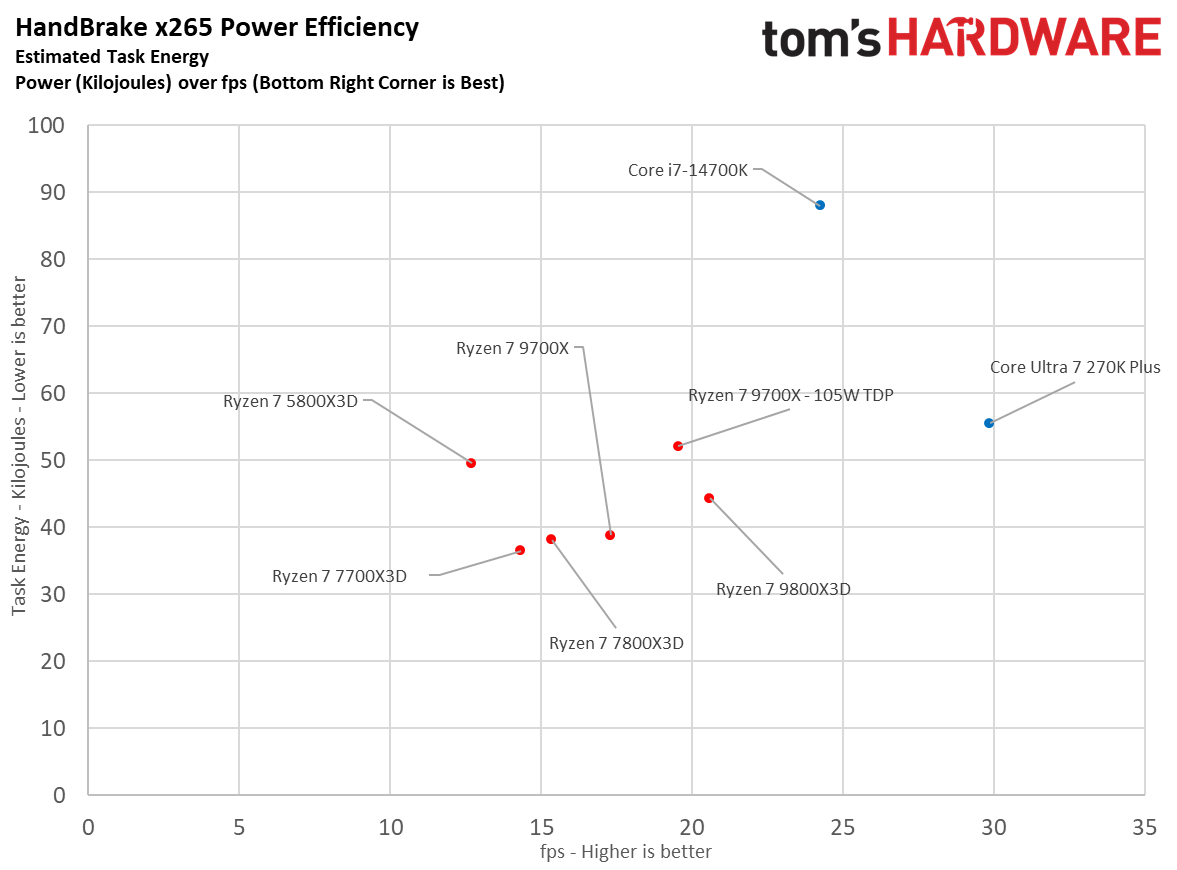
We can also visualize this using our scatterplots. In the Linpack power efficiency chart, the Ryzen 7 7700X3D and Ryzen 7 7800X3D sit almost on top of each other toward the bottom-left of the graph, both well ahead of the Core i7-14700K and Core Ultra 7 270K Plus in efficiency. The HandBrake x265 scatter plot tells a slightly different story. The 7700X3D sits marginally lower in energy use, while the 7800X3D pushes a bit further right thanks to its higher FPS, landing both chips close together towards the middle of the plot.
Curiously, the 7800X3D never falls behind by a wide margin in these efficiency charts, but the 7700X3D is consistently the more frugal chip whenever raw wattage is being measured directly. The long and short of it is that AMD seems to have dialed back the power ceiling on the 7700X3D without giving up much in the way of real-world efficiency, which makes sense given it is the newer, more refined part in this matchup.
⭐Winner: AMD Ryzen 7 7700X3D
The Ryzen 7 7700X3D draws less power across idle, active idle, and full-load scenarios, and it backs that up with better efficiency numbers in nearly every test we ran. The 7800X3D still performs faster, but not by enough to justify its higher power draw in this round.
Pricing: AMD Ryzen 7 7700X3D vs Ryzen 7 7800X3D
Pricing is interesting as this is where the two chips get quite close, since they share the same platform, the same socket, and largely the same feature set. The Ryzen 7 7800X3D currently sits at $340, though it’s previously sold closer to $340, while the newer Ryzen 7 7700X3D comes in at $330, making it $10 cheaper out of the gate.
That $10 difference on the CPU itself is straightforward enough, and the platform costs line up, as well. Both CPUs support the same AM5 platform. A decent B650 board runs about $150-$200, while X670E boards with better VRMs and connectivity climb into the $250-$350 range.
Memory requirements are also identical, since both CPUs support DDR5 exclusively. A 32GB DDR5-6000 kit, which is the sweet spot for AM5 platforms, currently runs between $300 and $400 depending on the brand and timings. Given the ongoing RAMpocalypse, that price could shift, but it applies equally to both chips, so it does not tilt the comparison one way or the other.
Both CPUs are remarkably efficient, but they run hotter than what their power draw suggests; that’s the insulation effect of the cache at work. A competent air cooler between $30 and $80 is enough to keep the chip cool, though you might want to step up to a midrange AIO liquid cooler between $80 and $120.
Platform longevity is identical between the two as well, since both are on the AM5 platform that AMD has committed to supporting for years to come. Neither chip has an advantage in future upgrade paths, so this round really does come down to dollars and cents.
And that makes picking a winner here tricky. The Ryzen 7 7800X3D has seen consistent price drops, with it dropping from $360 to $340 just in the time between writing and publishing this article. The Ryzen 7 7700X3D briefly dropped down to $290, though it climbed back up to $330 and has remained there since.
⭐ Winner: Tie
This round is a tie because, depending on the day, the Ryzen 7 7800X3D might be the exact same price (we’ve actually seen it cheaper on sale) than the 7700X3D. If you want a shorthand, if you can buy the Ryzen 7 7800X3D for less than $350, it makes up the extra cost in performance. Otherwise, the 7700X3D comes out ahead on value.
Bottom Line: Intel Core Ultra 7 270K Plus vs AMD Ryzen 7 7700X3D
|
AMD Ryzen 7 7800X3D |
AMD Ryzen 7 7700X3D |
|
|
Features and Specifications |
❌ |
|
|
Gaming |
❌ |
|
|
Productivity Applications |
❌ |
|
|
Overclocking |
❌ |
❌ |
|
Power Consumption, Efficiency, and Cooling |
❌ |
|
|
Pricing |
❌ |
❌ |
|
Total |
5 |
3 |
After a six-round matchup, the Ryzen 7 7800X3D comes out on top with a 5-3 scoreline, coming ahead in features, gaming performance, and productivity, while coming in a tie with the 7700X3D in pricing and power consumption.
The 7800X3D’s wins all trace back to the same factor: higher clock speeds. It has more headroom baked in from the factory, and that advantage carries through gaming performance and productivity workloads. Its victory in both of these categories was slim, but consistent.
The Ryzen 7 7700X3D answers back where it counts the most for a lot of buyers. It draws noticeably less power at idle and under load, runs slightly cooler, and is more efficient across nearly every metric we tested. That efficiency doesn’t translate into direct savings, however. Both chips have a very similar thermal profile.
If you want the fastest possible gaming and productivity performance on this platform and don’t mind paying a bit more upfront, the Ryzen 7 7800X3D is the CPU to get. The performance gap isn’t enormous, but it is still noticeable enough across every round we tested.
Given how close these two chips actually are once you factor in price and efficiency, this is one of the tighter faceoffs we’ve done. Still, the numbers don’t lie, and the 7800X3D is the overall victor in this battle.
⭐ Winner: AMD Ryzen 7 7800X3D
More CPU Faceoffs
- AMD Ryzen 9 9950X3D2 vs Ryzen 9 9950X3D
- Intel Core i5-14400 vs AMD Ryzen 5 7600X
- AMD Ryzen 7 9850X3D vs Intel Core i9-14900K
- AMD Ryzen 7 9850X3D vs Ryzen 7 9800X3D