How Capcom Reinvented And Updated Onimusha’s Combat In Way Of The Sword

Onimusha: Way of the Sword is the latest game to grace the cover of Game Informer, and I traveled all the way to Osaka, Japan, to play the game for hours in Capcom’s HQ, interview the developers making it, and learn how the team was returning to this samurai action franchise that hasn’t had a new release in 20 years.
I spoke to director Satoru Nihei and animation team lead Hiroshi Yugen about the studio’s approach to reinventing and updating combat, and learned the biggest goal at Capcom was to take the action of the cutscenes in previous games and make that the gameplay of Way of the Sword. If my three hours of hands-on time with the game, including never-before-seen content I’ll be diving into in future features, is any indication, Capcom is on the right path.

Yugen says when Nihei asked him to join the project, one of the first things he did was look at past Onimusha games. He decided then that he wanted to take the larger-than-life moments from the cutscenes of those older titles and imbue Way of the Sword’s gameplay with those feelings. The next step after that was to look at all kinds of research materials to learn more about how samurai used swords in Edo-period Japan, the fundamentals of sword duels, and more. Then, he got into contact with sword fight choreographers to see swordplay in action, learn the reasoning behind different actions, swings, and poses, and more to “really get to the core” of it all.
Considering Toshirō Mifune is the face of protagonist Miyamoto Musashi, I wasn’t surprised to learn Yugen looked to Mifune movies to see how he moved both as a samurai (in Akira Kurosawa films, for example) and as Musashi in the 1950s Samurai Trilogy of films. “There was definitely some inspiration taken from [Mifune’s] movies, but not just his movies,” Yugen says. “We watched a lot of different movies in the samurai genre to really get a feel for what goes into those, what makes the samurai; and we didn’t just focus on the action in those movies but also the more human side of things. You know, like the defeated samurai escaping from battle – those elements as well are something we looked at really closely when reviewing a lot of these movies.”
Nihei tells me selecting Yugen to lead up the game’s animation and combat design was an obvious choice, calling him a “legend within Capcom.”
“I was very familiar with his name and really wanted a chance to work with him on this project, so that’s why I approached him,” Nihei says. “Getting to work with him and watching these movies and seeing how he picked apart the cool elements from them and figuring out what they wanted to achieve with this game, I feel it was a good choice. We have this legendary veteran on the project so we are definitely confident that we’ve created a really solid swordplay experience.”

Yugen has been at Capcom for 30 years, but this is his first time working on the Onimusha series, and he said yes immediately to Nihei when asked to join the project.
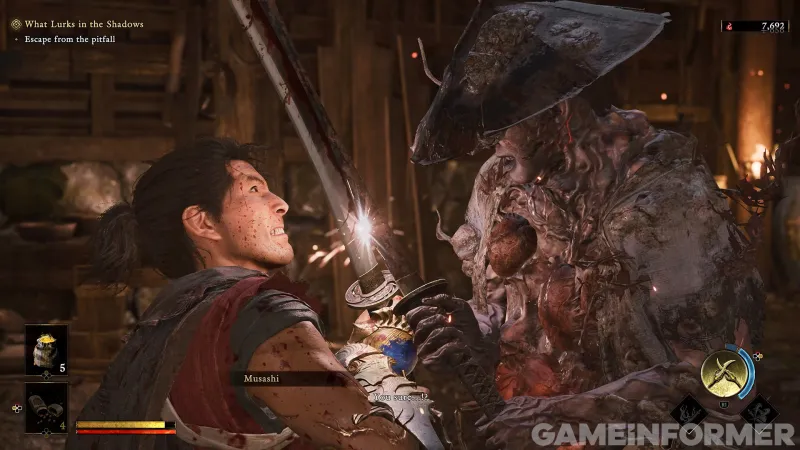
Yugen says Way of the Sword improves upon previous Onimusha games by making adjusting the Issen, which is a move pulled off by attacking an enemy at the exact same time that they attack you. It results in an insta-kill on smaller mob enemies and heavy damage on larger enemies, and remains the hardest move to pull off in combat in Way of the Sword, just as it was the hardest to pull off in previous games.
“Obviously, in the previous titles, Issen does feel great to use and pull off, but it happened so fast […] it’s hard to tell exactly what’s going on in that moment and so one of the things that Nihei-san approached me about with this title was trying to make the Issen a little more realistic and a little more grounded – like what would that look like, what would it feel like?” Yugen tells me. He adds that there are around 10 different variations that Musashi can pull off depending on attacks coming from different angles and more.
One thing Yugen says Nihei threw at him that was challenging to implement was Musashi’s ability to black from dozens of angles. Not wanting Musashi to block unrealistically or look like he’s simply pivoting in place, Nihei tasked Yugen with creating an animation system that allowed Musashi to block from, for example, high-behind, mid-behind, low-behind, high-left side, mid-high side, and so on. “It was a difficult and time-consuming process, but now that it’s in the game and seeing it in the game and how it works and how it’s been received, I’m glad we put it in there,” Yugen says.

Speaking to the 20-year gap between Way of the Sword and the previous mainline Onimusha release, Yugen says it was important that the team pay attention to how the action space has evolved in those two decades, but only just so – Way of the Sword still needed to play like an Onimusha game. That’s why mechanics like the Issen and Chain Issen return alongside new moves like the Blade Barrage.
One of the more obvious additions to the game’s combat is the two control types: Aggressive and Defensive. The former puts Musashi’s main attacks on the face buttons, with blocks and the like assigned to Square – it’s the default control scheme and is designed for players familiar with action games that feel confident in their offense. The latter puts the block button on L1, amongst other changes, to make moves like parry easier for those less familiar with action games – it’s for players who want to play more defensively, as the name implies. Yugen says the team went back and forth on which one to include, but that ultimately, it decided on including both approaches.
You can actually test out both the Aggressive and Defensive control types in the Way of the Sword demo that’s available on PlayStation 5, Xbox Series X/S, and PC. Though the game will also launch on Nintendo Switch 2, a demo for that platform is not available.
I’ll be diving deeper into Capcom’s return to Onimusha as part of Game Informer’s month of Way of the Sword coverage. We’ll be publishing exclusive gameplay and behind-the-scenes videos (including a Rapid-Fire Interview) on the Game Informer YouTube channel as well. Keep an eye on the Onimusha: Way of the Sword coverage hub so you don’t miss any of it.
In the meantime, here’s some additional Onimusha: Way of the Sword reading for you:
- Onimusha 2 Director Motohide Eshiro On Way Of The Sword’s Resurrection Of The Series
- A Look Back On The First Two Onimusha Games With Planner And Director Motohide Eshiro
- Here’s How The Late Japanese Actor Toshirō Mifune Became The Face Of Musashi In Onimusha: Way Of The Sword
- Capcom Says Onimusha: Way Of The Sword Success Being The ‘Pinnacle Of Swordplay Action Games’ Is What Success Looks Like After A 20-Year Gap
- There Are No Minigames In Onimusha: Way Of The Sword, But It Sounds Like The Phantom Realm Is Back
- Puzzle Boxes Are Gone In Onimusha: Way Of The Sword, But Bigger Environmental Puzzles Have Taken Their Place
- Onimusha: Way Of The Sword Isn’t Connected To Previous Games, But There Are Homages
- How Capcom Decided On Miyamoto Musashi For Its Onimusha: Way Of The Sword Protagonist
- Why 2026 Was The Year To Bring Onimusha Back After A 20-Year Gap
- Why Kyoto Was The Perfect Setting For Onimusha: Way Of The Sword
Have you played the Onimusha: Way of the Sword demo? Let us know what you think of the action combat in the comments below!