
Secret tracking device placed in rare book ends up in Amazon processing facility — destroying books to train AI models is ‘all’ the Vegas warehouse does
AI companies are reportedly buying up millions of books, some of which are rare, and using them to train AI models, often destroying the book in the process. And we now have more specifics about how this process works, thanks to an investigation from 404 Media. The outlet placed a tracking device inside a rare book that was part of a large, 1,000-book order — and it ended up in a Las Vegas Amazon warehouse.
Employees who spoke to 404 Media said they spend their time at the facility (named VGT3) cutting the spines off of books and feeding them into a scanner. VGT3 is reportedly part of another, larger facility in Las Vegas called LAS8. Its purpose, according to the employees who spoke to 404 media, is solely to cut the spines off books and scan them. “All we do is scan books,” one employee told the outlet.
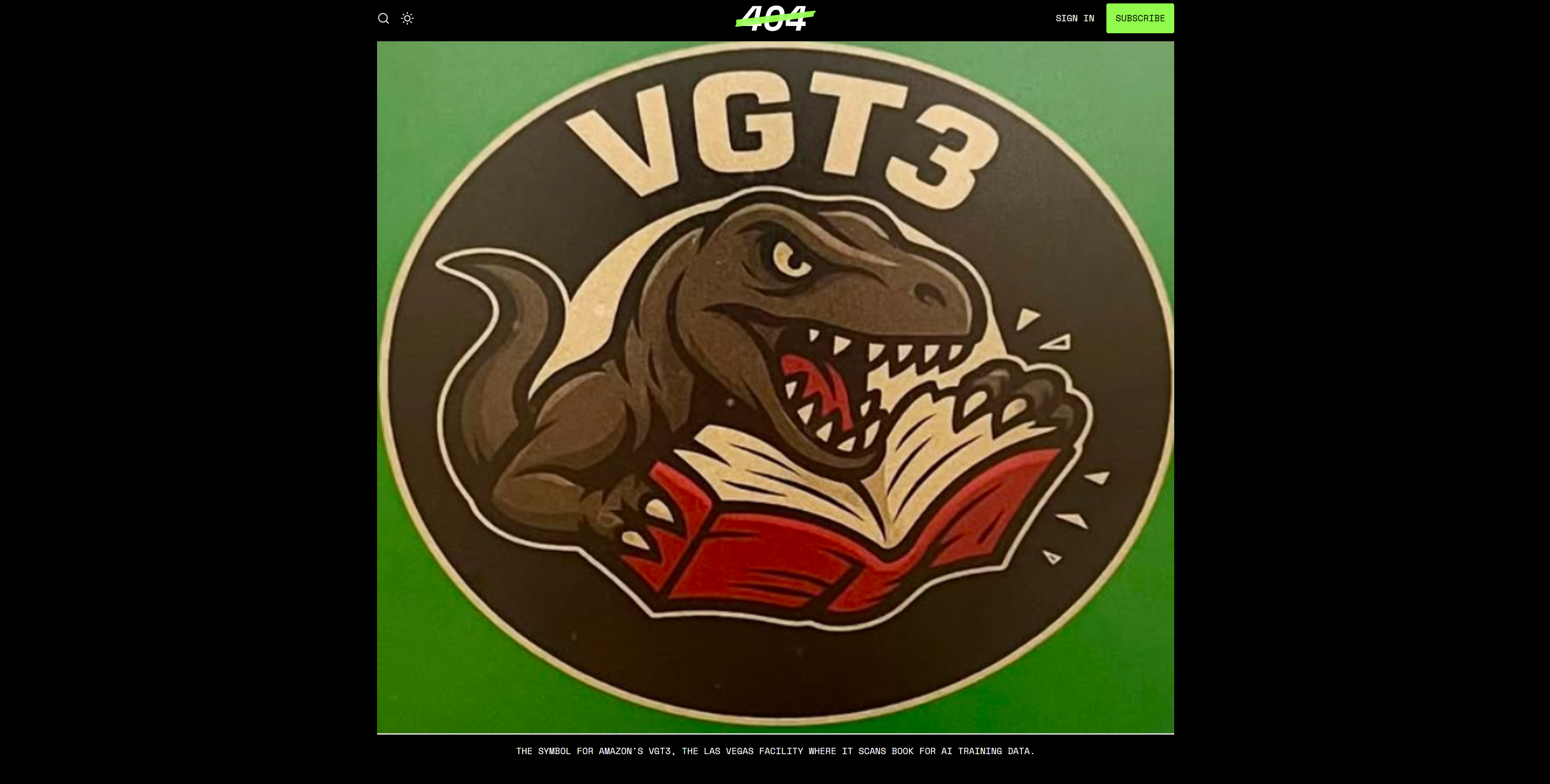
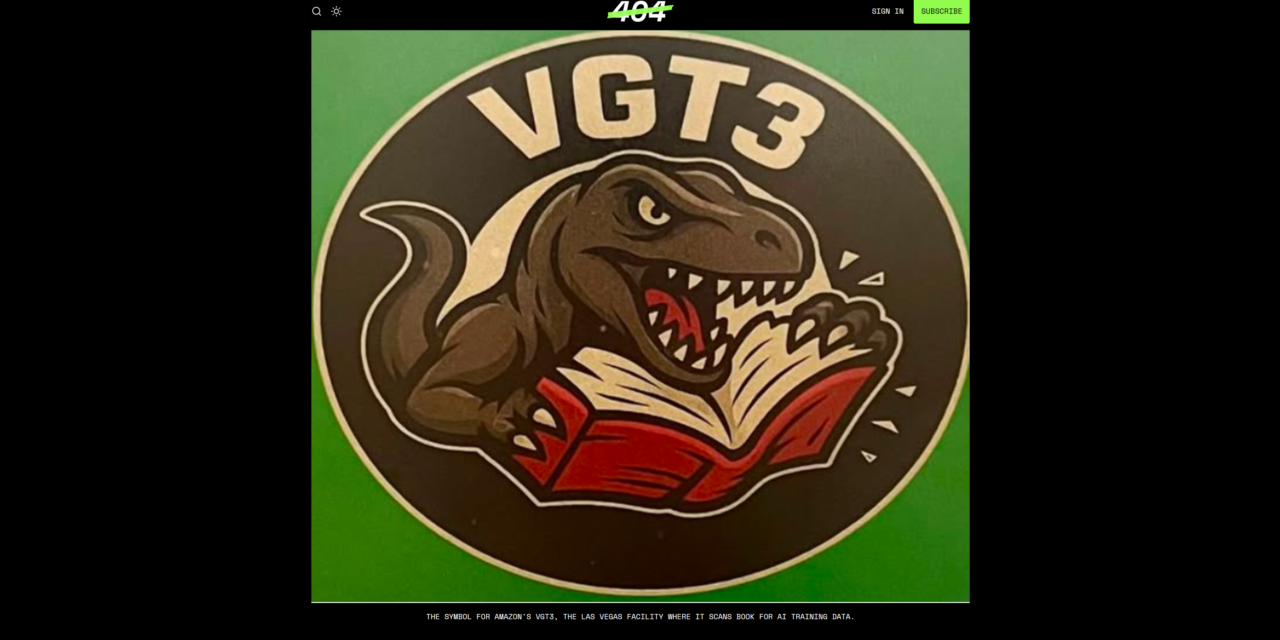
If there was any doubt about the purpose of the facility, a logo with VGT3 shows a dinosaur holding a book, looking like it’s about to rip it up and take a bite. At the very least, the dinosaur isn’t reading the book. You can see that image captured on 404’s website above.
The investigation started in July, when 404 asked a bookseller if the outlet could place an Apple AirTag in a book inside a 1,000-book shipment. A shipment this large is unusual, though they’ve reportedly become increasingly common in the AI era. Book sales are up, and many suspect that isn’t due to a rise in readership, but for training frontier AI models. The order was submitted through Biblio, an online marketplace that claims to be the “largest independent book marketplace in the world.”
Often, these large orders contain a scattershot of different books. An independent bookseller in Ireland, for example, received an order for 5,000 books that they suspected was for training AI. “Some was high-quality non-fiction, like A History of Connemara, and the next thing might be The Eddie Hobbs Guide to your SSIA,” Tomás Kenny of Kennys Bookshop said at the time. 404 Media says that employees at VGT3 are required to scan the ISBN (barcode) of each book, lending credibility to the theory that AI companies are working through a list of every book that has ever been published.
Or, at least, every book with an ISBN. A bookseller told 404 Media that these large orders “never” include rare books that don’t have an ISBN.
Earlier this year, court filings revealed Anthropic’s ‘Project Panama,’ which kicked off in 2024. Documents as part of those filings make the project’s purpose clear: “Project Panama is our effort to destructively scan all the books in the world,” said an internal planning document. A judge ruled that Anthropic was allowed to use books to train its AI models. However, it was fined $1.5 billion for keeping 7 million pirated books in a central library. In a 2025 lawsuit against Meta, it was revealed that it had pirated nearly 82TB of books.
Scanning books en masse is nothing new. In 2005, Google spearheaded Google Books by scanning out-of-copyright titles from an on-campus library using specialized scanners. The books were then returned. Presumably, Google made use of some type of V-shaped scanner, which lays a book out naturally so as not to disturb the spine and binding.
In the case of VGT3, 404 reports that employees cut off the spine of the book before scanning, presumably to feed the pages flat into an industrial scanner. The insatiable hunger for data in frontier AI models seems to be moving at a faster pace than Google’s early book digitization efforts.
It’s hard to say why a facility like VGT3 operates in this way, though it likely comes down to cost. As major companies like Meta and Anthropic have been caught with a library of pirated books, they now need to buy them. And when purchasing thousands of books at a time, it’s probably much cheaper to get secondhand copies from marketplaces like Biblio than it is to spend full price on digital versions of those books (if digital versions exist in the first place).