

Meta’s $18 billion payout isn’t enough to save our kids
I’m not a parent, but I’m looking at the Meta settlement wondering if our kids are any safer.
If you haven’t heard already, Meta agreed last Wednesday to settle a lawsuit over Facebook and Instagram’s affect on children. Brought by 47 states, Washington D.C., and several U.S. territories, the suit alleged that Meta purposely made its platforms addictive to kids, ultimately causing negative mental health outcomes like anxiety, depression, and even suicide. Four states (California, Colorado, Kentucky, and New Jersey) also alleged that Meta violated state consumer protection laws.
Welcome to Safe Mode, your weekly report for pressing security and privacy news—and what steps to take next. Want this newsletter to come directly to your inbox? Sign up on our website!
A potential payout of $18 billion is on the table, with $12.7 billion in guaranteed payouts. The additional $5 billion will be paid if rivals YouTube and TikTok also agree to implement measures like a one-hour time limit, blocking late night access, and implementing age verification—plus pony up about $2.5 billion each. But Meta has also pledged reform for teen accounts of Facebook and Instagram. The biggest changes: automatically limiting teens to two hours of use per day across both platforms, muting notifications during school hours, and blocking usage from midnight through 6 a.m. Likes will also be hidden from view.
The changes are a start. But the kids may not be all right for a while longer.
For starters, these Facebook and Instagram changes are only mandated for 10 years. Meta can still serve personalized recommendations and targeted advertising too, if those features aren’t adjusted or turned off. And teens are allowed to send direct messages during school or late at night. (Meta describes this as allowing “teens to stay connected with friends and family.”)
Most parents likely won’t automatically know they have to take additional steps to more fully protect their kids—that unless they actively poke at Facebook and Instagram settings and monitor account use, those teens could still be exposed to harmful material or conversations. For example: A feed with only content from followed accounts will be available to teens, but only if selected as the default. And bullying can still happen over direct messages.
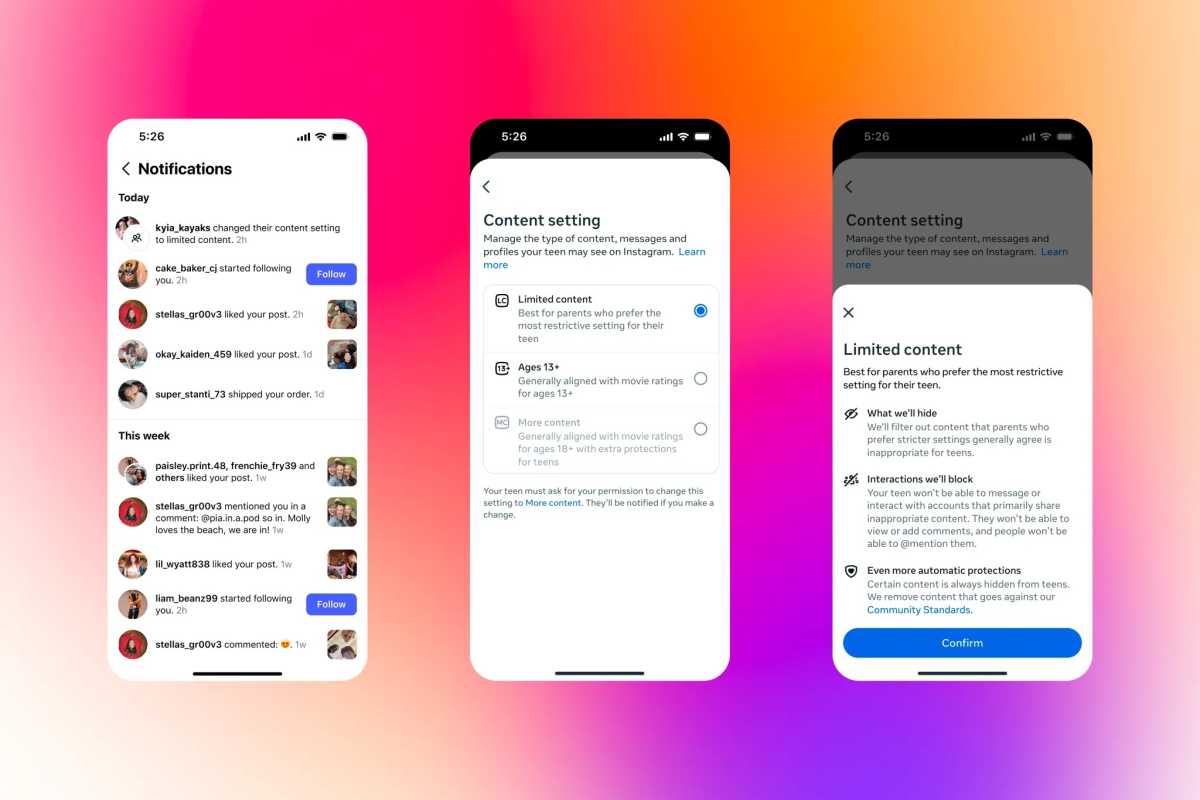
Meta says the new restrictions on teen accounts will release alongside existing parental management tools.
Meta
I’m also concerned about how Meta will ensure teens don’t circumvent these restrictions. The company doesn’t want to manage the age verification process directly. Instead, Meta is advocating for age verification to be performed by app stores. But that creates a whole new set of problems. First, the basic privacy risks: What documentation will be required for verification? Who will process the applications? Will biometrics be involved? How will all the data be stored? Who will have access to that data? And second: Will all apps in an app store have access to that data? Could a shady developer purposely target the under-18 crowd?
Plus, age verification in general is a mess, and will be a mess for a while longer. Governments have begun passing legislation requiring it, but without a true understanding of how to implement it effectively. (My own state of California came out with a shockingly bad take on this, to the point where free software like Linux could have been affected.)
In the meantime, governments still have to figure out how they’ll direct the settlement funds, which will be paid over a 10-year period. And other lawsuits may introduce further changes for child use of social media: Additional cases from individuals, local governments, and school districts are pending in federal and state courts. (That includes Florida, which did not agree to the August 26 settlement.)
But until the dust settles, I strongly recommend all adults get up to speed on digital dangers for teens—and then help the kids around us navigate them, same as we’d teach them for real-world concerns. Parents should take point in their children’s lives, but we’re all in this together.
In the news
This week was a reminder that sometimes, basic security goes a long way—when it’s in your control. Our privacy, on the other hand, is often in the hands of others…or, as illustrated by retailer AliExpress’s supposed shenanigans, purposely messed with.

Retailer AliExpress allegedly is fingerprinting users through an older browser trick.
AliExpress
The good:
- Privacy-minded engineers have been fighting back against Meta glasses, creating apps to detect the hard-to-detect recording devices. The apps don’t fully combat the problem of secret recording, but they at least give a potential heads-up.
The unexpected:
- Turns out Windows XP is still far more beloved than Windows 8—according to Statcounter, it still holds a larger market share. Either way, this factoid is bad news if you’re on either operating system, as they’re no longer supported by security updates. Time to upgrade!
The bad:
- ClarityCheck, a service that lets you look up people with a photo, exposed millions of images publicly—as well as email addresses and phone numbers. A sobering reminder that such data broker sites aren’t well-secured…and that you have little control over how someone can look you up online.
- Three UK airports leaked email addresses, phone numbers, vehicle registration numbers, and postcodes of over 8 million travelers. Details were gathered by Manchester Airport, London Stansted, and East Midlands Airport through Wi-Fi use or airport bookings. Keep an eye out for phishing or scam attempts.
- Retailer AliExpress allegedly tracks users through silent audio played through browser tabs. Dan Goodwin of Ars Technica describes the technique as “outdated,” but I see it as proof that a simple approach can still get the job done. Close out your AliExpress browser tabs when you’re done, if you must shop there.
- Mini-PC maker Geekom admitted an outdated support page served malicious versions of its drivers. If you think you’ve been affected, wipe your PC and start again with a completely clean install of Windows—and to get your driver updates through Microsoft.
Tip of the week

Jinhan Moon / Unsplash
Kids unfortunately can become targets for child exploitation—and AI tools have unfortunately made creation of sexually explicit, abusive content even easier.
You can protect your kids by being careful about what you post online, especially as the school year starts. For starters, keep photos as private as possible. (I recommend sharing in group chats on secure chat apps, like Signal or WhatsApp.) Also, don’t share details about their birth dates, schools, or even preferences. Such information can be used by unscrupulous adults to groom children.